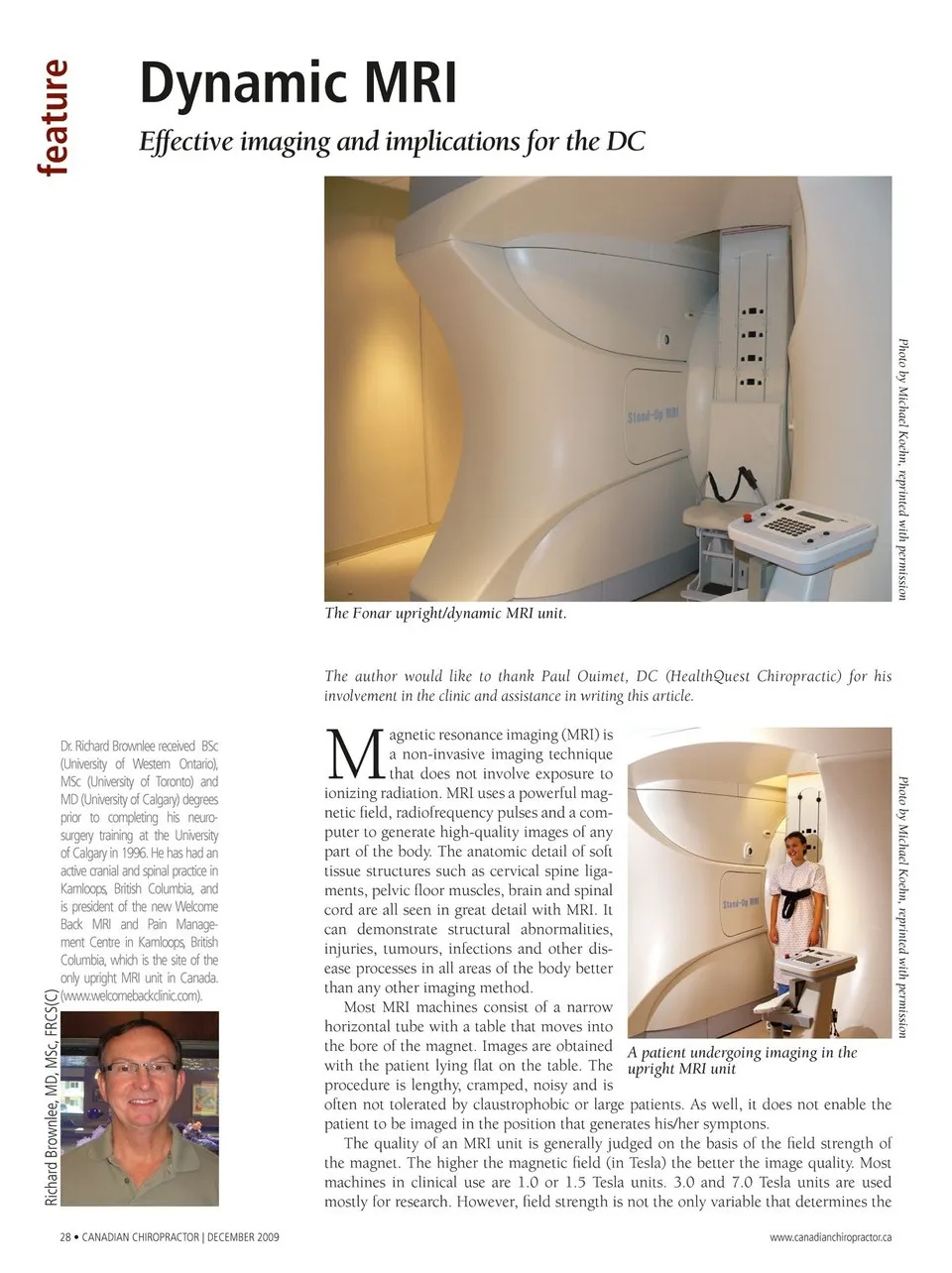
Dynamic MRI Effective imaging and implications for the DC The Fonar upright/dynamic MRI unit. The author would like to thank Paul Ouimet, DC (HealthQuest Chiropractic) for his involvement in the clinic and assistance in writing this article. dr. richard Brownlee received BSc (University of Western ontario), MSc (University of toronto) and Md (University of Calgary) degrees prior to completing his neuro- surgery training at the University of Calgary in 1996. he has had an active cranial and spinal practice in Kamloops, British Columbia, and is president of the new Welcome Back Mri and pain Manage- ment Centre in Kamloops, British Columbia, which is the site of the only upright Mri unit in Canada. (www.welcomebackclinic.com). ionizing radiation. MRI uses a powerful mag- netic field, radiofrequency pulses and a com- puter to generate high-quality images of any part of the body. The anatomic detail of soft tissue structures such as cervical spine liga- ments, pelvic floor muscles, brain and spinal cord are all seen in great detail with MRI. It can demonstrate structural abnormalities, injuries, tumours, infections and other dis- ease processes in all areas of the body better than any other imaging method. Most MRI machines consist of a narrow horizontal tube with a table that moves into the bore of the magnet. Images are obtained with the patient lying flat on the table. The procedure is lengthy, cramped, noisy and is often not tolerated by claustrophobic or large patients. As well, it does not enable the patient to be imaged in the position that generates his/her symptons. The quality of an MRI unit is generally judged on the basis of the field strength of M A patient undergoing imaging in the upright MRI unit the magnet. The higher the magnetic field (in Tesla) the better the image quality. Most machines in clinical use are 1.0 or 1.5 Tesla units. 3.0 and 7.0 Tesla units are used mostly for research. However, field strength is not the only variable that determines the 28 • Canadian ChiropraCtor | dECEMBEr 2009 www.canadianchiropractor.ca agnetic resonance imaging (MRI) is a non-invasive imaging technique that does not involve exposure to Photo by Michael Koehn, reprinted with permission Photo by Michael Koehn, reprinted with permission richard Brownlee,Md, MSc, FrCS(C) feature
Chiropractic + Naturopathic Doctor December 2009: Page 28