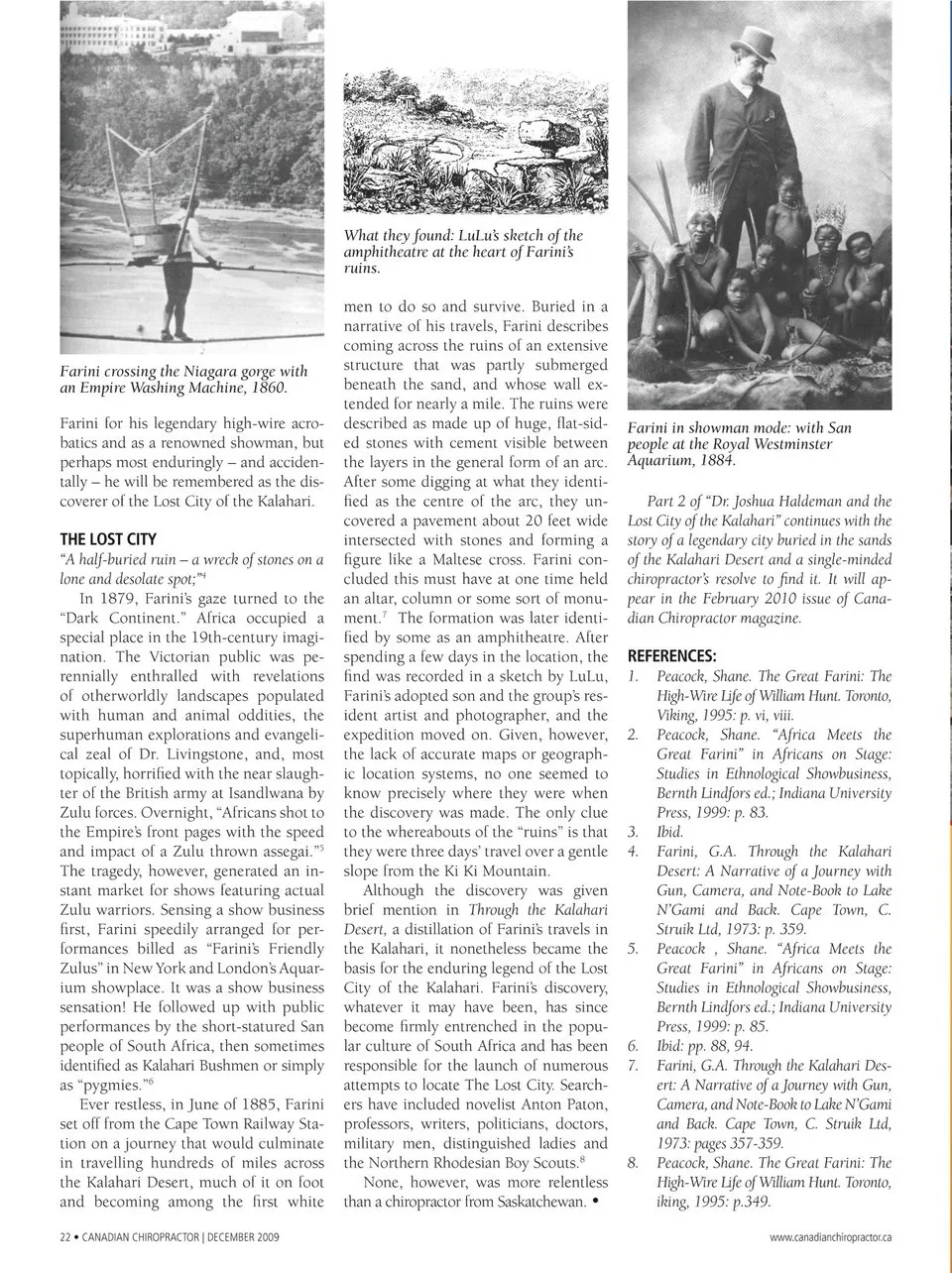
What they found: LuLu’s sketch of the amphitheatre at the heart of Farini’s ruins. Farini crossing the Niagara gorge with an Empire Washing Machine, 1860. Farini for his legendary high-wire acro- batics and as a renowned showman, but perhaps most enduringly – and acciden- tally – he will be remembered as the dis- coverer of the Lost City of the Kalahari. THE LOST CITY “A half-buried ruin – a wreck of stones on a lone and desolate spot;”4 In 1879, Farini’s gaze turned to the “Dark Continent.” Africa occupied a special place in the 19th-century imagi- nation. The Victorian public was pe- rennially enthralled with revelations of otherworldly landscapes populated with human and animal oddities, the superhuman explorations and evangeli- cal zeal of Dr. Livingstone, and, most topically, horrified with the near slaugh- ter of the British army at Isandlwana by Zulu forces. Overnight, “Africans shot to the Empire’s front pages with the speed and impact of a Zulu thrown assegai.”5 The tragedy, however, generated an in- stant market for shows featuring actual Zulu warriors. Sensing a show business first, Farini speedily arranged for per- formances billed as “Farini’s Friendly Zulus” in New York and London’s Aquar- ium showplace. It was a show business sensation! He followed up with public performances by the short-statured San people of South Africa, then sometimes identified as Kalahari Bushmen or simply as “pygmies.”6 Ever restless, in June of 1885, Farini set off from the Cape Town Railway Sta- tion on a journey that would culminate in travelling hundreds of miles across the Kalahari Desert, much of it on foot and becoming among the first white 22 • Canadian ChiropraCtor | dECEMBEr 2009 men to do so and survive. Buried in a narrative of his travels, Farini describes coming across the ruins of an extensive structure that was partly submerged beneath the sand, and whose wall ex- tended for nearly a mile. The ruins were described as made up of huge, flat-sid- ed stones with cement visible between the layers in the general form of an arc. After some digging at what they identi- fied as the centre of the arc, they un- covered a pavement about 20 feet wide intersected with stones and forming a figure like a Maltese cross. Farini con- cluded this must have at one time held an altar, column or some sort of monu- ment.7 The formation was later identi- fied by some as an amphitheatre. After spending a few days in the location, the find was recorded in a sketch by LuLu, Farini’s adopted son and the group’s res- ident artist and photographer, and the expedition moved on. Given, however, the lack of accurate maps or geograph- ic location systems, no one seemed to know precisely where they were when the discovery was made. The only clue to the whereabouts of the “ruins” is that they were three days’ travel over a gentle slope from the Ki Ki Mountain. Although the discovery was given brief mention in Through the Kalahari Desert, a distillation of Farini’s travels in the Kalahari, it nonetheless became the basis for the enduring legend of the Lost City of the Kalahari. Farini’s discovery, whatever it may have been, has since become firmly entrenched in the popu- lar culture of South Africa and has been responsible for the launch of numerous attempts to locate The Lost City. Search- ers have included novelist Anton Paton, professors, writers, politicians, doctors, military men, distinguished ladies and the Northern Rhodesian Boy Scouts.8 None, however, was more relentless than a chiropractor from Saskatchewan. • Farini in showman mode: with San people at the Royal Westminster Aquarium, 1884. Part 2 of “Dr. Joshua Haldeman and the Lost City of the Kalahari” continues with the story of a legendary city buried in the sands of the Kalahari Desert and a single-minded chiropractor’s resolve to find it. It will ap- pear in the February 2010 issue of Cana- dian Chiropractor magazine. REFERENCES: 1. Peacock, Shane. The Great Farini: The High-Wire Life of William Hunt. Toronto, Viking, 1995: p. vi, viii. 2. Peacock, Shane. “Africa Meets the Great Farini” in Africans on Stage: Studies in Ethnological Showbusiness, Bernth Lindfors ed.; Indiana University Press, 1999: p. 83. 3. Ibid. 4. Farini, G.A. Through the Kalahari Desert: A Narrative of a Journey with Gun, Camera, and Note-Book to Lake N’Gami and Back. Cape Town, C. Struik Ltd, 1973: p. 359. 5. Peacock , Shane. “Africa Meets the Great Farini” in Africans on Stage: Studies in Ethnological Showbusiness, Bernth Lindfors ed.; Indiana University Press, 1999: p. 85. 6. Ibid: pp. 88, 94. Farini, G.A. Through the Kalahari Des- 7. ert: A Narrative of a Journey with Gun, Camera, and Note-Book to Lake N’Gami and Back. Cape Town, C. Struik Ltd, 1973: pages 357-359. 8. Peacock, Shane. The Great Farini: The High-Wire Life of William Hunt. Toronto, iking, 1995: p.349. www.canadianchiropractor.ca
Chiropractic + Naturopathic Doctor December 2009: Page 22