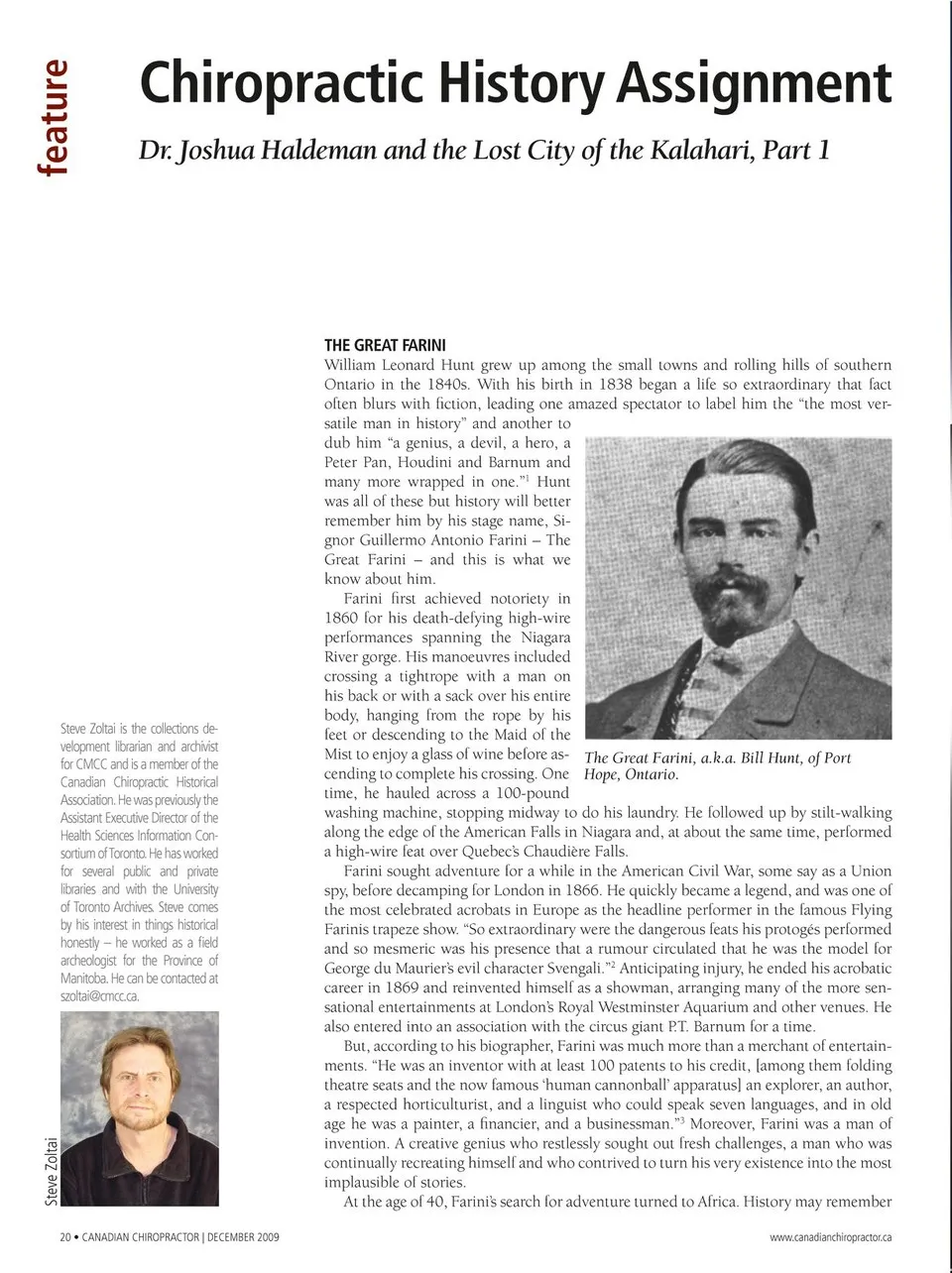
Chiropractic History Assignment Dr. Joshua Haldeman and the Lost City of the Kalahari, Part 1 THE GREAT FARINI William Leonard Hunt grew up among the small towns and rolling hills of southern Ontario in the 1840s. With his birth in 1838 began a life so extraordinary that fact often blurs with fiction, leading one amazed spectator to label him the “the most ver- satile man in history” and another to dub him “a genius, a devil, a hero, a Peter Pan, Houdini and Barnum and many more wrapped in one.”1 Hunt was all of these but history will better remember him by his stage name, Si- gnor Guillermo Antonio Farini – The Great Farini – and this is what we know about him. Farini first achieved notoriety in Steve Zoltai is the collections de- velopment librarian and archivist for CMCC and is a member of the Canadian Chiropractic historical association. he was previously the assistant Executive director of the health Sciences information Con- sortium of toronto. he has worked for several public and private libraries and with the University of toronto archives. Steve comes by his interest in things historical honestly – he worked as a field archeologist for the province of Manitoba. he can be contacted at [email protected]. 1860 for his death-defying high-wire performances spanning the Niagara River gorge. His manoeuvres included crossing a tightrope with a man on his back or with a sack over his entire body, hanging from the rope by his feet or descending to the Maid of the Mist to enjoy a glass of wine before as- cending to complete his crossing. One time, he hauled across a 100-pound washing machine, stopping midway to do his laundry. He followed up by stilt-walking along the edge of the American Falls in Niagara and, at about the same time, performed a high-wire feat over Quebec’s Chaudière Falls. Farini sought adventure for a while in the American Civil War, some say as a Union The Great Farini, a.k.a. Bill Hunt, of Port Hope, Ontario. spy, before decamping for London in 1866. He quickly became a legend, and was one of the most celebrated acrobats in Europe as the headline performer in the famous Flying Farinis trapeze show. “So extraordinary were the dangerous feats his protogés performed and so mesmeric was his presence that a rumour circulated that he was the model for George du Maurier’s evil character Svengali.”2 Anticipating injury, he ended his acrobatic career in 1869 and reinvented himself as a showman, arranging many of the more sen- sational entertainments at London’s Royal Westminster Aquarium and other venues. He also entered into an association with the circus giant P.T. Barnum for a time. But, according to his biographer, Farini was much more than a merchant of entertain- ments. “He was an inventor with at least 100 patents to his credit, [among them folding theatre seats and the now famous ‘human cannonball’ apparatus] an explorer, an author, a respected horticulturist, and a linguist who could speak seven languages, and in old age he was a painter, a financier, and a businessman.”3 Moreover, Farini was a man of invention. A creative genius who restlessly sought out fresh challenges, a man who was continually recreating himself and who contrived to turn his very existence into the most implausible of stories. At the age of 40, Farini’s search for adventure turned to Africa. History may remember 20 • Canadian ChiropraCtor | dECEMBEr 2009 www.canadianchiropractor.ca Steve Zoltai feature
Chiropractic + Naturopathic Doctor December 2009: Page 20