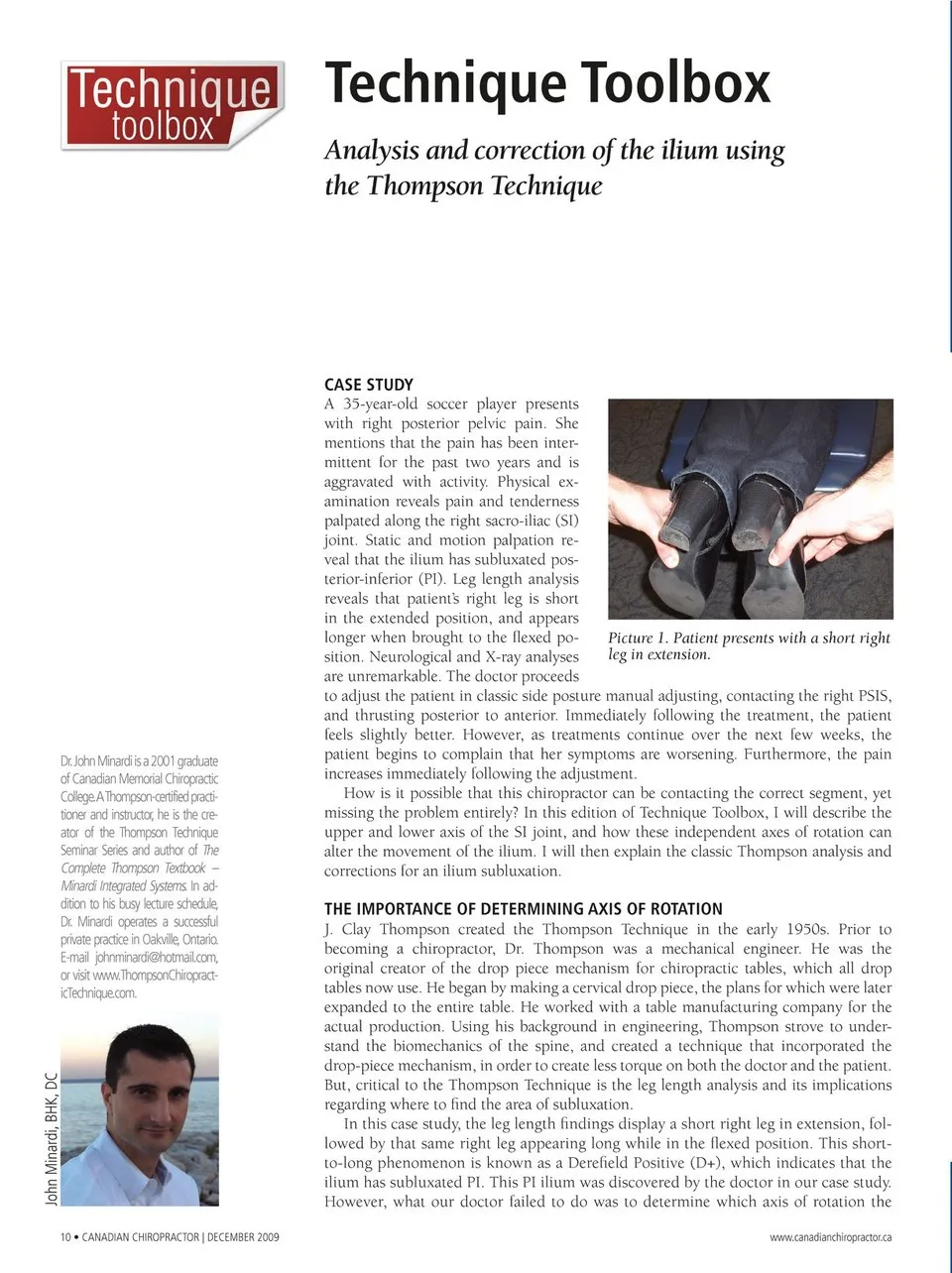
Technique Toolbox Analysis and correction of the ilium using the Thompson Technique dr. John Minardi is a 2001 graduate of Canadian Memorial Chiropractic College. a thompson-certified practi- tioner and instructor, he is the cre- ator of the thompson technique Seminar Series and author of the Complete thompson textbook – Minardi integrated Systems. in ad- dition to his busy lecture schedule, dr. Minardi operates a successful private practice in oakville, ontario. E-mail [email protected], or visit www.thompsonChiropract- ictechnique.com. CASE STUDY A 35-year-old soccer player presents with right posterior pelvic pain. She mentions that the pain has been inter- mittent for the past two years and is aggravated with activity. Physical ex- amination reveals pain and tenderness palpated along the right sacro-iliac (SI) joint. Static and motion palpation re- veal that the ilium has subluxated pos- terior-inferior (PI). Leg length analysis reveals that patient’s right leg is short in the extended position, and appears longer when brought to the flexed po- sition. Neurological and X-ray analyses are unremarkable. The doctor proceeds to adjust the patient in classic side posture manual adjusting, contacting the right PSIS, and thrusting posterior to anterior. Immediately following the treatment, the patient feels slightly better. However, as treatments continue over the next few weeks, the patient begins to complain that her symptoms are worsening. Furthermore, the pain increases immediately following the adjustment. How is it possible that this chiropractor can be contacting the correct segment, yet Picture 1. Patient presents with a short right leg in extension. missing the problem entirely? In this edition of Technique Toolbox, I will describe the upper and lower axis of the SI joint, and how these independent axes of rotation can alter the movement of the ilium. I will then explain the classic Thompson analysis and corrections for an ilium subluxation. THE IMPORTANCE OF DETERMINING AXIS OF ROTATION J. Clay Thompson created the Thompson Technique in the early 1950s. Prior to becoming a chiropractor, Dr. Thompson was a mechanical engineer. He was the original creator of the drop piece mechanism for chiropractic tables, which all drop tables now use. He began by making a cervical drop piece, the plans for which were later expanded to the entire table. He worked with a table manufacturing company for the actual production. Using his background in engineering, Thompson strove to under- stand the biomechanics of the spine, and created a technique that incorporated the drop-piece mechanism, in order to create less torque on both the doctor and the patient. But, critical to the Thompson Technique is the leg length analysis and its implications regarding where to find the area of subluxation. In this case study, the leg length findings display a short right leg in extension, fol- lowed by that same right leg appearing long while in the flexed position. This short- to-long phenomenon is known as a Derefield Positive (D+), which indicates that the ilium has subluxated PI. This PI ilium was discovered by the doctor in our case study. However, what our doctor failed to do was to determine which axis of rotation the 10 • Canadian ChiropraCtor | dECEMBEr 2009 www.canadianchiropractor.ca John Minardi, BhK, dC
Chiropractic + Naturopathic Doctor December 2009: Page 10