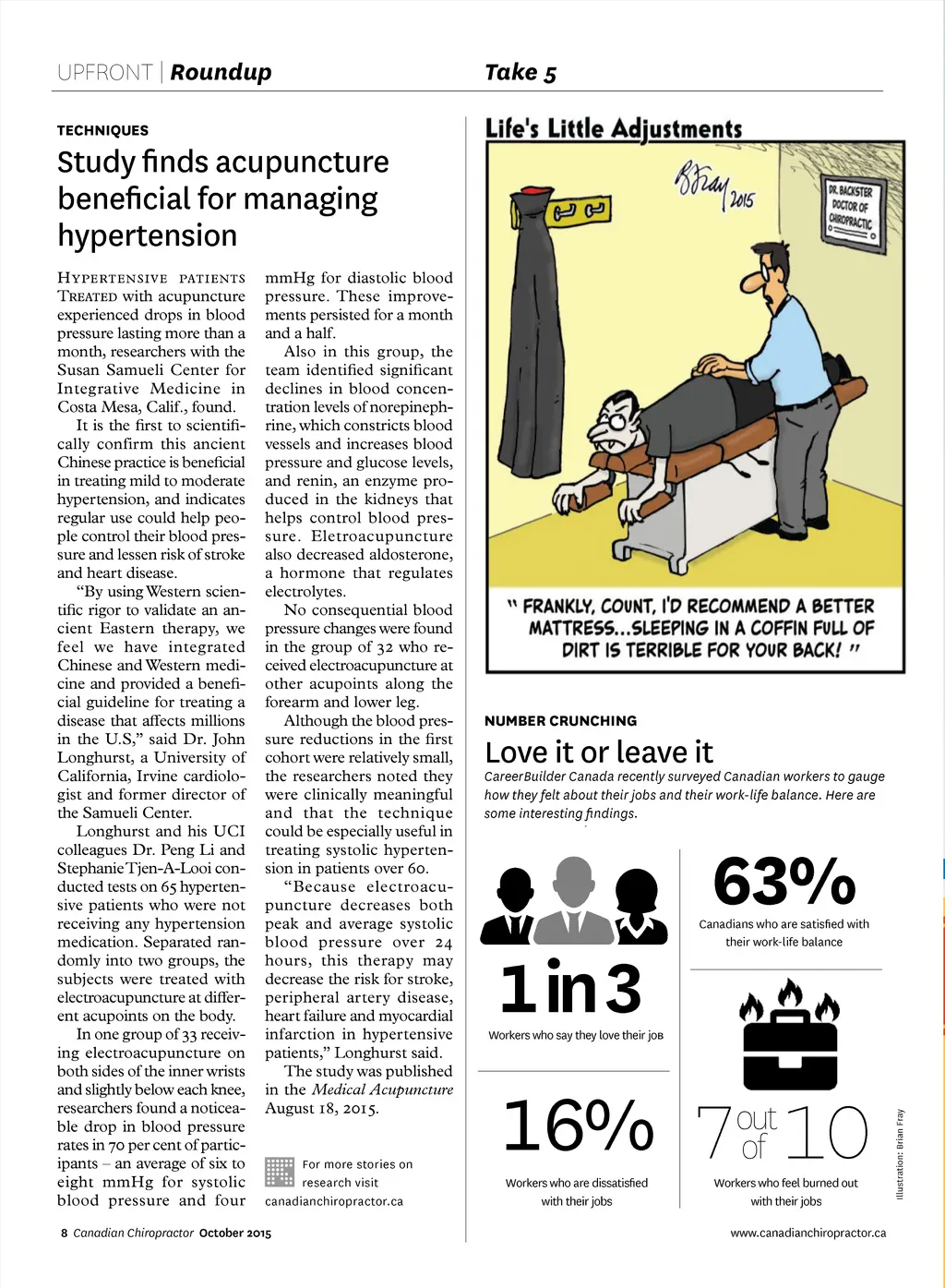
UPFRONT | Roundup TECHNIQUES Take 5 Study finds acupuncture beneficial for managing hypertension Hypertensive patients Treated with acupuncture experienced drops in blood pressure lasting more than a month, researchers with the Susan Samueli Center for Integrative Medicine in Costa Mesa, Calif., found. It is the first to scientifi-cally confirm this ancient Chinese practice is beneficial in treating mild to moderate hypertension, and indicates regular use could help peo-ple control their blood pres-sure and lessen risk of stroke and heart disease. “By using Western scien-tific rigor to validate an an-cient Eastern therapy, we feel we have integrated Chinese and Western medi-cine and provided a benefi-cial guideline for treating a disease that affects millions in the U.S,” said Dr. John Longhurst, a University of California, Irvine cardiolo-gist and former director of the Samueli Center. Longhurst and his UCI colleagues Dr. Peng Li and Stephanie Tjen-A-Looi con-ducted tests on 65 hyperten-sive patients who were not receiving any hypertension medication. Separated ran-domly into two groups, the subjects were treated with electroacupuncture at differ-ent acupoints on the body. In one group of 33 receiv-ing electroacupuncture on both sides of the inner wrists and slightly below each knee, researchers found a noticea-ble drop in blood pressure rates in 70 per cent of partic-ipants – an average of six to eight mmHg for systolic blood pressure and four mmHg for diastolic blood pressure. These improve-ments persisted for a month and a half. Also in this group, the team identified significant declines in blood concen-tration levels of norepineph-rine, which constricts blood vessels and increases blood pressure and glucose levels, and renin, an enzyme pro-duced in the kidneys that helps control blood pres-sure. Eletroacupuncture also decreased aldosterone, a hormone that regulates electrolytes. No consequential blood pressure changes were found in the group of 32 who re-ceived electroacupuncture at other acupoints along the forearm and lower leg. Although the blood pres-sure reductions in the first cohort were relatively small, the researchers noted they were clinically meaningful and that the technique could be especially useful in treating systolic hyperten-sion in patients over 60. “Because electroacu-puncture decreases both peak and average systolic blood pressure over 24 hours, this therapy may decrease the risk for stroke, peripheral artery disease, heart failure and myocardial infarction in hypertensive patients,” Longhurst said. The study was published in the Medical Acupuncture August 18, 2015. For more stories on research visit canadianchiropractor.ca NUMBER CRUNCHING Love it or leave it CareerBuilder Canada recently surveyed Canadian workers to gauge how they felt about their jobs and their work-life balance. Here are some interesting findings. Workers who say they love their job 1 in 3 Canadians who are satisfied with their work-life balance 63% Workers who are dissatisfied with their jobs Workers who feel burned out with their jobs 8 Canadian Chiropractor October 2015 www.canadianchiropractor.ca Illustration: Brian Fray 16% 7 out of 10
Chiropractic + Naturopathic Doctor October 2015: Page 8