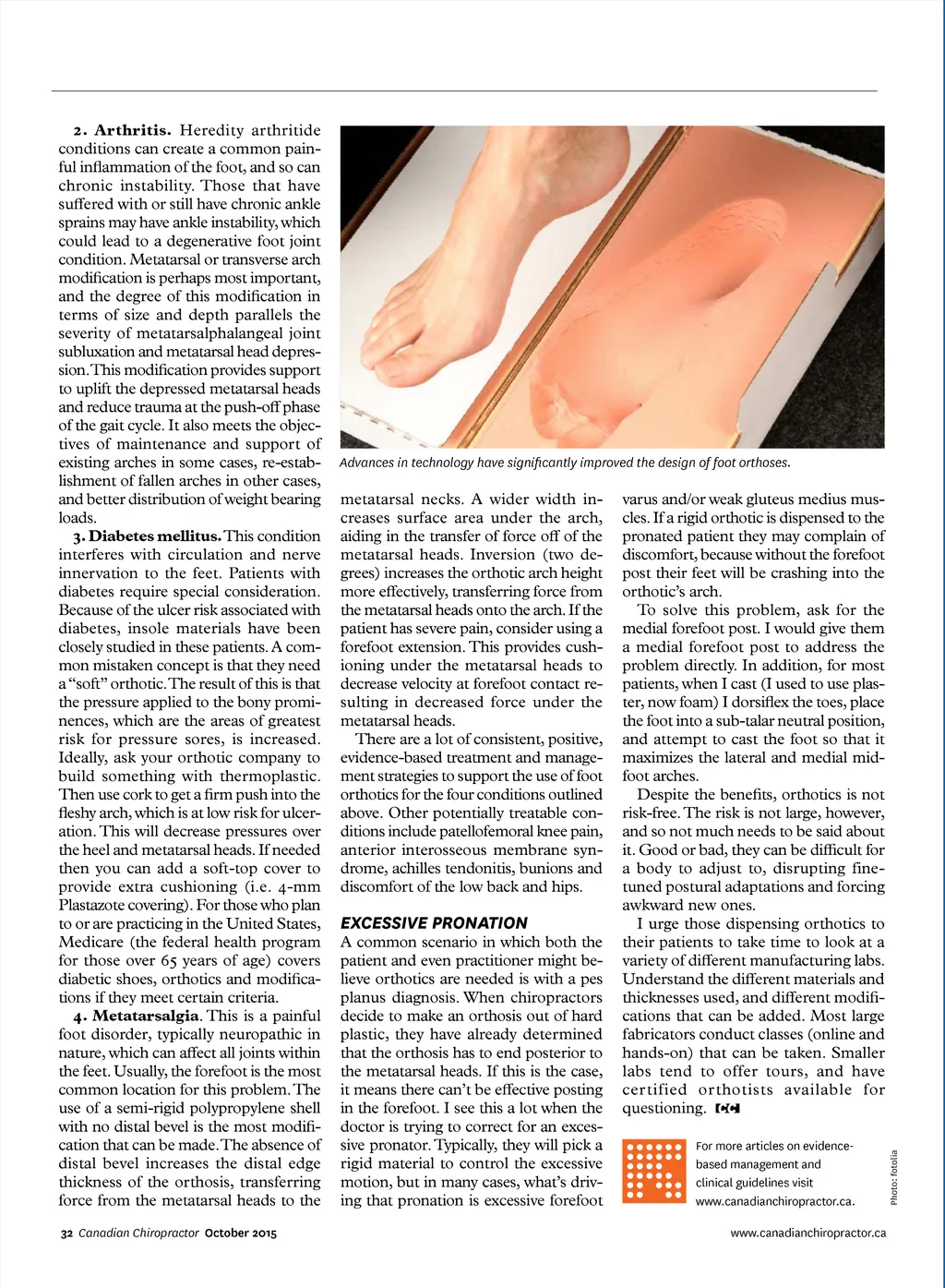
2. Arthritis. Heredity arthritide conditions can create a common pain-ful inflammation of the foot, and so can chronic instability. Those that have suffered with or still have chronic ankle sprains may have ankle instability, which could lead to a degenerative foot joint condition. Metatarsal or transverse arch modification is perhaps most important, and the degree of this modification in terms of size and depth parallels the severity of metatarsalphalangeal joint subluxation and metatarsal head depres-sion. This modification provides support to uplift the depressed metatarsal heads and reduce trauma at the push-off phase of the gait cycle. It also meets the objec-tives of maintenance and support of existing arches in some cases, re-estab-lishment of fallen arches in other cases, and better distribution of weight bearing loads. 3. Diabetes mellitus. This condition interferes with circulation and nerve innervation to the feet. Patients with diabetes require special consideration. Because of the ulcer risk associated with diabetes, insole materials have been closely studied in these patients. A com-mon mistaken concept is that they need a “soft” orthotic. The result of this is that the pressure applied to the bony promi-nences, which are the areas of greatest risk for pressure sores, is increased. Ideally, ask your orthotic company to build something with thermoplastic. Then use cork to get a firm push into the fleshy arch, which is at low risk for ulcer-ation. This will decrease pressures over the heel and metatarsal heads. If needed then you can add a soft-top cover to provide extra cushioning (i.e. 4-mm Plastazote covering). For those who plan to or are practicing in the United States, Medicare (the federal health program for those over 65 years of age) covers diabetic shoes, orthotics and modifica-tions if they meet certain criteria. 4. Metatarsalgia . This is a painful foot disorder, typically neuropathic in nature, which can affect all joints within the feet. Usually, the forefoot is the most common location for this problem. The use of a semi-rigid polypropylene shell with no distal bevel is the most modifi-cation that can be made. The absence of distal bevel increases the distal edge thickness of the orthosis, transferring force from the metatarsal heads to the 32 Canadian Chiropractor October 2015 Advances in technology have significantly improved the design of foot orthoses. metatarsal necks. A wider width in-creases surface area under the arch, aiding in the transfer of force off of the metatarsal heads. Inversion (two de-grees) increases the orthotic arch height more effectively, transferring force from the metatarsal heads onto the arch. If the patient has severe pain, consider using a forefoot extension. This provides cush-ioning under the metatarsal heads to decrease velocity at forefoot contact re-sulting in decreased force under the metatarsal heads. There are a lot of consistent, positive, evidence-based treatment and manage-ment strategies to support the use of foot orthotics for the four conditions outlined above. Other potentially treatable con-ditions include patellofemoral knee pain, anterior interosseous membrane syn-drome, achilles tendonitis, bunions and discomfort of the low back and hips. EXCESSIVE PRONATION A common scenario in which both the patient and even practitioner might be-lieve orthotics are needed is with a pes planus diagnosis. When chiropractors decide to make an orthosis out of hard plastic, they have already determined that the orthosis has to end posterior to the metatarsal heads. If this is the case, it means there can’t be effective posting in the forefoot. I see this a lot when the doctor is trying to correct for an exces-sive pronator. Typically, they will pick a rigid material to control the excessive motion, but in many cases, what’s driv-ing that pronation is excessive forefoot varus and/or weak gluteus medius mus-cles. If a rigid orthotic is dispensed to the pronated patient they may complain of discomfort, because without the forefoot post their feet will be crashing into the orthotic’s arch. To solve this problem, ask for the medial forefoot post. I would give them a medial forefoot post to address the problem directly. In addition, for most patients, when I cast (I used to use plas-ter, now foam) I dorsiflex the toes, place the foot into a sub-talar neutral position, and attempt to cast the foot so that it maximizes the lateral and medial mid-foot arches. Despite the benefits, orthotics is not risk-free. The risk is not large, however, and so not much needs to be said about it. Good or bad, they can be difficult for a body to adjust to, disrupting fine-tuned postural adaptations and forcing awkward new ones. I urge those dispensing orthotics to their patients to take time to look at a variety of different manufacturing labs. Understand the different materials and thicknesses used, and different modifi-cations that can be added. Most large fabricators conduct classes (online and hands-on) that can be taken. Smaller labs tend to offer tours, and have certified orthotists available for questioning. For more articles on evidence-based management and clinical guidelines visit www.canadianchiropractor.ca. www.canadianchiropractor.ca Photo: fotolia
Chiropractic + Naturopathic Doctor October 2015: Page 32