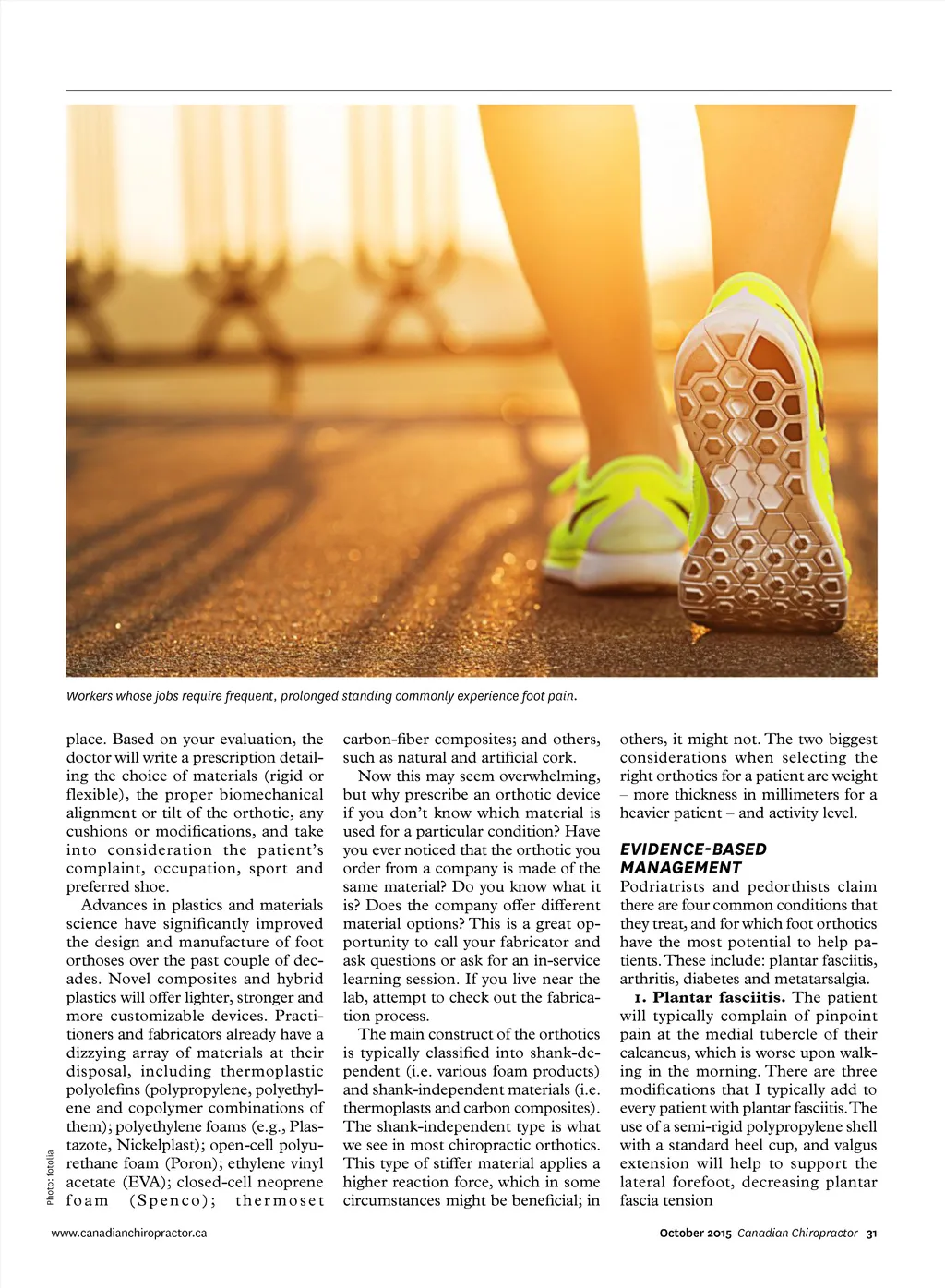
FEATURE CLINICAL OPTICS ON ORTHOTICS Treatment and management options for common foot conditions N BY JENNIFER ILLES ot surprisingly, work-ers whose job requires them to stand for many hours a day commonly experience foot pain and discom-fort. This can ulti-mately lead to other implications of the foot and the kinetic chain. A paper published in the Journal of Prosthetics and Orthotics in 1989 claims approximately 75 per cent of Americans have reported foot problems in their life (“Computer aided design and com-puter aided manufacturing of foot or-thoses” by T.B. Staats and M.P. Kriech-baum). The most common problems associated with foot pain are ankle, leg, knee, hip and spinal disorders in people who spend many hours standing, ac-cording to studies published in 2005 in the Journal of Chiropractic Medicine (“Chiropractic adjustments and orthot-ics reduced symptoms for standing workers” by J. Zhang) and in 1987 in the journal Orthopedics (“Effect of vis-coelastic insoles on pain” by R.E. Tooms, R.W.Griffin and P. Green). There are researchers and health-care practitioners who believe foot orthotics are effective in managing problems of the feet and lower extremities, and in relieving low back pain. H.J. Dananberg and M. Guilliano investigated this ap-proach in their study published in the Journal of the American Podiatric Medical Association in 1999. However, according to a recent When I taught anatomy classes for a prosthetic and orthotic school, the students would ask why chiropractors called it an “orthotic.” Chiropractors typically call it an orthotic, but it really should be referred to as a foot orthotic or foot orthoses. For the sake of sim-plicity the word orthotic has been used throughout this article. A custom orthotic is a shell or sup-port made out of various materials which, when placed in the shoe, sup-ports the foot and maintains normal foot function. It usually extends from the heel to just distal to the metatarsal heads. Custom orthotics should not be confused with prefabricated arch supports. To start the orthotic process, a bio-mechanical evaluation of the lower DR. JENNIFER ILLES, DC, is assistant clinical professor at D’Youville College’s Chiropractic Program. extremities, and some form of scan-She has practised in Ontario, Florida and New York. She can be reached at [email protected]. ning or casting of the feet will take 30 Canadian Chiropractor October 2015 www.canadianchiropractor.ca PubMed search, there are less than three non-case report studies examin-ing the combination of chiropractic care and orthotics for relieving foot and foot associated pain. The author, a chiropractor, speculates that spinal and extra-spinal adjustments function synergistically or complementary with orthotics. This is theorized because chiropractic care improves restricted joint mobility, and reduces muscle tension, which shortens the break-in time for using orthotics. Some believe foot orthotics are important for the body’s entire kinetic chain, through supporting body mechanics. One study by Stude and Brink sup-ported the idea that foot orthotics enhance balance, performance and reduce fatigue. In the study, published in the Journal of Manipulative and Physiological Therapeutics in 1997, the researchers described that golfers wearing orthotics for over a period of six weeks had less foot fatigue and gained a seven per cent mean increase in club-head velocity. Another study of postal workers performed by Carley revealed a 67 per cent reduction in foot, knee or back pain. Carley’s study was published in Biomechanics in 1998. A more recent study, in 2011, demonstrated that custom foot orthot-ics were beneficial to patients with chronic low back pain after six weeks of use. This randomized controlled pilot study, by Cambron, Duarte, Dexheimer and Solecki, was published in the Journal of Manipulative and Physiological Therapeutics . However, some of these studies on foot orthotics remain inconclusive because they lack controls, and appro-priate sample size. In their paper titled, “Efficacy of foot orthoses. What does the literature tell us?” authors Landorf and Keenan note different patient conditions and comorbidities, orthot-ics casting, and outcome assessments also make the effectiveness of these studies difficult to evaluate. Their pa-per was published in 2000 in the Journal of the American Podiatric Med-ical Association . CUSTOM ORTHOTIC MATERIALS
Chiropractic + Naturopathic Doctor October 2015: Page 30