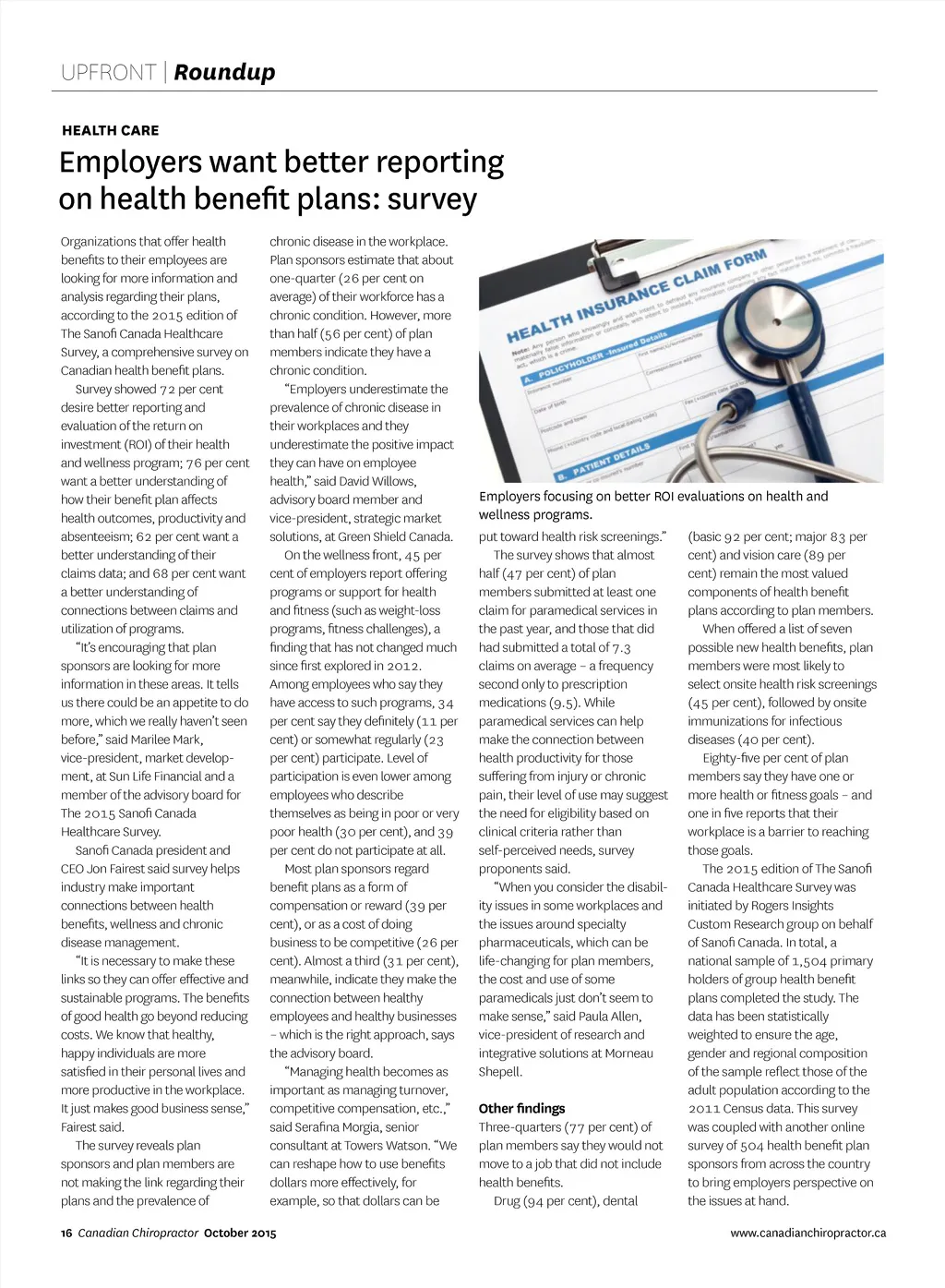
UPFRONT | Roundup Employers want better reporting on health benefit plans: survey Organizations that offer health benefits to their employees are looking for more information and analysis regarding their plans, according to the 2015 edition of The Sanofi Canada Healthcare Survey, a comprehensive survey on Canadian health benefit plans. Survey showed 72 per cent desire better reporting and evaluation of the return on investment (ROI) of their health and wellness program; 76 per cent want a better understanding of how their benefit plan affects health outcomes, productivity and absenteeism; 62 per cent want a better understanding of their claims data; and 68 per cent want a better understanding of connections between claims and utilization of programs. “It’s encouraging that plan sponsors are looking for more information in these areas. It tells us there could be an appetite to do more, which we really haven’t seen before,” said Marilee Mark, vice-president, market develop-ment, at Sun Life Financial and a member of the advisory board for The 2015 Sanofi Canada Healthcare Survey. Sanofi Canada president and CEO Jon Fairest said survey helps industry make important connections between health benefits, wellness and chronic disease management. “It is necessary to make these links so they can offer effective and sustainable programs. The benefits of good health go beyond reducing costs. We know that healthy, happy individuals are more satisfied in their personal lives and more productive in the workplace. It just makes good business sense,” Fairest said. The survey reveals plan sponsors and plan members are not making the link regarding their plans and the prevalence of chronic disease in the workplace. Plan sponsors estimate that about one-quarter (26 per cent on average) of their workforce has a chronic condition. However, more than half (56 per cent) of plan members indicate they have a chronic condition. “Employers underestimate the prevalence of chronic disease in their workplaces and they underestimate the positive impact they can have on employee health,” said David Willows, advisory board member and vice-president, strategic market solutions, at Green Shield Canada. On the wellness front, 45 per cent of employers report offering programs or support for health and fitness (such as weight-loss programs, fitness challenges), a finding that has not changed much since first explored in 2012. Among employees who say they have access to such programs, 34 per cent say they definitely (11 per cent) or somewhat regularly (23 per cent) participate. Level of participation is even lower among employees who describe themselves as being in poor or very poor health (30 per cent), and 39 per cent do not participate at all. Most plan sponsors regard benefit plans as a form of compensation or reward (39 per cent), or as a cost of doing business to be competitive (26 per cent). Almost a third (31 per cent), meanwhile, indicate they make the connection between healthy employees and healthy businesses – which is the right approach, says the advisory board. “Managing health becomes as important as managing turnover, competitive compensation, etc.,” said Serafina Morgia, senior consultant at Towers Watson. “We can reshape how to use benefits dollars more effectively, for example, so that dollars can be HEALTH CARE Employers focusing on better ROI evaluations on health and wellness programs. put toward health risk screenings.” (basic 92 per cent; major 83 per The survey shows that almost cent) and vision care (89 per half (47 per cent) of plan cent) remain the most valued members submitted at least one components of health benefit claim for paramedical services in plans according to plan members. the past year, and those that did When offered a list of seven had submitted a total of 7.3 possible new health benefits, plan claims on average – a frequency members were most likely to second only to prescription select onsite health risk screenings medications (9.5). While (45 per cent), followed by onsite paramedical services can help immunizations for infectious make the connection between diseases (40 per cent). health productivity for those Eighty-five per cent of plan suffering from injury or chronic members say they have one or pain, their level of use may suggest more health or fitness goals – and the need for eligibility based on one in five reports that their clinical criteria rather than workplace is a barrier to reaching self-perceived needs, survey those goals. proponents said. The 2015 edition of The Sanofi “When you consider the disabil-Canada Healthcare Survey was ity issues in some workplaces and initiated by Rogers Insights the issues around specialty Custom Research group on behalf pharmaceuticals, which can be of Sanofi Canada. In total, a life-changing for plan members, national sample of 1,504 primary the cost and use of some holders of group health benefit paramedicals just don’t seem to plans completed the study. The make sense,” said Paula Allen, data has been statistically vice-president of research and weighted to ensure the age, integrative solutions at Morneau gender and regional composition Shepell. of the sample reflect those of the adult population according to the Other findings 2011 Census data. This survey Three-quarters (77 per cent) of was coupled with another online plan members say they would not survey of 504 health benefit plan move to a job that did not include sponsors from across the country health benefits. to bring employers perspective on Drug (94 per cent), dental the issues at hand. www.canadianchiropractor.ca 16 Canadian Chiropractor October 2015
Chiropractic + Naturopathic Doctor October 2015: Page 16