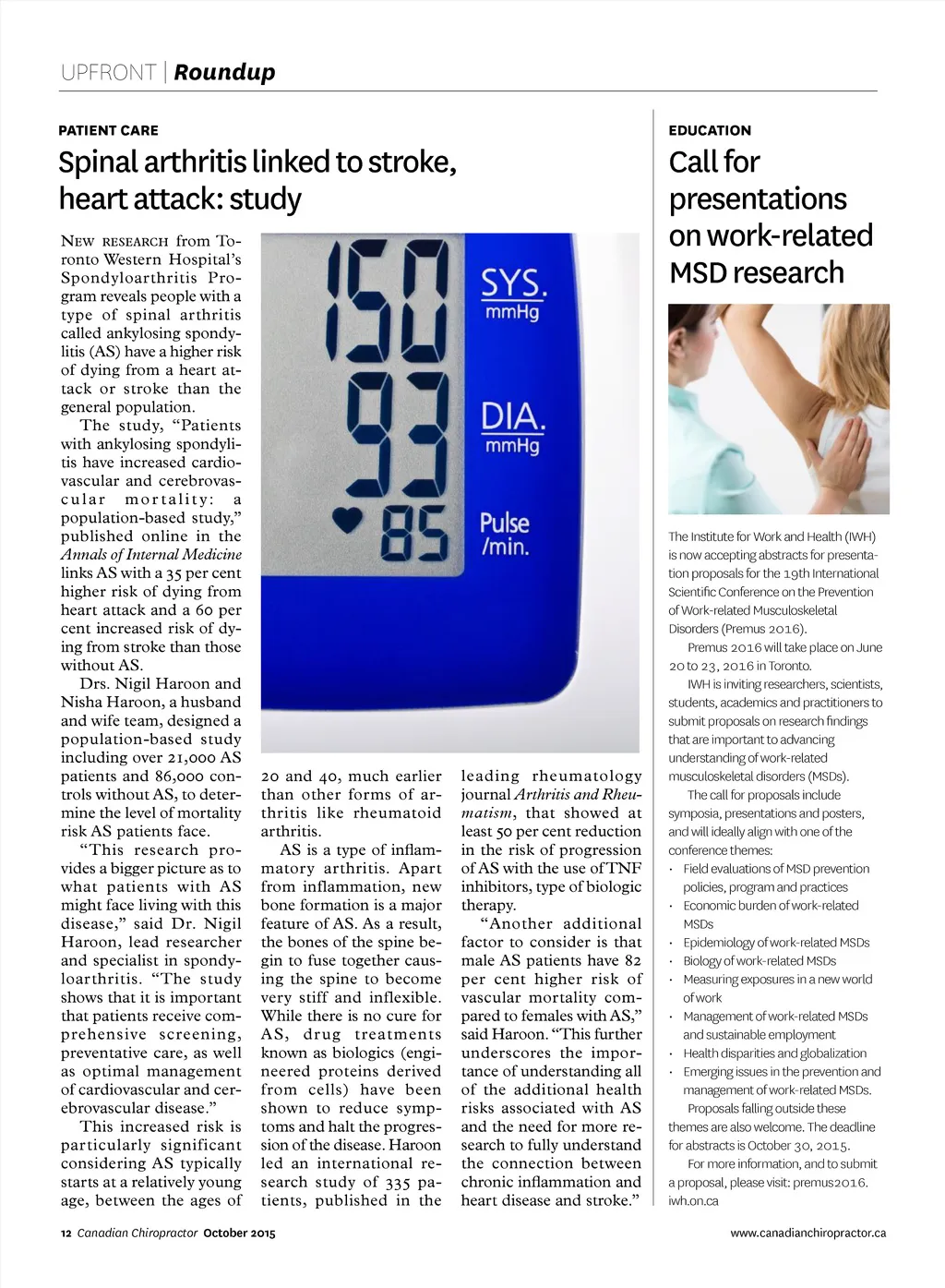
UPFRONT | Roundup PATIENT CARE Spinal arthritis linked to stroke, heart attack: study New research from To-ronto Western Hospital’s Spondyloarthritis Pro-gram reveals people with a type of spinal arthritis called ankylosing spondy-litis (AS) have a higher risk of dying from a heart at-tack or stroke than the general population. The study, “Patients with ankylosing spondyli-tis have increased cardio-vascular and cerebrovas-cular mor tality: a population-based study,” published online in the Annals of Internal Medicine links AS with a 35 per cent higher risk of dying from heart attack and a 60 per cent increased risk of dy-ing from stroke than those without AS. Drs. Nigil Haroon and Nisha Haroon, a husband and wife team, designed a population-based study including over 21,000 AS patients and 86,000 con-trols without AS, to deter-mine the level of mortality risk AS patients face. “This research pro-vides a bigger picture as to what patients with AS might face living with this disease,” said Dr. Nigil Haroon, lead researcher and specialist in spondy-loarthritis. “The study shows that it is important that patients receive com-prehensive screening , preventative care, as well as optimal management of cardiovascular and cer-ebrovascular disease.” This increased risk is particularly significant considering AS typically starts at a relatively young age, between the ages of EDUCATION Call for presentations on work-related MSD research 20 and 40, much earlier than other forms of ar-thritis like rheumatoid arthritis. AS is a type of inflam-matory arthritis. Apart from inflammation, new bone formation is a major feature of AS. As a result, the bones of the spine be-gin to fuse together caus-ing the spine to become very stiff and inflexible. While there is no cure for AS, dr ug treatments known as biologics (engi-neered proteins derived from cells) have been shown to reduce symp-toms and halt the progres-sion of the disease. Haroon led an international re-search study of 335 pa-tients, published in the leading rheumatology journal Arthritis and Rheu-matism , that showed at least 50 per cent reduction in the risk of progression of AS with the use of TNF inhibitors, type of biologic therapy. “Another additional factor to consider is that male AS patients have 82 per cent higher risk of vascular mortality com-pared to females with AS,” said Haroon. “This further underscores the impor-tance of understanding all of the additional health risks associated with AS and the need for more re-search to fully understand the connection between chronic inflammation and heart disease and stroke.” The Institute for Work and Health (IWH) is now accepting abstracts for presenta-tion proposals for the 19th International Scientific Conference on the Prevention of Work-related Musculoskeletal Disorders (Premus 2016). Premus 2016 will take place on June 20 to 23, 2016 in Toronto. IWH is inviting researchers, scientists, students, academics and practitioners to submit proposals on research findings that are important to advancing understanding of work-related musculoskeletal disorders (MSDs). The call for proposals include symposia, presentations and posters, and will ideally align with one of the conference themes: • Field evaluations of MSD prevention policies, program and practices • Economic burden of work-related MSDs • Epidemiology of work-related MSDs • Biology of work-related MSDs • Measuring exposures in a new world of work • Management of work-related MSDs and sustainable employment • Health disparities and globalization • Emerging issues in the prevention and management of work-related MSDs. Proposals falling outside these themes are also welcome. The deadline for abstracts is October 30, 2015. For more information, and to submit a proposal, please visit: premus2016. iwh.on.ca www.canadianchiropractor.ca 12 Canadian Chiropractor October 2015
Chiropractic + Naturopathic Doctor October 2015: Page 12