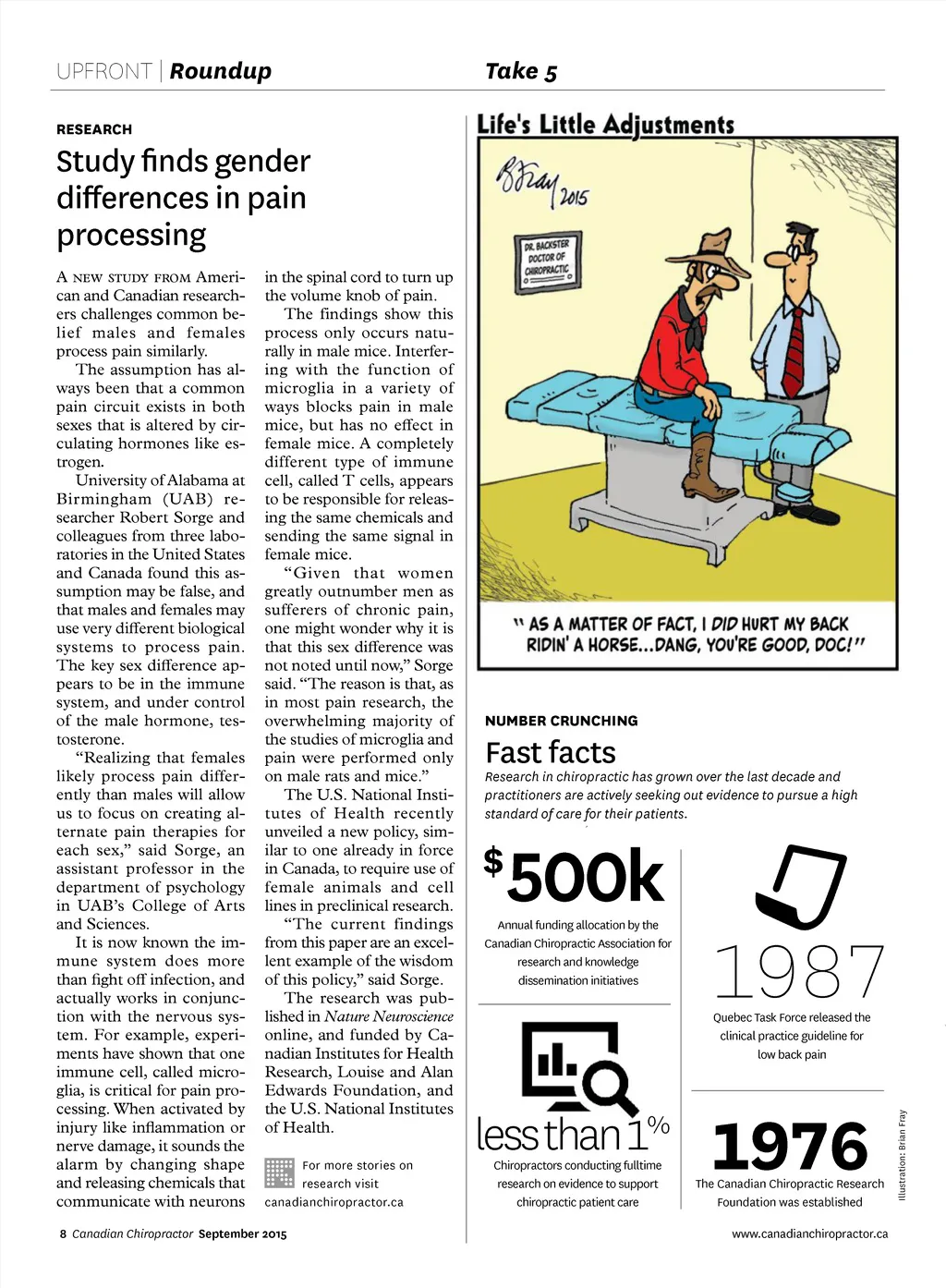
UPFRONT | Roundup RESEARCH Take 5 Study finds gender differences in pain processing A new study from Ameri-can and Canadian research-ers challenges common be-lief males and females process pain similarly. The assumption has al-ways been that a common pain circuit exists in both sexes that is altered by cir-culating hormones like es-trogen . University of Alabama at Birmingham (UAB) re-searcher Robert Sorge and colleagues from three labo-ratories in the United States and Canada found this as-sumption may be false, and that males and females may use very different biological systems to process pain. The key sex difference ap-pears to be in the immune system, and under control of the male hormone, tes-tosterone. “Realizing that females likely process pain differ-ently than males will allow us to focus on creating al-ternate pain therapies for each sex,” said Sorge, an assistant professor in the department of psychology in UAB’s College of Arts and Sciences. It is now known the im-mune system does more than fight off infection, and actually works in conjunc-tion with the nervous sys-tem. For example, experi-ments have shown that one immune cell, called micro-glia, is critical for pain pro-cessing. When activated by injury like inflammation or nerve damage, it sounds the alarm by changing shape and releasing chemicals that communicate with neurons in the spinal cord to turn up the volume knob of pain. The findings show this process only occurs natu-rally in male mice. Interfer-ing with the function of microglia in a variety of ways blocks pain in male mice, but has no effect in female mice. A completely different type of immune cell, called T cells, appears to be responsible for releas-ing the same chemicals and sending the same signal in female mice. “Given that women greatly outnumber men as sufferers of chronic pain, one might wonder why it is that this sex difference was not noted until now,” Sorge said. “The reason is that, as in most pain research, the overwhelming majority of the studies of microglia and pain were performed only on male rats and mice.” The U.S. National Insti-tutes of Health recently unveiled a new policy, sim-ilar to one already in force in Canada, to require use of female animals and cell lines in preclinical research. “The current findings from this paper are an excel-lent example of the wisdom of this policy,” said Sorge. The research was pub-lished in Nature Neuroscience online, and funded by Ca-nadian Institutes for Health Research, Louise and Alan Edwards Foundation, and the U.S. National Institutes of Health. For more stories on research visit canadianchiropractor.ca NUMBER CRUNCHING Fast facts Research in chiropractic has grown over the last decade and practitioners are actively seeking out evidence to pursue a high standard of care for their patients. $ Annual funding allocation by the Canadian Chiropractic Association for research and knowledge dissemination initiatives 500k 1987 Quebec Task Force released the clinical practice guideline for low back pain The Canadian Chiropractic Research Foundation was established www.canadianchiropractor.ca Illustration: Brian Fray less than 1 % Chiropractors conducting fulltime research on evidence to support chiropractic patient care 1976 8 Canadian Chiropractor September 2015
Chiropractic + Naturopathic Doctor September 2015: Page 8