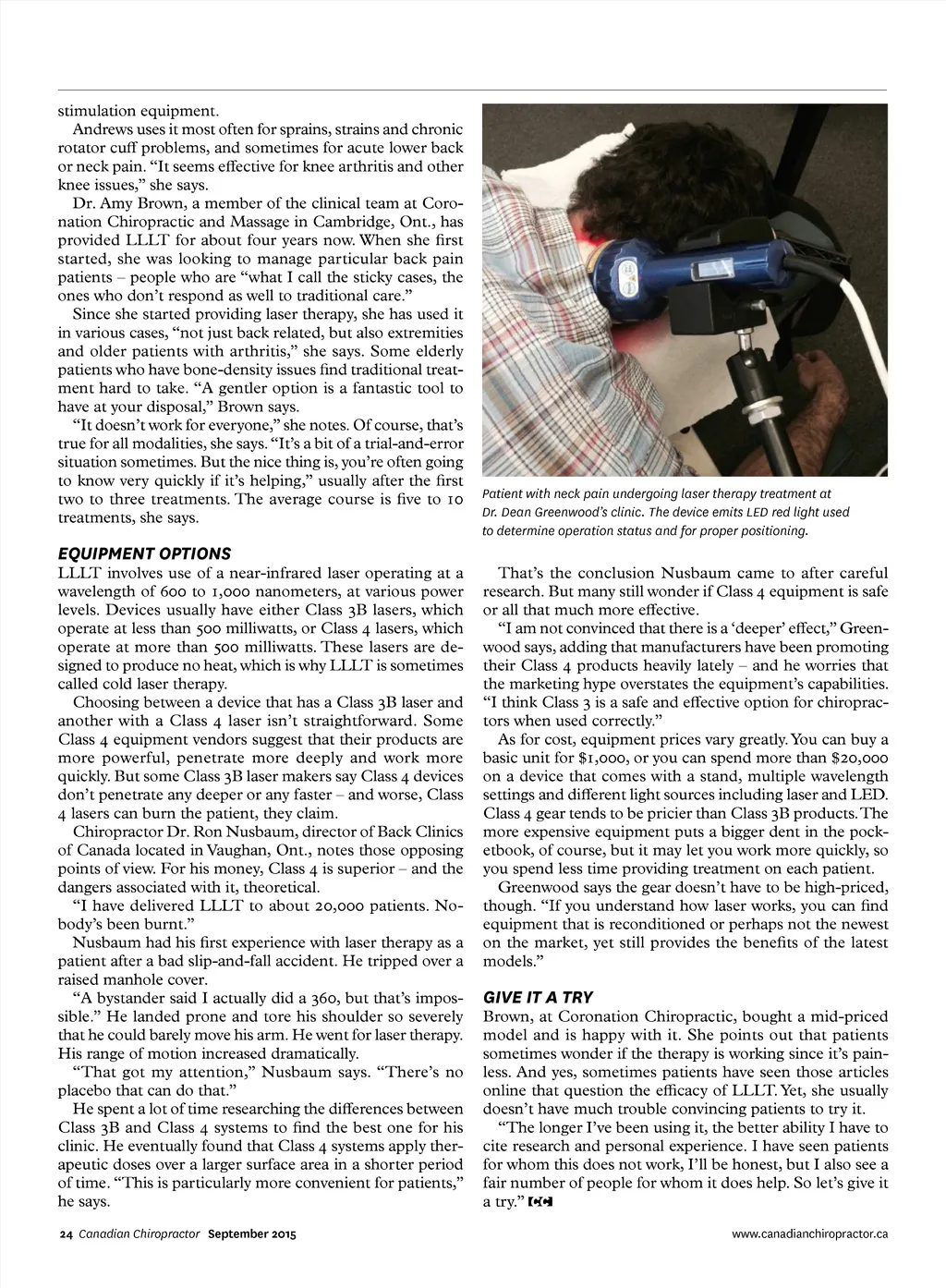
stimulation equipment. Andrews uses it most often for sprains, strains and chronic rotator cuff problems, and sometimes for acute lower back or neck pain. “It seems effective for knee arthritis and other knee issues,” she says. Dr. Amy Brown, a member of the clinical team at Coro-nation Chiropractic and Massage in Cambridge, Ont., has provided LLLT for about four years now. When she first started, she was looking to manage particular back pain patients – people who are “what I call the sticky cases, the ones who don’t respond as well to traditional care.” Since she started providing laser therapy, she has used it in various cases, “not just back related, but also extremities and older patients with arthritis,” she says. Some elderly patients who have bone-density issues find traditional treat-ment hard to take. “A gentler option is a fantastic tool to have at your disposal,” Brown says. “It doesn’t work for everyone,” she notes. Of course, that’s true for all modalities, she says. “It’s a bit of a trial-and-error situation sometimes. But the nice thing is, you’re often going to know very quickly if it’s helping,” usually after the first two to three treatments. The average course is five to 10 treatments, she says. Patient with neck pain undergoing laser therapy treatment at Dr. Dean Greenwood’s clinic. The device emits LED red light used to determine operation status and for proper positioning. EQUIPMENT OPTIONS LLLT involves use of a near-infrared laser operating at a wavelength of 600 to 1,000 nanometers, at various power levels. Devices usually have either Class 3B lasers, which operate at less than 500 milliwatts, or Class 4 lasers, which operate at more than 500 milliwatts. These lasers are de-signed to produce no heat, which is why LLLT is sometimes called cold laser therapy. Choosing between a device that has a Class 3B laser and another with a Class 4 laser isn’t straightforward. Some Class 4 equipment vendors suggest that their products are more powerful, penetrate more deeply and work more quickly. But some Class 3B laser makers say Class 4 devices don’t penetrate any deeper or any faster – and worse, Class 4 lasers can burn the patient, they claim. Chiropractor Dr. Ron Nusbaum, director of Back Clinics of Canada located in Vaughan, Ont., notes those opposing points of view. For his money, Class 4 is superior – and the dangers associated with it, theoretical. “I have delivered LLLT to about 20,000 patients. No-body’s been burnt.” Nusbaum had his first experience with laser therapy as a patient after a bad slip-and-fall accident. He tripped over a raised manhole cover. “A bystander said I actually did a 360, but that’s impos-sible.” He landed prone and tore his shoulder so severely that he could barely move his arm. He went for laser therapy. His range of motion increased dramatically. “That got my attention,” Nusbaum says. “There’s no placebo that can do that.” He spent a lot of time researching the differences between Class 3B and Class 4 systems to find the best one for his clinic. He eventually found that Class 4 systems apply ther-apeutic doses over a larger surface area in a shorter period of time. “This is particularly more convenient for patients,” he says. 24 Canadian Chiropractor September 2015 That’s the conclusion Nusbaum came to after careful research. But many still wonder if Class 4 equipment is safe or all that much more effective. “I am not convinced that there is a ‘deeper’ effect,” Green-wood says, adding that manufacturers have been promoting their Class 4 products heavily lately – and he worries that the marketing hype overstates the equipment’s capabilities. “I think Class 3 is a safe and effective option for chiroprac-tors when used correctly.” As for cost, equipment prices vary greatly. You can buy a basic unit for $1,000, or you can spend more than $20,000 on a device that comes with a stand, multiple wavelength settings and different light sources including laser and LED. Class 4 gear tends to be pricier than Class 3B products. The more expensive equipment puts a bigger dent in the pock-etbook, of course, but it may let you work more quickly, so you spend less time providing treatment on each patient. Greenwood says the gear doesn’t have to be high-priced, though. “If you understand how laser works, you can find equipment that is reconditioned or perhaps not the newest on the market, yet still provides the benefits of the latest models.” GIVE IT A TRY Brown, at Coronation Chiropractic, bought a mid-priced model and is happy with it. She points out that patients sometimes wonder if the therapy is working since it’s pain-less. And yes, sometimes patients have seen those articles online that question the efficacy of LLLT. Yet, she usually doesn’t have much trouble convincing patients to try it. “The longer I’ve been using it, the better ability I have to cite research and personal experience. I have seen patients for whom this does not work, I’ll be honest, but I also see a fair number of people for whom it does help. So let’s give it a try.” www.canadianchiropractor.ca
Chiropractic + Naturopathic Doctor September 2015: Page 24