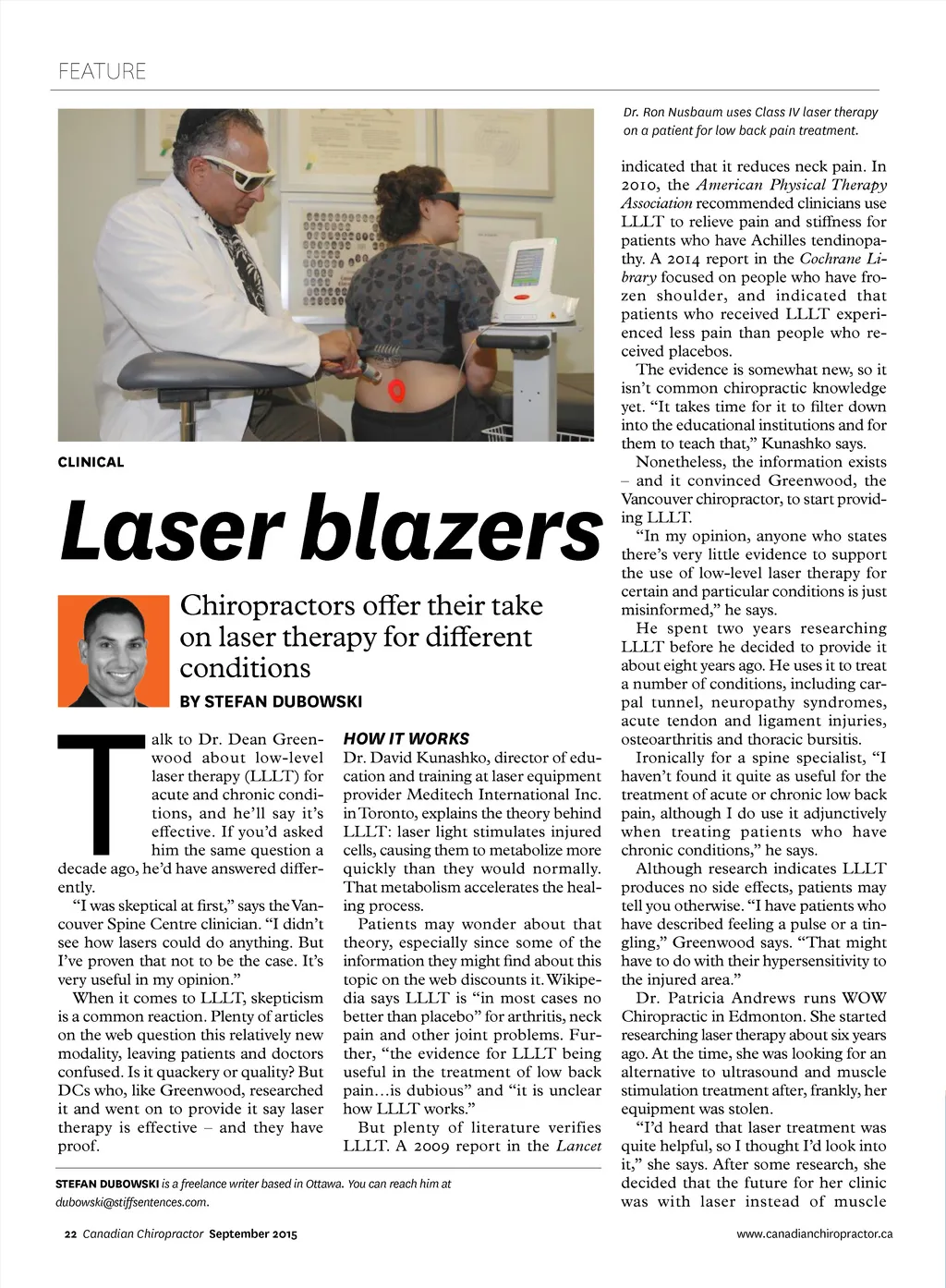
FEATURE Dr. Ron Nusbaum uses Class IV laser therapy on a patient for low back pain treatment. CLINICAL Laser blazers T Chiropractors offer their take on laser therapy for different conditions BY STEFAN DUBOWSKI HOW IT WORKS Dr. David Kunashko, director of edu-cation and training at laser equipment provider Meditech International Inc. in Toronto, explains the theory behind LLLT: laser light stimulates injured cells, causing them to metabolize more quickly than they would normally. That metabolism accelerates the heal-ing process. Patients may wonder about that theory, especially since some of the information they might find about this topic on the web discounts it. Wikipe-dia says LLLT is “in most cases no better than placebo” for arthritis, neck pain and other joint problems. Fur-ther, “the evidence for LLLT being useful in the treatment of low back pain…is dubious” and “it is unclear how LLLT works.” But plenty of literature verifies LLLT. A 2009 report in the Lancet alk to Dr. Dean Green-wood about low-level laser therapy (LLLT) for acute and chronic condi-tions, and he’ll say it’s effective. If you’d asked him the same question a decade ago, he’d have answered differ-ently. “I was skeptical at first,” says the Van-couver Spine Centre clinician. “I didn’t see how lasers could do anything. But I’ve proven that not to be the case. It’s very useful in my opinion.” When it comes to LLLT, skepticism is a common reaction. Plenty of articles on the web question this relatively new modality, leaving patients and doctors confused. Is it quackery or quality? But DCs who, like Greenwood, researched it and went on to provide it say laser therapy is effective – and they have proof. STEFAN DUBOWSKI is a freelance writer based in Ottawa. You can reach him at [email protected]. 22 Canadian Chiropractor September 2015 indicated that it reduces neck pain. In 2010, the American Physical Therapy Association recommended clinicians use LLLT to relieve pain and stiffness for patients who have Achilles tendinopa-thy. A 2014 report in the Cochrane Li-brary focused on people who have fro-zen shoulder, and indicated that patients who received LLLT experi-enced less pain than people who re-ceived placebos. The evidence is somewhat new, so it isn’t common chiropractic knowledge yet. “It takes time for it to filter down into the educational institutions and for them to teach that,” Kunashko says. Nonetheless, the information exists – and it convinced Greenwood, the Vancouver chiropractor, to start provid-ing LLLT. “In my opinion, anyone who states there’s very little evidence to support the use of low-level laser therapy for certain and particular conditions is just misinformed,” he says. He spent two years researching LLLT before he decided to provide it about eight years ago. He uses it to treat a number of conditions, including car-pal tunnel, neuropathy syndromes, acute tendon and ligament injuries, osteoarthritis and thoracic bursitis. Ironically for a spine specialist, “I haven’t found it quite as useful for the treatment of acute or chronic low back pain, although I do use it adjunctively when treating patients who have chronic conditions,” he says. Although research indicates LLLT produces no side effects, patients may tell you otherwise. “I have patients who have described feeling a pulse or a tin-gling,” Greenwood says. “That might have to do with their hypersensitivity to the injured area.” Dr. Patricia Andrews runs WOW Chiropractic in Edmonton. She started researching laser therapy about six years ago. At the time, she was looking for an alternative to ultrasound and muscle stimulation treatment after, frankly, her equipment was stolen. “I’d heard that laser treatment was quite helpful, so I thought I’d look into it,” she says. After some research, she decided that the future for her clinic was with laser instead of muscle www.canadianchiropractor.ca
Chiropractic + Naturopathic Doctor September 2015: Page 22