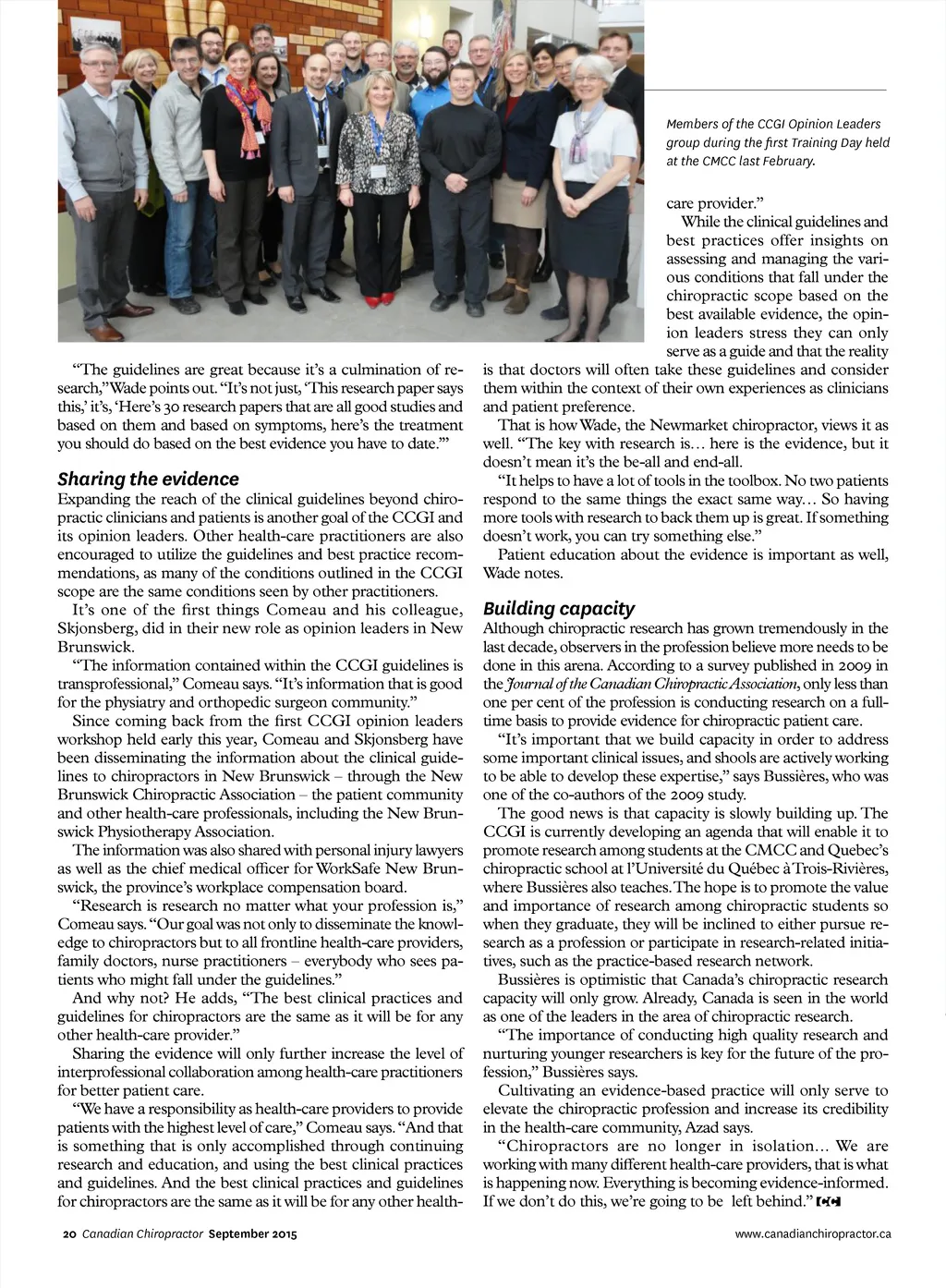
Members of the CCGI Opinion Leaders group during the first Training Day held at the CMCC last February. “The guidelines are great because it’s a culmination of re-search,” Wade points out. “It’s not just, ‘This research paper says this,’ it’s, ‘Here’s 30 research papers that are all good studies and based on them and based on symptoms, here’s the treatment you should do based on the best evidence you have to date.’” Sharing the evidence Expanding the reach of the clinical guidelines beyond chiro-practic clinicians and patients is another goal of the CCGI and its opinion leaders. Other health-care practitioners are also encouraged to utilize the guidelines and best practice recom-mendations, as many of the conditions outlined in the CCGI scope are the same conditions seen by other practitioners. It’s one of the first things Comeau and his colleague, Skjonsberg, did in their new role as opinion leaders in New Brunswick. “The information contained within the CCGI guidelines is transprofessional,” Comeau says. “It’s information that is good for the physiatry and orthopedic surgeon community.” Since coming back from the first CCGI opinion leaders workshop held early this year, Comeau and Skjonsberg have been disseminating the information about the clinical guide-lines to chiropractors in New Brunswick – through the New Brunswick Chiropractic Association – the patient community and other health-care professionals, including the New Brun-swick Physiotherapy Association. The information was also shared with personal injury lawyers as well as the chief medical officer for WorkSafe New Brun-swick, the province’s workplace compensation board. “Research is research no matter what your profession is,” Comeau says. “Our goal was not only to disseminate the knowl-edge to chiropractors but to all frontline health-care providers, family doctors, nurse practitioners – everybody who sees pa-tients who might fall under the guidelines.” And why not? He adds, “The best clinical practices and guidelines for chiropractors are the same as it will be for any other health-care provider.” Sharing the evidence will only further increase the level of interprofessional collaboration among health-care practitioners for better patient care. “We have a responsibility as health-care providers to provide patients with the highest level of care,” Comeau says. “And that is something that is only accomplished through continuing research and education, and using the best clinical practices and guidelines. And the best clinical practices and guidelines for chiropractors are the same as it will be for any other health-20 Canadian Chiropractor September 2015 care provider.” While the clinical guidelines and best practices offer insights on assessing and managing the vari-ous conditions that fall under the chiropractic scope based on the best available evidence, the opin-ion leaders stress they can only serve as a guide and that the reality is that doctors will often take these guidelines and consider them within the context of their own experiences as clinicians and patient preference. That is how Wade, the Newmarket chiropractor, views it as well. “The key with research is… here is the evidence, but it doesn’t mean it’s the be-all and end-all. “It helps to have a lot of tools in the toolbox. No two patients respond to the same things the exact same way… So having more tools with research to back them up is great. If something doesn’t work, you can try something else.” Patient education about the evidence is important as well, Wade notes. Building capacity Although chiropractic research has grown tremendously in the last decade, observers in the profession believe more needs to be done in this arena. According to a survey published in 2009 in the Journal of the Canadian Chiropractic Association , only less than one per cent of the profession is conducting research on a full-time basis to provide evidence for chiropractic patient care. “It’s important that we build capacity in order to address some important clinical issues, and shools are actively working to be able to develop these expertise,” says Bussières, who was one of the co-authors of the 2009 study. The good news is that capacity is slowly building up. The CCGI is currently developing an agenda that will enable it to promote research among students at the CMCC and Quebec’s chiropractic school at l’Université du Québec à Trois-Rivières, where Bussières also teaches. The hope is to promote the value and importance of research among chiropractic students so when they graduate, they will be inclined to either pursue re-search as a profession or participate in research-related initia-tives, such as the practice-based research network. Bussières is optimistic that Canada’s chiropractic research capacity will only grow. Already, Canada is seen in the world as one of the leaders in the area of chiropractic research. “The importance of conducting high quality research and nurturing younger researchers is key for the future of the pro-fession,” Bussières says. Cultivating an evidence-based practice will only serve to elevate the chiropractic profession and increase its credibility in the health-care community, Azad says. “Chiropractors are no longer in isolation... We are working with many different health-care providers, that is what is happening now. Everything is becoming evidence-informed. If we don’t do this, we’re going to be left behind.” www.canadianchiropractor.ca
Chiropractic + Naturopathic Doctor September 2015: Page 20