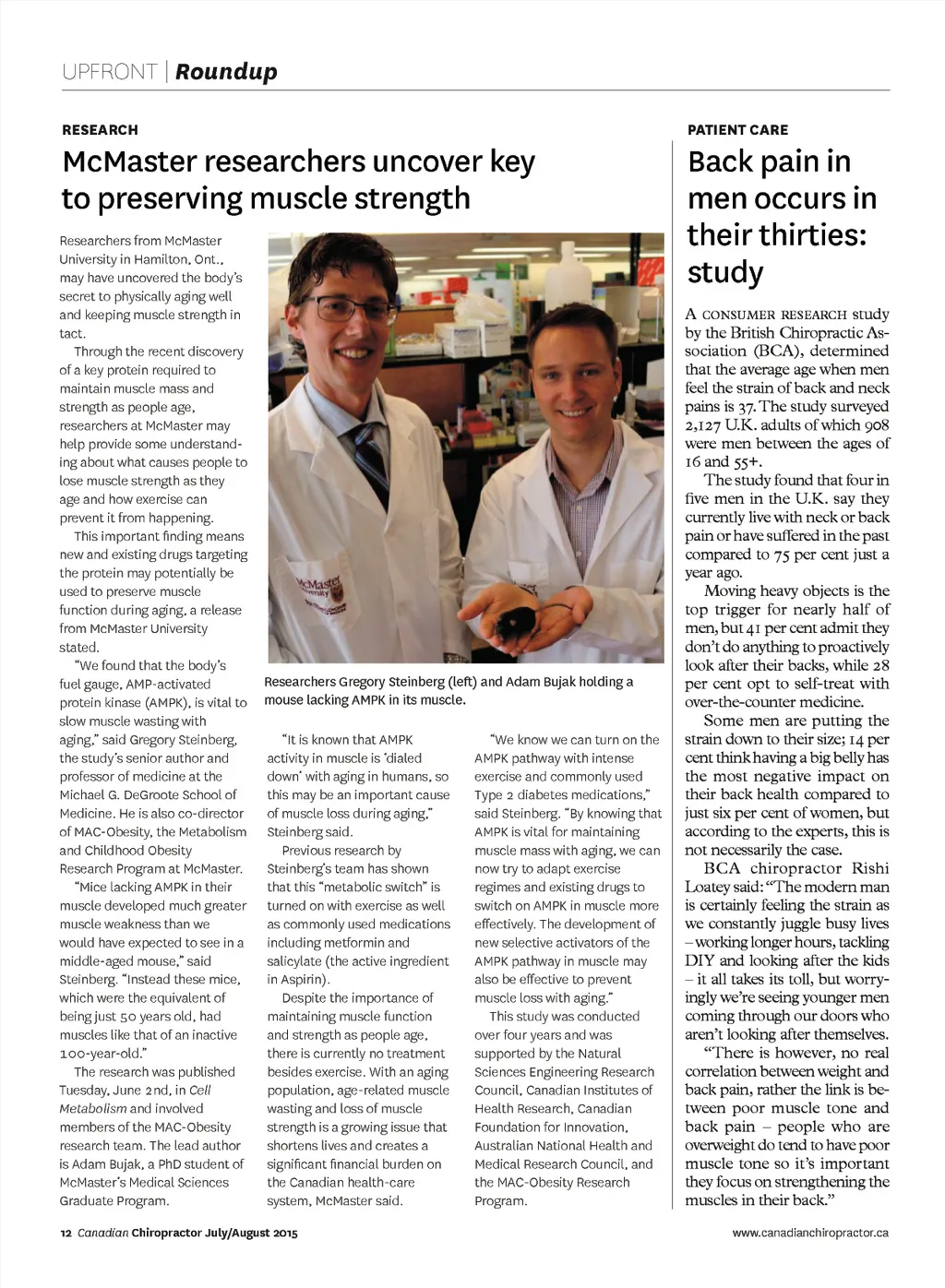
UPFRONT | Roundup RESEARCH McMaster researchers uncover key to preserving muscle strength Researchers from McMaster University in Hamilton, Ont., may have uncovered the body’s secret to physically aging well and keeping muscle strength in tact. Through the recent discovery of a key protein required to maintain muscle mass and strength as people age, researchers at McMaster may help provide some understand-ing about what causes people to lose muscle strength as they age and how exercise can prevent it from happening. This important finding means new and existing drugs targeting the protein may potentially be used to preserve muscle function during aging, a release from McMaster University stated. “We found that the body’s fuel gauge, AMP-activated protein kinase (AMPK), is vital to slow muscle wasting with aging,” said Gregory Steinberg, the study’s senior author and professor of medicine at the Michael G. DeGroote School of Medicine. He is also co-director of MAC-Obesity, the Metabolism and Childhood Obesity Research Program at McMaster. “Mice lacking AMPK in their muscle developed much greater muscle weakness than we would have expected to see in a middle-aged mouse,” said Steinberg. “Instead these mice, which were the equivalent of being just 50 years old, had muscles like that of an inactive 100-year-old.” The research was published Tuesday, June 2nd, in Cell Metabolism and involved members of the MAC-Obesity research team. The lead author is Adam Bujak, a PhD student of McMaster’s Medical Sciences Graduate Program. PATIENT CARE Back pain in men occurs in their thirties: study A consumer research study by the British Chiropractic As-sociation (BCA), determined that the average age when men feel the strain of back and neck pains is 37. The study surveyed 2,127 U.K. adults of which 908 were men between the ages of 16 and 55+. The study found that four in five men in the U.K. say they currently live with neck or back pain or have suffered in the past compared to 75 per cent just a year ago. Moving heavy objects is the top trigger for nearly half of men, but 41 per cent admit they don’t do anything to proactively look after their backs, while 28 per cent opt to self-treat with over-the-counter medicine. Some men are putting the strain down to their size; 14 per cent think having a big belly has the most negative impact on their back health compared to just six per cent of women, but according to the experts, this is not necessarily the case. BCA chiropractor Rishi Loatey said: “The modern man is certainly feeling the strain as we constantly juggle busy lives – working longer hours, tackling DIY and looking after the kids – it all takes its toll, but worry-ingly we’re seeing younger men coming through our doors who aren’t looking after themselves. “There is however, no real correlation between weight and back pain, rather the link is be-tween poor muscle tone and back pain – people who are overweight do tend to have poor muscle tone so it’s important they focus on strengthening the muscles in their back.” www.canadianchiropractor.ca Researchers Gregory Steinberg (left) and Adam Bujak holding a mouse lacking AMPK in its muscle. “It is known that AMPK activity in muscle is ‘dialed down’ with aging in humans, so this may be an important cause of muscle loss during aging,” Steinberg said. Previous research by Steinberg’s team has shown that this “metabolic switch” is turned on with exercise as well as commonly used medications including metformin and salicylate (the active ingredient in Aspirin). Despite the importance of maintaining muscle function and strength as people age, there is currently no treatment besides exercise. With an aging population, age-related muscle wasting and loss of muscle strength is a growing issue that shortens lives and creates a significant financial burden on the Canadian health-care system, McMaster said. “We know we can turn on the AMPK pathway with intense exercise and commonly used Type 2 diabetes medications,” said Steinberg. “By knowing that AMPK is vital for maintaining muscle mass with aging, we can now try to adapt exercise regimes and existing drugs to switch on AMPK in muscle more effectively. The development of new selective activators of the AMPK pathway in muscle may also be effective to prevent muscle loss with aging.” This study was conducted over four years and was supported by the Natural Sciences Engineering Research Council, Canadian Institutes of Health Research, Canadian Foundation for Innovation, Australian National Health and Medical Research Council, and the MAC-Obesity Research Program. 12 Canadian Chiropractor July/August 2015
Chiropractic + Naturopathic Doctor July August 2015: Page 12