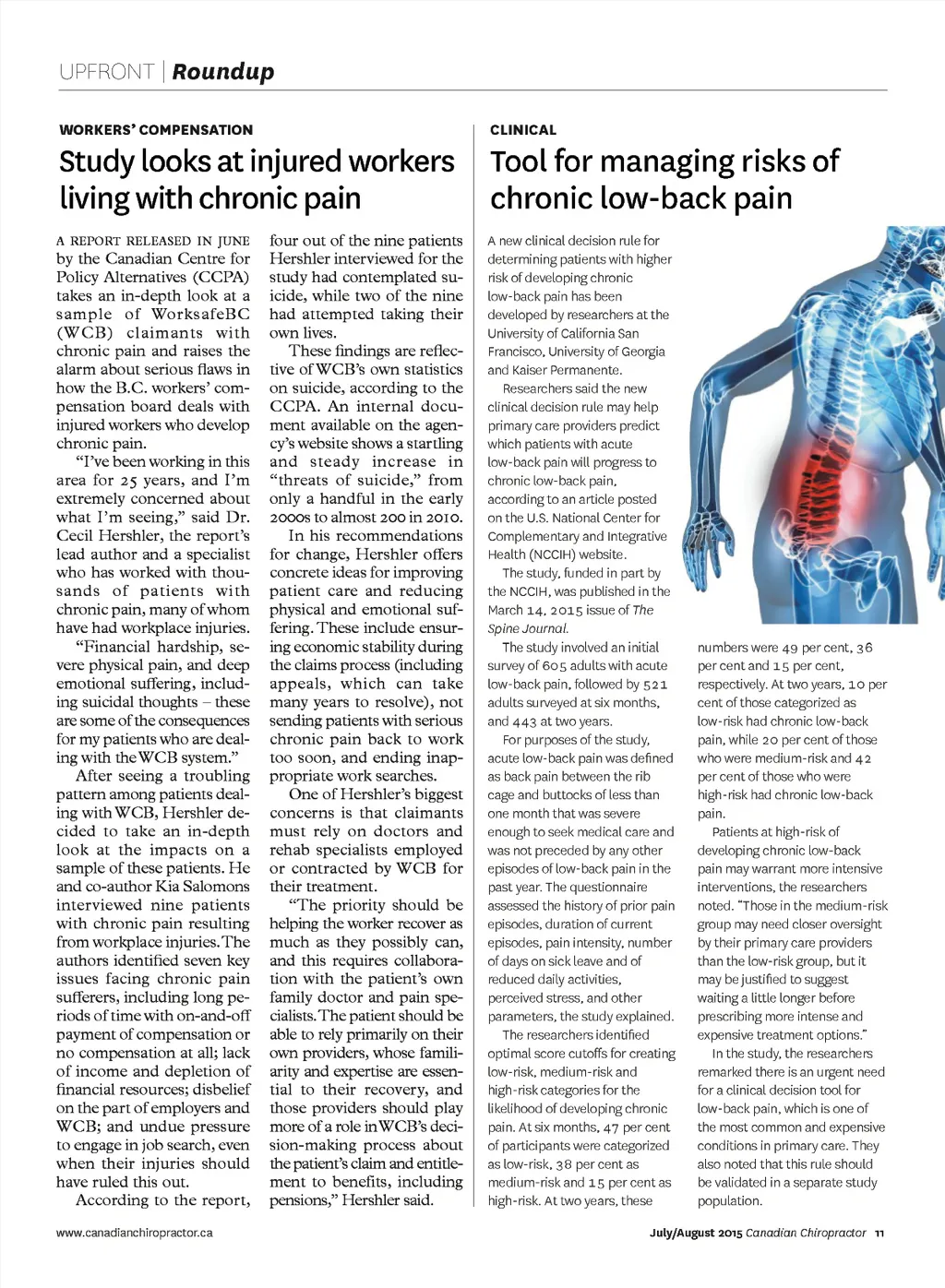
UPFRONT | Roundup WORKERS’ COMPENSATION Study looks at injured workers living with chronic pain a report released in june by the Canadian Centre for Policy Alternatives (CCPA) takes an in-depth look at a sample of WorksafeBC (WCB) claimants with chronic pain and raises the alarm about serious flaws in how the B.C. workers’ com-pensation board deals with injured workers who develop chronic pain. “I’ve been working in this area for 25 years, and I’m extremely concerned about what I’m seeing,” said Dr. Cecil Hershler, the report’s lead author and a specialist who has worked with thou-sands of patients with chronic pain, many of whom have had workplace injuries. “Financial hardship, se-vere physical pain, and deep emotional suffering, includ-ing suicidal thoughts – these are some of the consequences for my patients who are deal-ing with the WCB system.” After seeing a troubling pattern among patients deal-ing with WCB, Hershler de-cided to take an in-depth look at the impacts on a sample of these patients. He and co-author Kia Salomons interviewed nine patients with chronic pain resulting from workplace injuries. The authors identified seven key issues facing chronic pain sufferers, including long pe-riods of time with on-and-off payment of compensation or no compensation at all; lack of income and depletion of financial resources; disbelief on the part of employers and WCB; and undue pressure to engage in job search, even when their injuries should have ruled this out. According to the report, www.canadianchiropractor.ca CLINICAL Tool for managing risks of chronic low-back pain A new clinical decision rule for determining patients with higher risk of developing chronic low-back pain has been developed by researchers at the University of California San Francisco, University of Georgia and Kaiser Permanente. Researchers said the new clinical decision rule may help primary care providers predict which patients with acute low-back pain will progress to chronic low-back pain, according to an article posted on the U.S. National Center for Complementary and Integrative Health (NCCIH) website. The study, funded in part by the NCCIH, was published in the March 14, 2015 issue of The Spine Journal. The study involved an initial survey of 605 adults with acute low-back pain, followed by 521 adults surveyed at six months, and 443 at two years. For purposes of the study, acute low-back pain was defined as back pain between the rib cage and buttocks of less than one month that was severe enough to seek medical care and was not preceded by any other episodes of low-back pain in the past year. The questionnaire assessed the history of prior pain episodes, duration of current episodes, pain intensity, number of days on sick leave and of reduced daily activities, perceived stress, and other parameters, the study explained. The researchers identified optimal score cutoffs for creating low-risk, medium-risk and high-risk categories for the likelihood of developing chronic pain. At six months, 47 per cent of participants were categorized as low-risk, 38 per cent as medium-risk and 15 per cent as high-risk. At two years, these four out of the nine patients Hershler interviewed for the study had contemplated su-icide, while two of the nine had attempted taking their own lives. These findings are reflec-tive of WCB’s own statistics on suicide, according to the CCPA. An internal docu-ment available on the agen-cy’s website shows a startling and steady increase in “threats of suicide,” from only a handful in the early 2000s to almost 200 in 2010. In his recommendations for change, Hershler offers concrete ideas for improving patient care and reducing physical and emotional suf-fering. These include ensur-ing economic stability during the claims process (including appeals, which can take many years to resolve), not sending patients with serious chronic pain back to work too soon, and ending inap-propriate work searches. One of Hershler’s biggest concerns is that claimants must rely on doctors and rehab specialists employed or contracted by WCB for their treatment. “The priority should be helping the worker recover as much as they possibly can, and this requires collabora-tion with the patient’s own family doctor and pain spe-cialists. The patient should be able to rely primarily on their own providers, whose famili-arity and expertise are essen-tial to their recovery, and those providers should play more of a role in WCB’s deci-sion-making process about the patient’s claim and entitle-ment to benefits, including pensions,” Hershler said. numbers were 49 per cent, 36 per cent and 15 per cent, respectively. At two years, 10 per cent of those categorized as low-risk had chronic low-back pain, while 20 per cent of those who were medium-risk and 42 per cent of those who were high-risk had chronic low-back pain. Patients at high-risk of developing chronic low-back pain may warrant more intensive interventions, the researchers noted. “Those in the medium-risk group may need closer oversight by their primary care providers than the low-risk group, but it may be justified to suggest waiting a little longer before prescribing more intense and expensive treatment options.” In the study, the researchers remarked there is an urgent need for a clinical decision tool for low-back pain, which is one of the most common and expensive conditions in primary care. They also noted that this rule should be validated in a separate study population. July/August 2015 Canadian Chiropractor 11
Chiropractic + Naturopathic Doctor July August 2015: Page 11