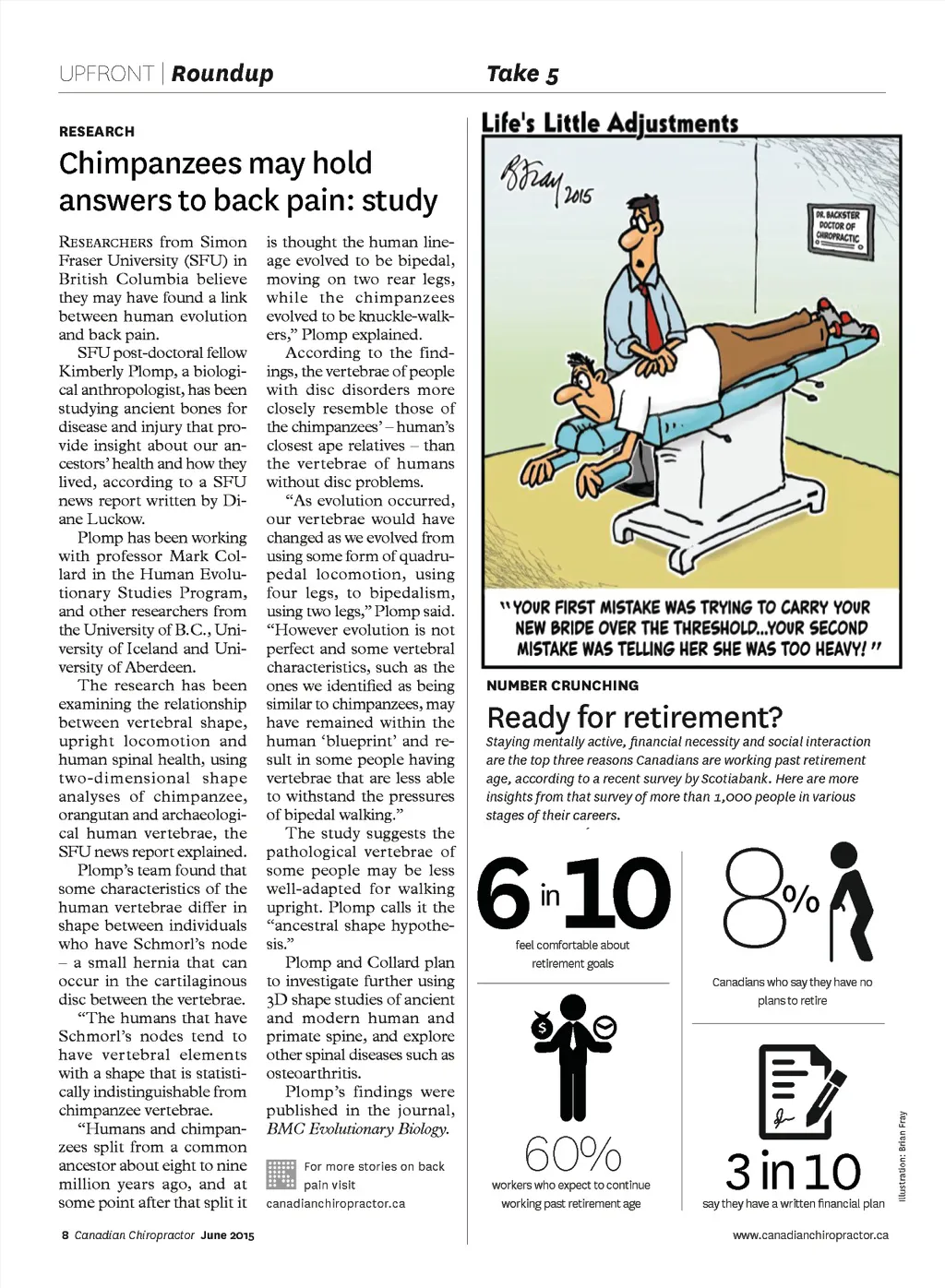
UPFRONT | Roundup RESEARCH Take 5 Chimpanzees may hold answers to back pain: study Researchers from Simon Fraser University (SFU) in British Columbia believe they may have found a link between human evolution and back pain. SFU post-doctoral fellow Kimberly Plomp, a biologi-cal anthropologist, has been studying ancient bones for disease and injury that pro-vide insight about our an-cestors’ health and how they lived, according to a SFU news report written by Di-ane Luckow. Plomp has been working with professor Mark Col-lard in the Human Evolu-tionary Studies Program, and other researchers from the University of B.C., Uni-versity of Iceland and Uni-versity of Aberdeen. The research has been examining the relationship between vertebral shape, upright locomotion and human spinal health, using two-dimensional shape analyses of chimpanzee, orangutan and archaeologi-cal human vertebrae, the SFU news report explained. Plomp’s team found that some characteristics of the human vertebrae differ in shape between individuals who have Schmorl’s node – a small hernia that can occur in the cartilaginous disc between the vertebrae. “The humans that have Schmorl’s nodes tend to have vertebral elements with a shape that is statisti-cally indistinguishable from chimpanzee vertebrae. “Humans and chimpan-zees split from a common ancestor about eight to nine million years ago, and at some point after that split it 8 Canadian Chiropractor June 2015 For more stories on back pain visit canadianchiropractor.ca workers who expect to continue working past retirement age 60% say they have a written financial plan www.canadianchiropractor.ca 3 in 10 Illustration: Brian Fray is thought the human line-age evolved to be bipedal, moving on two rear legs, while the chimpanzees evolved to be knuckle-walk-ers,” Plomp explained. According to the find-ings, the vertebrae of people with disc disorders more closely resemble those of the chimpanzees’ – human’s closest ape relatives – than the vertebrae of humans without disc problems. “As evolution occurred, our vertebrae would have changed as we evolved from using some form of quadru-pedal locomotion, using four legs, to bipedalism, using two legs,” Plomp said. “However evolution is not perfect and some vertebral characteristics, such as the ones we identified as being similar to chimpanzees, may have remained within the human ‘blueprint’ and re-sult in some people having vertebrae that are less able to withstand the pressures of bipedal walking.” The study suggests the pathological vertebrae of some people may be less well-adapted for walking upright. Plomp calls it the “ancestral shape hypothe-sis.” Plomp and Collard plan to investigate further using 3D shape studies of ancient and modern human and primate spine, and explore other spinal diseases such as osteoarthritis. Plomp’s findings were published in the journal, BMC Evolutionary Biology. NUMBER CRUNCHING Ready for retirement? 6 10 8 in feel comfortable about retirement goals Staying mentally active, financial necessity and social interaction are the top three reasons Canadians are working past retirement age, according to a recent survey by Scotiabank. Here are more insights from that survey of more than 1,000 people in various stages of their careers. % Canadians who say they have no plans to retire
Chiropractic + Naturopathic Doctor June 2015: Page 8