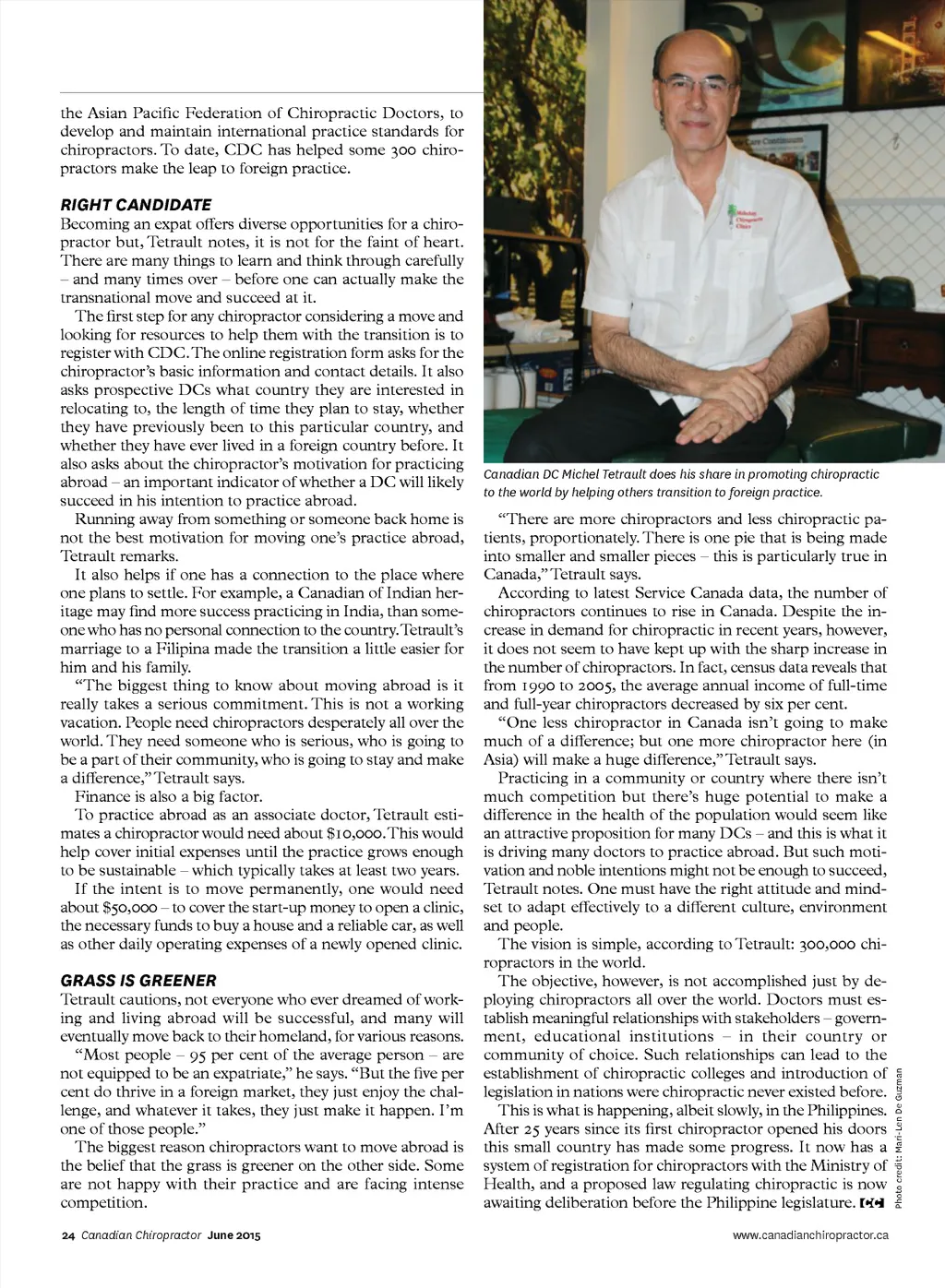
the Asian Pacific Federation of Chiropractic Doctors, to develop and maintain international practice standards for chiropractors. To date, CDC has helped some 300 chiro-practors make the leap to foreign practice. RIGHT CANDIDATE Becoming an expat offers diverse opportunities for a chiro-practor but, Tetrault notes, it is not for the faint of heart. There are many things to learn and think through carefully – and many times over – before one can actually make the transnational move and succeed at it. The first step for any chiropractor considering a move and looking for resources to help them with the transition is to register with CDC. The online registration form asks for the chiropractor’s basic information and contact details. It also asks prospective DCs what country they are interested in relocating to, the length of time they plan to stay, whether they have previously been to this particular country, and whether they have ever lived in a foreign country before. It also asks about the chiropractor’s motivation for practicing abroad – an important indicator of whether a DC will likely succeed in his intention to practice abroad. Running away from something or someone back home is not the best motivation for moving one’s practice abroad, Tetrault remarks. It also helps if one has a connection to the place where one plans to settle. For example, a Canadian of Indian her-itage may find more success practicing in India, than some-one who has no personal connection to the country. Tetrault’s marriage to a Filipina made the transition a little easier for him and his family. “The biggest thing to know about moving abroad is it really takes a serious commitment. This is not a working vacation. People need chiropractors desperately all over the world. They need someone who is serious, who is going to be a part of their community, who is going to stay and make a difference,” Tetrault says. Finance is also a big factor. To practice abroad as an associate doctor, Tetrault esti-mates a chiropractor would need about $10,000. This would help cover initial expenses until the practice grows enough to be sustainable – which typically takes at least two years. If the intent is to move permanently, one would need about $50,000 – to cover the start-up money to open a clinic, the necessary funds to buy a house and a reliable car, as well as other daily operating expenses of a newly opened clinic. Canadian DC Michel Tetrault does his share in promoting chiropractic to the world by helping others transition to foreign practice. GRASS IS GREENER Tetrault cautions, not everyone who ever dreamed of work-ing and living abroad will be successful, and many will eventually move back to their homeland, for various reasons. “Most people – 95 per cent of the average person – are not equipped to be an expatriate,” he says. “But the five per cent do thrive in a foreign market, they just enjoy the chal-lenge, and whatever it takes, they just make it happen. I’m one of those people.” The biggest reason chiropractors want to move abroad is the belief that the grass is greener on the other side. Some are not happy with their practice and are facing intense competition. 24 Canadian Chiropractor June 2015 “There are more chiropractors and less chiropractic pa-tients, proportionately. There is one pie that is being made into smaller and smaller pieces – this is particularly true in Canada,” Tetrault says. According to latest Service Canada data, the number of chiropractors continues to rise in Canada. Despite the in-crease in demand for chiropractic in recent years, however, it does not seem to have kept up with the sharp increase in the number of chiropractors. In fact, census data reveals that from 1990 to 2005, the average annual income of full-time and full-year chiropractors decreased by six per cent. “One less chiropractor in Canada isn’t going to make much of a difference; but one more chiropractor here (in Asia) will make a huge difference,” Tetrault says. Practicing in a community or country where there isn’t much competition but there’s huge potential to make a difference in the health of the population would seem like an attractive proposition for many DCs – and this is what it is driving many doctors to practice abroad. But such moti-vation and noble intentions might not be enough to succeed, Tetrault notes. One must have the right attitude and mind-set to adapt effectively to a different culture, environment and people. The vision is simple, according to Tetrault: 300,000 chi-ropractors in the world. The objective, however, is not accomplished just by de-ploying chiropractors all over the world. Doctors must es-tablish meaningful relationships with stakeholders – govern-ment, educational institutions – in their country or community of choice. Such relationships can lead to the establishment of chiropractic colleges and introduction of legislation in nations were chiropractic never existed before. This is what is happening, albeit slowly, in the Philippines. After 25 years since its first chiropractor opened his doors this small country has made some progress. It now has a system of registration for chiropractors with the Ministry of Health, and a proposed law regulating chiropractic is now awaiting deliberation before the Philippine legislature. www.canadianchiropractor.ca Photo credit: Mari-Len De Guzman
Chiropractic + Naturopathic Doctor June 2015: Page 24