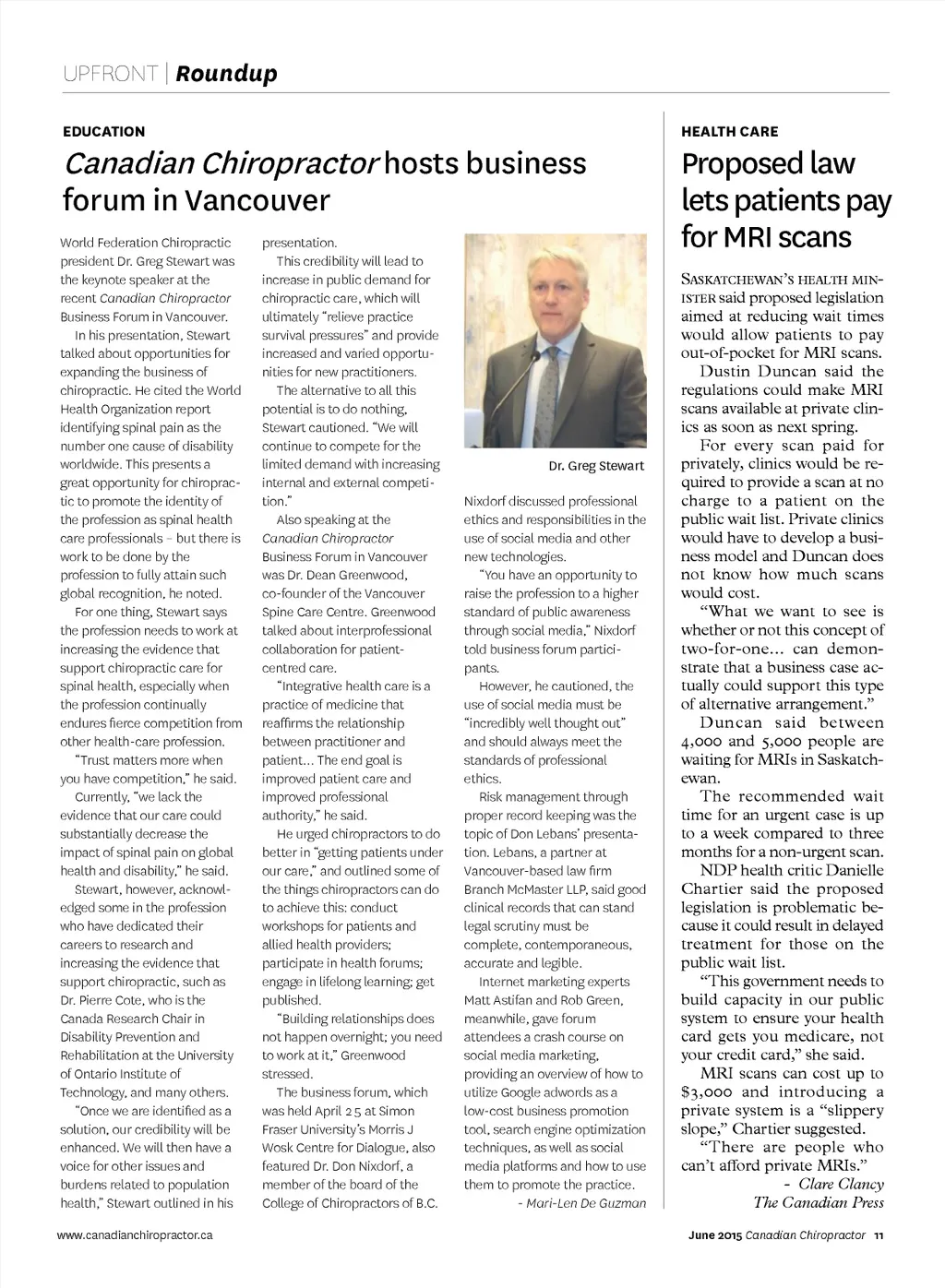
UPFRONT | Roundup Canadian Chiropractor hosts business forum in Vancouver World Federation Chiropractic president Dr. Greg Stewart was the keynote speaker at the recent Canadian Chiropractor Business Forum in Vancouver. In his presentation, Stewart talked about opportunities for expanding the business of chiropractic. He cited the World Health Organization report identifying spinal pain as the number one cause of disability worldwide. This presents a great opportunity for chiroprac-tic to promote the identity of the profession as spinal health care professionals – but there is work to be done by the profession to fully attain such global recognition, he noted. For one thing, Stewart says the profession needs to work at increasing the evidence that support chiropractic care for spinal health, especially when the profession continually endures fierce competition from other health-care profession. “Trust matters more when you have competition,” he said. Currently, “we lack the evidence that our care could substantially decrease the impact of spinal pain on global health and disability,” he said. Stewart, however, acknowl-edged some in the profession who have dedicated their careers to research and increasing the evidence that support chiropractic, such as Dr. Pierre Cote, who is the Canada Research Chair in Disability Prevention and Rehabilitation at the University of Ontario Institute of Technology, and many others. “Once we are identified as a solution, our credibility will be enhanced. We will then have a voice for other issues and burdens related to population health,” Stewart outlined in his www.canadianchiropractor.ca EDUCATION HEALTH CARE presentation. This credibility will lead to increase in public demand for chiropractic care, which will ultimately “relieve practice survival pressures” and provide increased and varied opportu-nities for new practitioners. The alternative to all this potential is to do nothing, Stewart cautioned. “We will continue to compete for the limited demand with increasing internal and external competi-tion.” Also speaking at the Canadian Chiropractor Business Forum in Vancouver was Dr. Dean Greenwood, co-founder of the Vancouver Spine Care Centre. Greenwood talked about interprofessional collaboration for patient-centred care. “Integrative health care is a practice of medicine that reaffirms the relationship between practitioner and patient… The end goal is improved patient care and improved professional authority,” he said. He urged chiropractors to do better in “getting patients under our care,” and outlined some of the things chiropractors can do to achieve this: conduct workshops for patients and allied health providers; participate in health forums; engage in lifelong learning; get published. “Building relationships does not happen overnight; you need to work at it,” Greenwood stressed. The business forum, which was held April 25 at Simon Fraser University’s Morris J Wosk Centre for Dialogue, also featured Dr. Don Nixdorf, a member of the board of the College of Chiropractors of B.C. Proposed law lets patients pay for MRI scans Saskatchewan’s health min-ister said proposed legislation aimed at reducing wait times would allow patients to pay out-of-pocket for MRI scans. Dustin Duncan said the regulations could make MRI scans available at private clin-ics as soon as next spring. For every scan paid for privately, clinics would be re-quired to provide a scan at no charge to a patient on the public wait list. Private clinics would have to develop a busi-ness model and Duncan does not know how much scans would cost. “What we want to see is whether or not this concept of two-for-one... can demon-strate that a business case ac-tually could support this type of alternative arrangement.” Duncan said between 4,000 and 5,000 people are waiting for MRIs in Saskatch-ewan. The recommended wait time for an urgent case is up to a week compared to three months for a non-urgent scan. NDP health critic Danielle Chartier said the proposed legislation is problematic be-cause it could result in delayed treatment for those on the public wait list. “This government needs to build capacity in our public system to ensure your health card gets you medicare, not your credit card,” she said. MRI scans can cost up to $3,000 and introducing a private system is a “slippery slope,” Chartier suggested. “There are people who can’t afford private MRIs.” -Clare Clancy The Canadian Press June 2015 Canadian Chiropractor 11 Dr. Greg Stewart Nixdorf discussed professional ethics and responsibilities in the use of social media and other new technologies. “You have an opportunity to raise the profession to a higher standard of public awareness through social media,” Nixdorf told business forum partici-pants. However, he cautioned, the use of social media must be “incredibly well thought out” and should always meet the standards of professional ethics. Risk management through proper record keeping was the topic of Don Lebans’ presenta-tion. Lebans, a partner at Vancouver-based law firm Branch McMaster LLP, said good clinical records that can stand legal scrutiny must be complete, contemporaneous, accurate and legible. Internet marketing experts Matt Astifan and Rob Green, meanwhile, gave forum attendees a crash course on social media marketing, providing an overview of how to utilize Google adwords as a low-cost business promotion tool, search engine optimization techniques, as well as social media platforms and how to use them to promote the practice. -Mari-Len De Guzman
Chiropractic + Naturopathic Doctor June 2015: Page 11