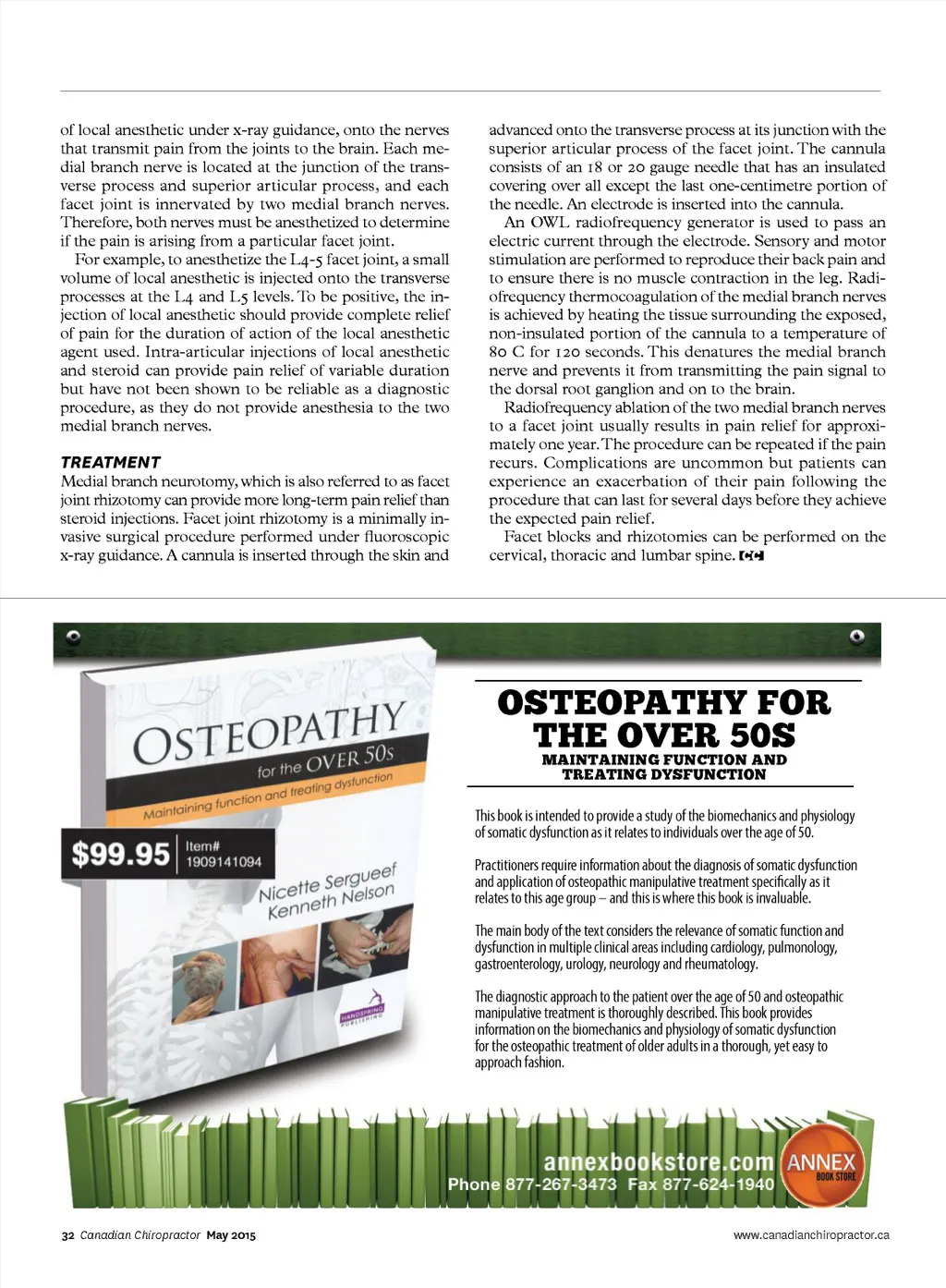
of local anesthetic under x-ray guidance, onto the nerves that transmit pain from the joints to the brain. Each me-dial branch nerve is located at the junction of the trans-verse process and superior articular process, and each facet joint is innervated by two medial branch nerves. Therefore, both nerves must be anesthetized to determine if the pain is arising from a particular facet joint. For example, to anesthetize the L4-5 facet joint, a small volume of local anesthetic is injected onto the transverse processes at the L4 and L5 levels. To be positive, the in-jection of local anesthetic should provide complete relief of pain for the duration of action of the local anesthetic agent used. Intra-articular injections of local anesthetic and steroid can provide pain relief of variable duration but have not been shown to be reliable as a diagnostic procedure, as they do not provide anesthesia to the two medial branch nerves. TREATMENT Medial branch neurotomy, which is also referred to as facet joint rhizotomy can provide more long-term pain relief than steroid injections. Facet joint rhizotomy is a minimally in-vasive surgical procedure performed under fluoroscopic x-ray guidance. A cannula is inserted through the skin and advanced onto the transverse process at its junction with the superior articular process of the facet joint. The cannula consists of an 18 or 20 gauge needle that has an insulated covering over all except the last one-centimetre portion of the needle. An electrode is inserted into the cannula. An OWL radiofrequency generator is used to pass an electric current through the electrode. Sensory and motor stimulation are performed to reproduce their back pain and to ensure there is no muscle contraction in the leg. Radi-ofrequency thermocoagulation of the medial branch nerves is achieved by heating the tissue surrounding the exposed, non-insulated portion of the cannula to a temperature of 80 C for 120 seconds. This denatures the medial branch nerve and prevents it from transmitting the pain signal to the dorsal root ganglion and on to the brain. Radiofrequency ablation of the two medial branch nerves to a facet joint usually results in pain relief for approxi-mately one year. The procedure can be repeated if the pain recurs. Complications are uncommon but patients can experience an exacerbation of their pain following the procedure that can last for several days before they achieve the expected pain relief. Facet blocks and rhizotomies can be performed on the cervical, thoracic and lumbar spine. OSTEOPATHY FOR THE OVER 50S MAINTAINING FUNCTION AND TREATING DYSFUNCTION This book is intended to provide a study of the biomechanics and physiology of somatic dysfunction as it relates to individuals over the age of 50. Practitioners require information about the diagnosis of somatic dysfunction and application of osteopathic manipulative treatment specifically as it relates to this age group – and this is where this book is invaluable. The main body of the text considers the relevance of somatic function and dysfunction in multiple clinical areas including cardiology, pulmonology, gastroenterology, urology, neurology and rheumatology. The diagnostic approach to the patient over the age of 50 and osteopathic manipulative treatment is thoroughly described. This book provides information on the biomechanics and physiology of somatic dysfunction for the osteopathic treatment of older adults in a thorough, yet easy to approach fashion. 32 Canadian Chiropractor May 2015 CHIROBOOKAD copy.indd 1 www.canadianchiropractor.ca 2015-04-07 2:50 PM
Chiropractic + Naturopathic Doctor May 2015: Page 32