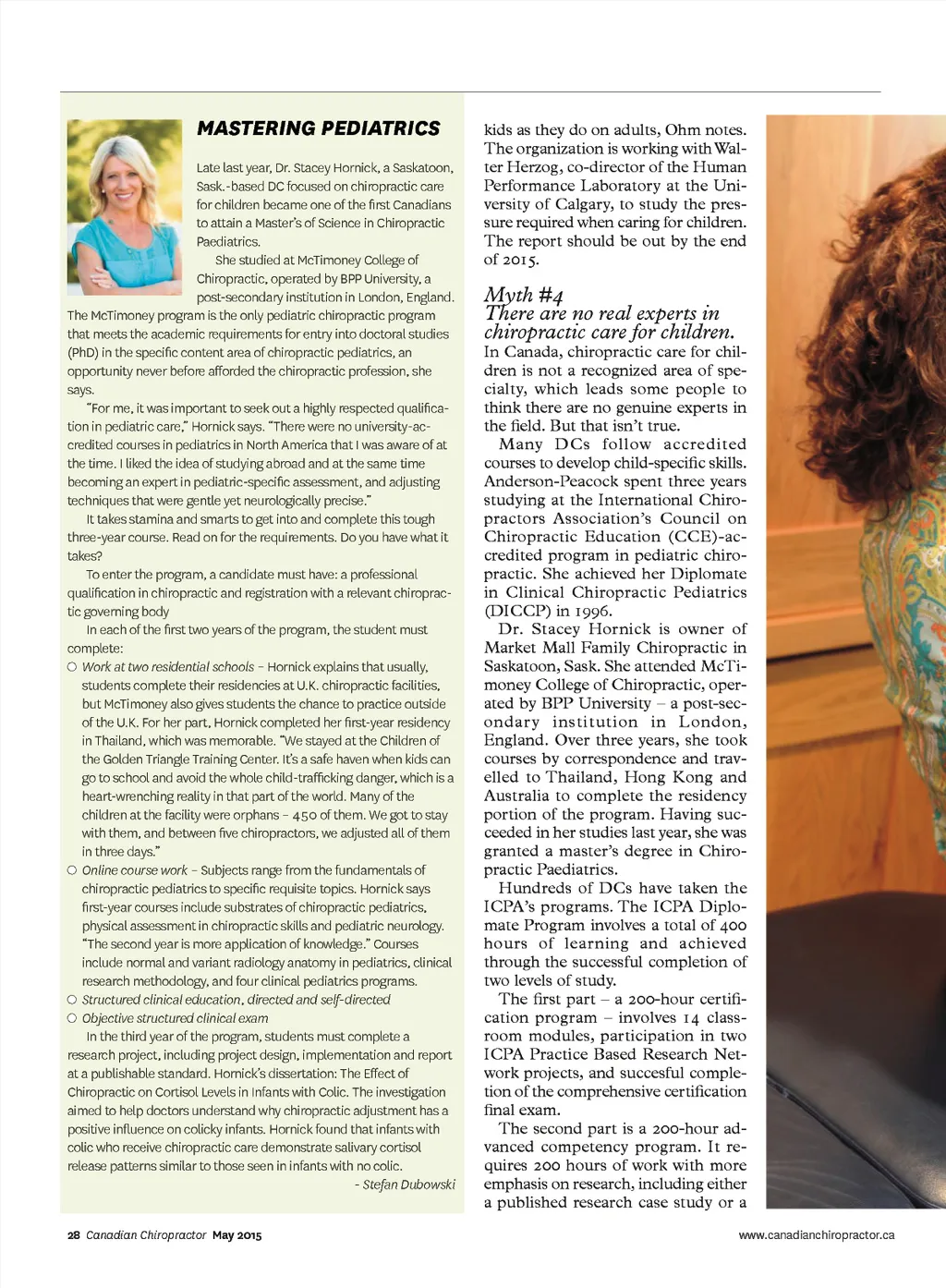
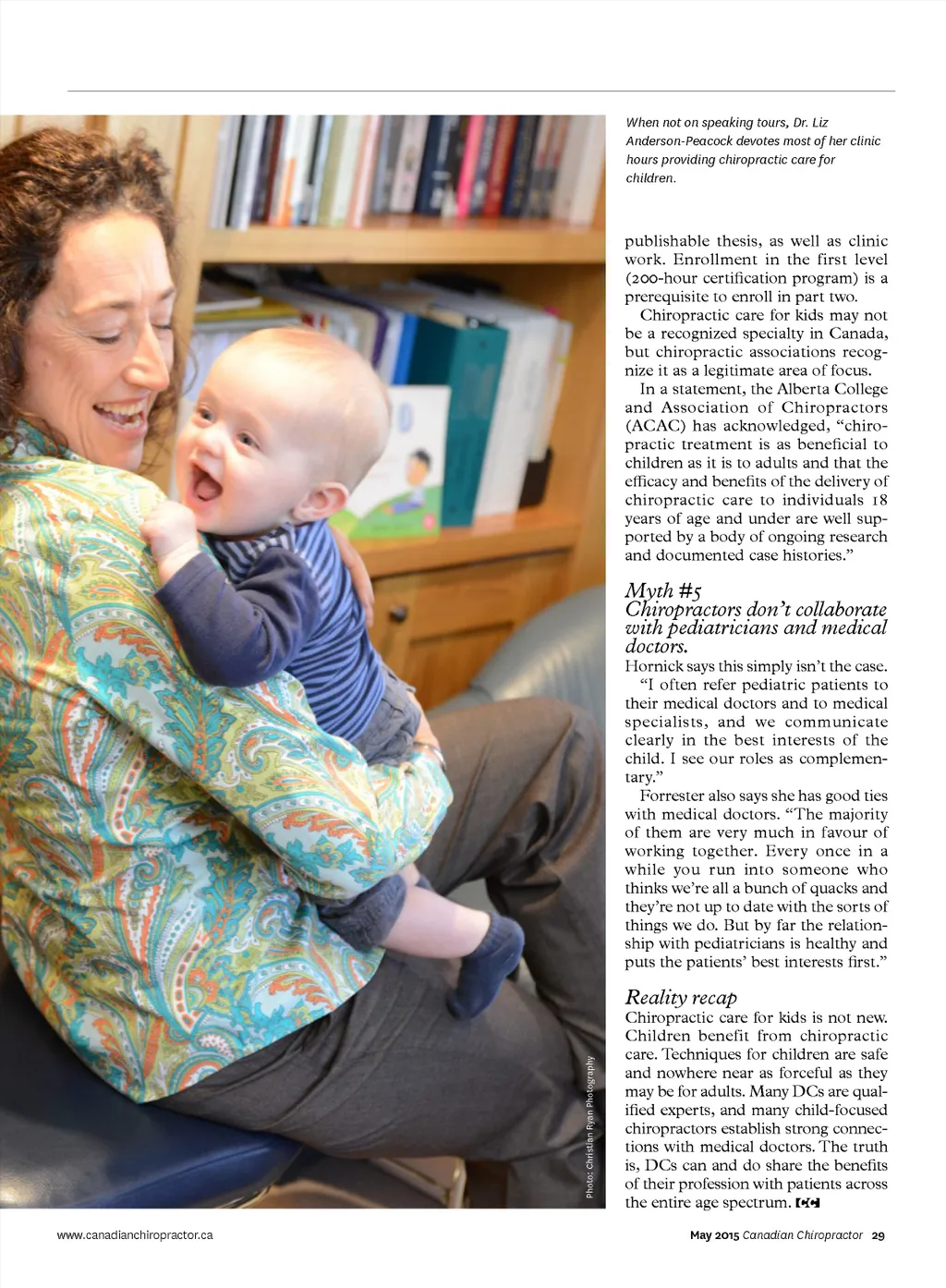
MASTERING PEDIATRICS Late last year, Dr. Stacey Hornick, a Saskatoon, Sask.-based DC focused on chiropractic care for children became one of the first Canadians to attain a Master’s of Science in Chiropractic Paediatrics. She studied at McTimoney College of Chiropractic, operated by BPP University, a post-secondary institution in London, England. The McTimoney program is the only pediatric chiropractic program that meets the academic requirements for entry into doctoral studies (PhD) in the specific content area of chiropractic pediatrics, an opportunity never before afforded the chiropractic profession, she says. “For me, it was important to seek out a highly respected qualifica-tion in pediatric care,” Hornick says. “There were no university-ac-credited courses in pediatrics in North America that I was aware of at the time. I liked the idea of studying abroad and at the same time becoming an expert in pediatric-specific assessment, and adjusting techniques that were gentle yet neurologically precise.” It takes stamina and smarts to get into and complete this tough three-year course. Read on for the requirements. Do you have what it takes? To enter the program, a candidate must have: a professional qualification in chiropractic and registration with a relevant chiroprac-tic governing body In each of the first two years of the program, the student must complete: Work at two residential schools – Hornick explains that usually, students complete their residencies at U.K. chiropractic facilities, but McTimoney also gives students the chance to practice outside of the U.K. For her part, Hornick completed her first-year residency in Thailand, which was memorable. “We stayed at the Children of the Golden Triangle Training Center. It’s a safe haven when kids can go to school and avoid the whole child-trafficking danger, which is a heart-wrenching reality in that part of the world. Many of the children at the facility were orphans – 450 of them. We got to stay with them, and between five chiropractors, we adjusted all of them in three days.” Online course work – Subjects range from the fundamentals of chiropractic pediatrics to specific requisite topics. Hornick says first-year courses include substrates of chiropractic pediatrics, physical assessment in chiropractic skills and pediatric neurology. “The second year is more application of knowledge.” Courses include normal and variant radiology anatomy in pediatrics, clinical research methodology, and four clinical pediatrics programs. Structured clinical education, directed and self-directed Objective structured clinical exam In the third year of the program, students must complete a research project, including project design, implementation and report at a publishable standard. Hornick’s dissertation: The Effect of Chiropractic on Cortisol Levels in Infants with Colic. The investigation aimed to help doctors understand why chiropractic adjustment has a positive influence on colicky infants. Hornick found that infants with colic who receive chiropractic care demonstrate salivary cortisol release patterns similar to those seen in infants with no colic. -Stefan Dubowski 28 Canadian Chiropractor May 2015 kids as they do on adults, Ohm notes. The organization is working with Wal-ter Herzog, co-director of the Human Performance Laboratory at the Uni-versity of Calgary, to study the pres-sure required when caring for children. The report should be out by the end of 2015. In Canada, chiropractic care for chil-dren is not a recognized area of spe-cialty, which leads some people to think there are no genuine experts in the field. But that isn’t true. Many DCs follow accredited courses to develop child-specific skills. Anderson-Peacock spent three years studying at the International Chiro-practors Association’s Council on Chiropractic Education (CCE)-ac-credited program in pediatric chiro-practic. She achieved her Diplomate in Clinical Chiropractic Pediatrics (DICCP) in 1996. Dr. Stacey Hornick is owner of Market Mall Family Chiropractic in Saskatoon, Sask. She attended McTi-money College of Chiropractic, oper-ated by BPP University – a post-sec-ondar y institution in London, England. Over three years, she took courses by correspondence and trav-elled to Thailand, Hong Kong and Australia to complete the residency portion of the program. Having suc-ceeded in her studies last year, she was granted a master’s degree in Chiro-practic Paediatrics. Hundreds of DCs have taken the ICPA’s programs. The ICPA Diplo-mate Program involves a total of 400 hours of learning and achieved through the successful completion of two levels of study. The first part – a 200-hour certifi-cation program – involves 14 class-room modules, participation in two ICPA Practice Based Research Net-work projects, and succesful comple-tion of the comprehensive certification final exam. The second part is a 200-hour ad-vanced competency program. It re-quires 200 hours of work with more emphasis on research, including either a published research case study or a www.canadianchiropractor.ca Myth #4 There are no real experts in chiropractic care for children.
Chiropractic + Naturopathic Doctor May 2015: Page 28