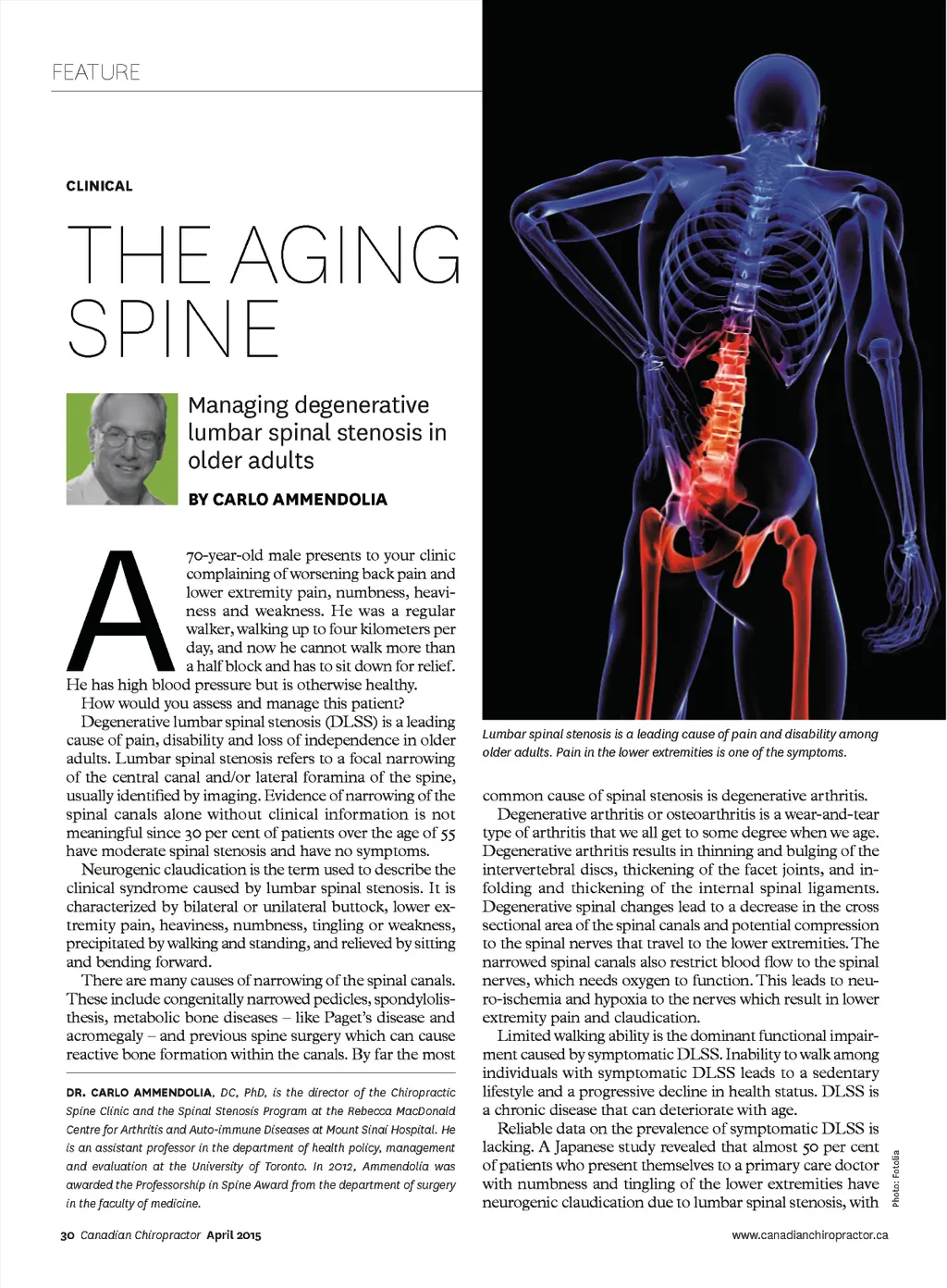
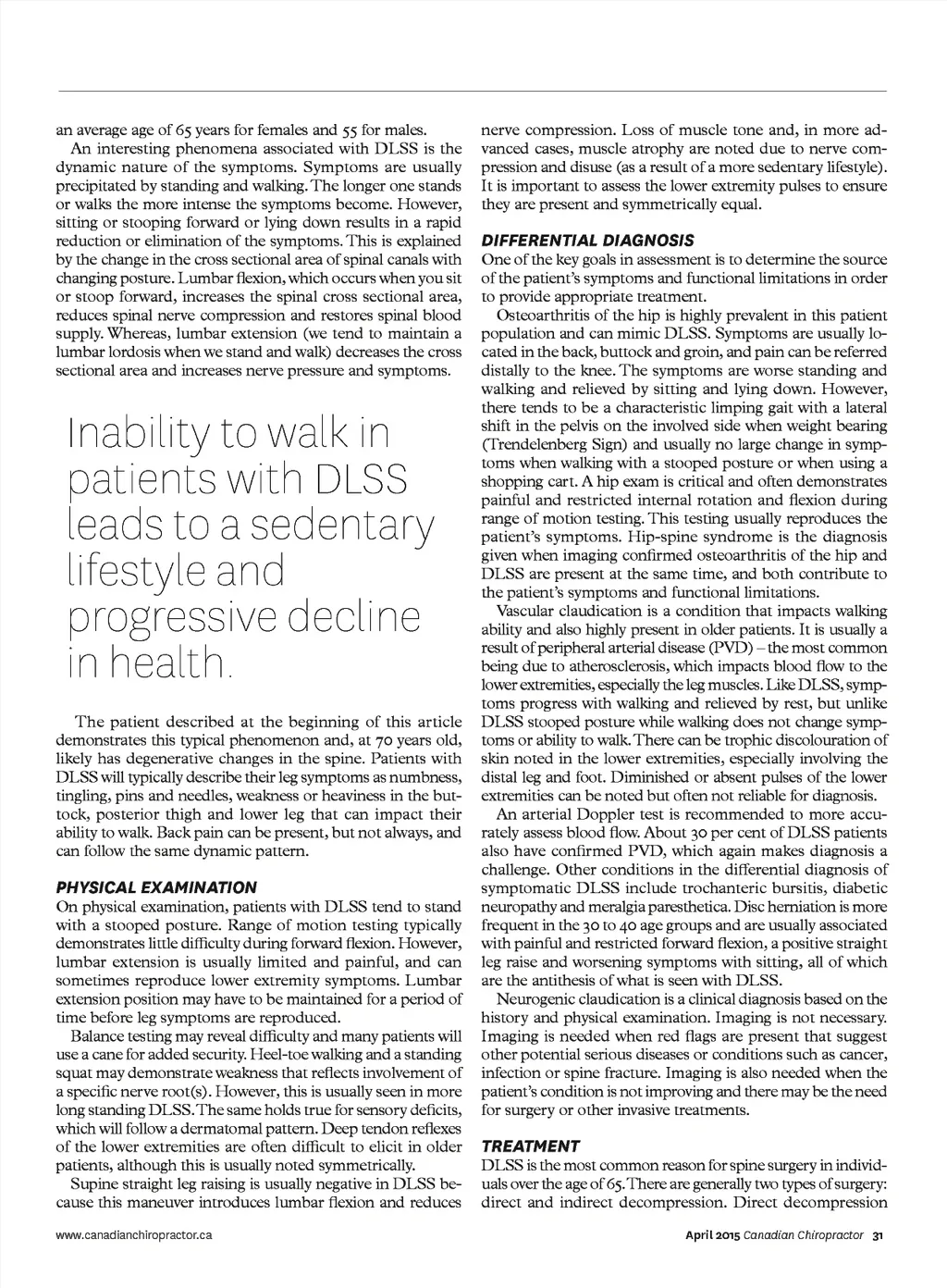
FEATURE CLINICAL THE AGING SPINE Managing degenerative lumbar spinal stenosis in older adults A BY CARLO AMMENDOLIA 70-year-old male presents to your clinic complaining of worsening back pain and lower extremity pain, numbness, heavi-ness and weakness. He was a regular walker, walking up to four kilometers per day, and now he cannot walk more than a half block and has to sit down for relief. He has high blood pressure but is otherwise healthy. How would you assess and manage this patient? Degenerative lumbar spinal stenosis (DLSS) is a leading cause of pain, disability and loss of independence in older adults. Lumbar spinal stenosis refers to a focal narrowing of the central canal and/or lateral foramina of the spine, usually identified by imaging. Evidence of narrowing of the spinal canals alone without clinical information is not meaningful since 30 per cent of patients over the age of 55 have moderate spinal stenosis and have no symptoms. Neurogenic claudication is the term used to describe the clinical syndrome caused by lumbar spinal stenosis. It is characterized by bilateral or unilateral buttock, lower ex-tremity pain, heaviness, numbness, tingling or weakness, precipitated by walking and standing, and relieved by sitting and bending forward. There are many causes of narrowing of the spinal canals. These include congenitally narrowed pedicles, spondylolis-thesis, metabolic bone diseases – like Paget’s disease and acromegaly – and previous spine surgery which can cause reactive bone formation within the canals. By far the most Lumbar spinal stenosis is a leading cause of pain and disability among older adults. Pain in the lower extremities is one of the symptoms. DR. CARLO AMMENDOLIA , DC, PhD, is the director of the Chiropractic Spine Clinic and the Spinal Stenosis Program at the Rebecca MacDonald Centre for Arthritis and Auto-immune Diseases at Mount Sinai Hospital. He is an assistant professor in the department of health policy, management and evaluation at the University of Toronto. In 2012, Ammendolia was awarded the Professorship in Spine Award from the department of surgery in the faculty of medicine. 30 Canadian Chiropractor April 2015 common cause of spinal stenosis is degenerative arthritis. Degenerative arthritis or osteoarthritis is a wear-and-tear type of arthritis that we all get to some degree when we age. Degenerative arthritis results in thinning and bulging of the intervertebral discs, thickening of the facet joints, and in-folding and thickening of the internal spinal ligaments. Degenerative spinal changes lead to a decrease in the cross sectional area of the spinal canals and potential compression to the spinal nerves that travel to the lower extremities. The narrowed spinal canals also restrict blood flow to the spinal nerves, which needs oxygen to function. This leads to neu-ro-ischemia and hypoxia to the nerves which result in lower extremity pain and claudication. Limited walking ability is the dominant functional impair-ment caused by symptomatic DLSS. Inability to walk among individuals with symptomatic DLSS leads to a sedentary lifestyle and a progressive decline in health status. DLSS is a chronic disease that can deteriorate with age. Reliable data on the prevalence of symptomatic DLSS is lacking. A Japanese study revealed that almost 50 per cent of patients who present themselves to a primary care doctor with numbness and tingling of the lower extremities have neurogenic claudication due to lumbar spinal stenosis, with www.canadianchiropractor.ca Photo: Fotolia
Chiropractic + Naturopathic Doctor April 2015: Page 30