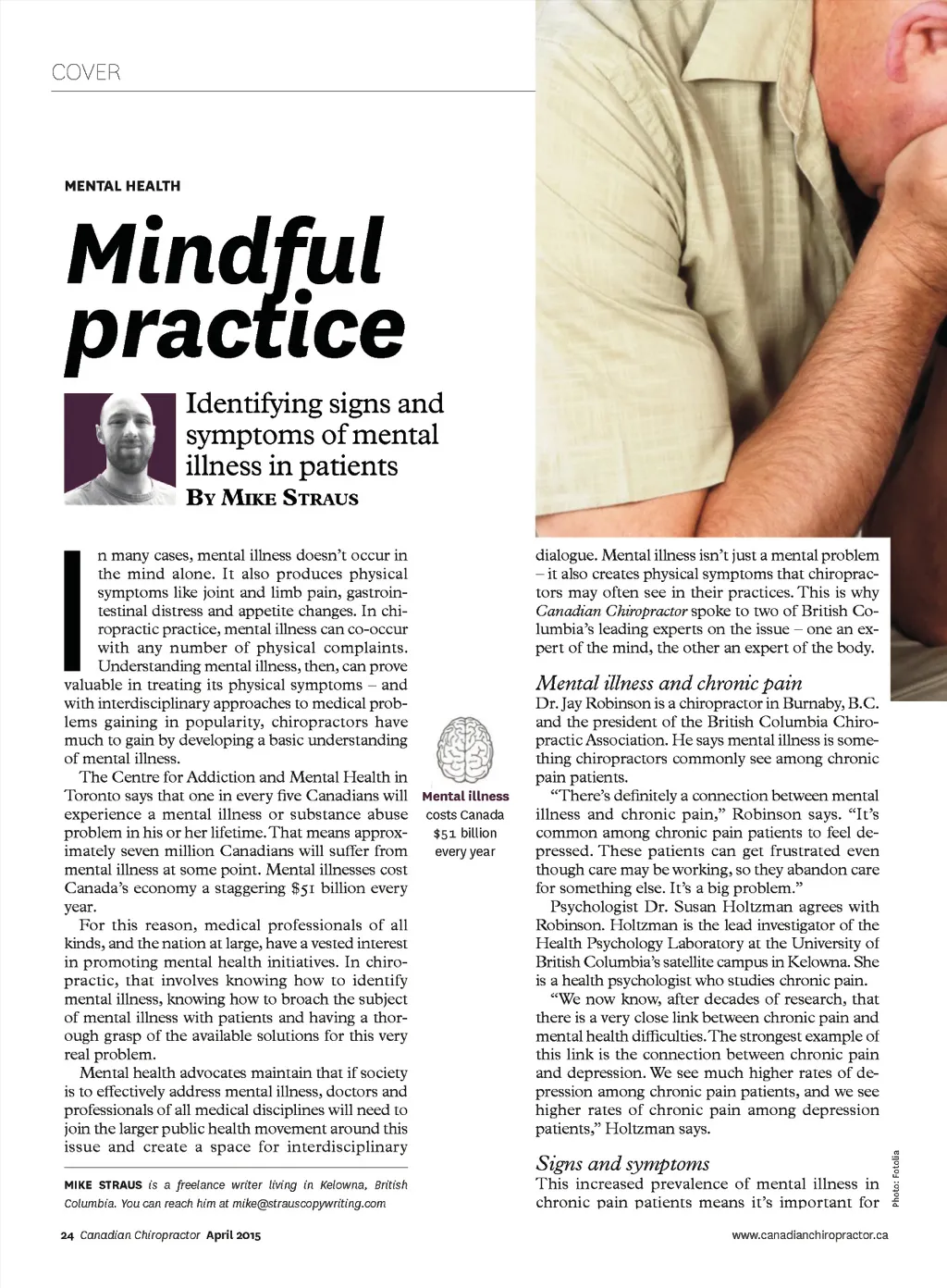
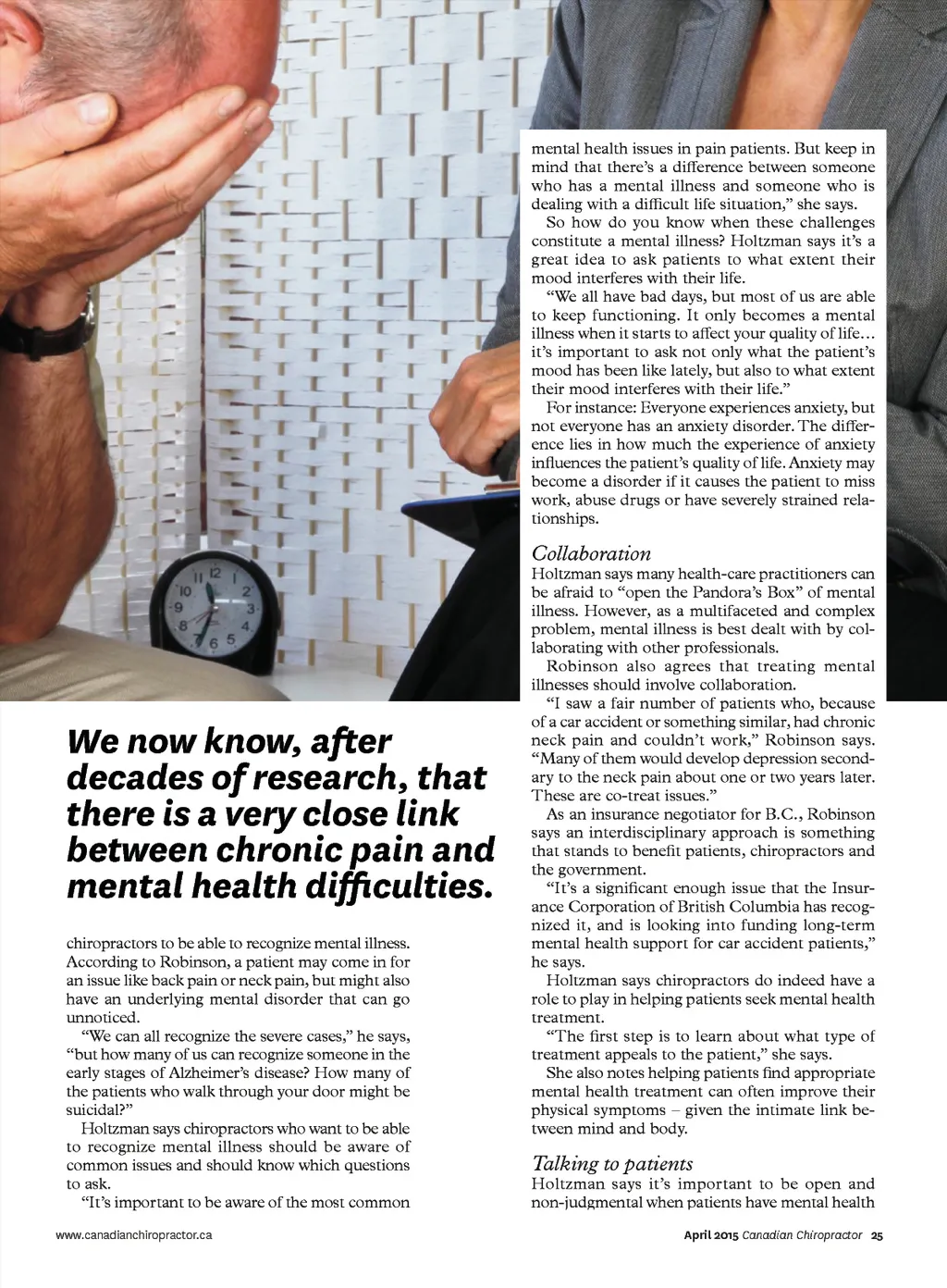
mental health issues in pain patients. But keep in mind that there’s a difference between someone who has a mental illness and someone who is dealing with a difficult life situation,” she says. So how do you know when these challenges constitute a mental illness? Holtzman says it’s a great idea to ask patients to what extent their mood interferes with their life. “We all have bad days, but most of us are able to keep functioning. It only becomes a mental illness when it starts to affect your quality of life… it’s important to ask not only what the patient’s mood has been like lately, but also to what extent their mood interferes with their life.” For instance: Everyone experiences anxiety, but not everyone has an anxiety disorder. The differ-ence lies in how much the experience of anxiety influences the patient’s quality of life. Anxiety may become a disorder if it causes the patient to miss work, abuse drugs or have severely strained rela-tionships. Holtzman says many health-care practitioners can be afraid to “open the Pandora’s Box” of mental illness. However, as a multifaceted and complex problem, mental illness is best dealt with by col-laborating with other professionals. Robinson also agrees that treating mental illnesses should involve collaboration. “I saw a fair number of patients who, because of a car accident or something similar, had chronic neck pain and couldn’t work,” Robinson says. “Many of them would develop depression second-ary to the neck pain about one or two years later. These are co-treat issues.” As an insurance negotiator for B.C., Robinson says an interdisciplinary approach is something that stands to benefit patients, chiropractors and the government. “It’s a significant enough issue that the Insur-ance Corporation of British Columbia has recog-nized it, and is looking into funding long-term mental health support for car accident patients,” he says. Holtzman says chiropractors do indeed have a role to play in helping patients seek mental health treatment. “The first step is to learn about what type of treatment appeals to the patient,” she says. She also notes helping patients find appropriate mental health treatment can often improve their physical symptoms – given the intimate link be-tween mind and body. Collaboration We now know, after decades of research, that there is a very close link between chronic pain and mental health difficulties. chiropractors to be able to recognize mental illness. According to Robinson, a patient may come in for an issue like back pain or neck pain, but might also have an underlying mental disorder that can go unnoticed. “We can all recognize the severe cases,” he says, “but how many of us can recognize someone in the early stages of Alzheimer’s disease? How many of the patients who walk through your door might be suicidal?” Holtzman says chiropractors who want to be able to recognize mental illness should be aware of common issues and should know which questions to ask. “It’s important to be aware of the most common www.canadianchiropractor.ca Talking to patients Holtzman says it’s important to be open and non-judgmental when patients have mental health April 2015 Canadian Chiropractor 25
Chiropractic + Naturopathic Doctor April 2015: Page 25