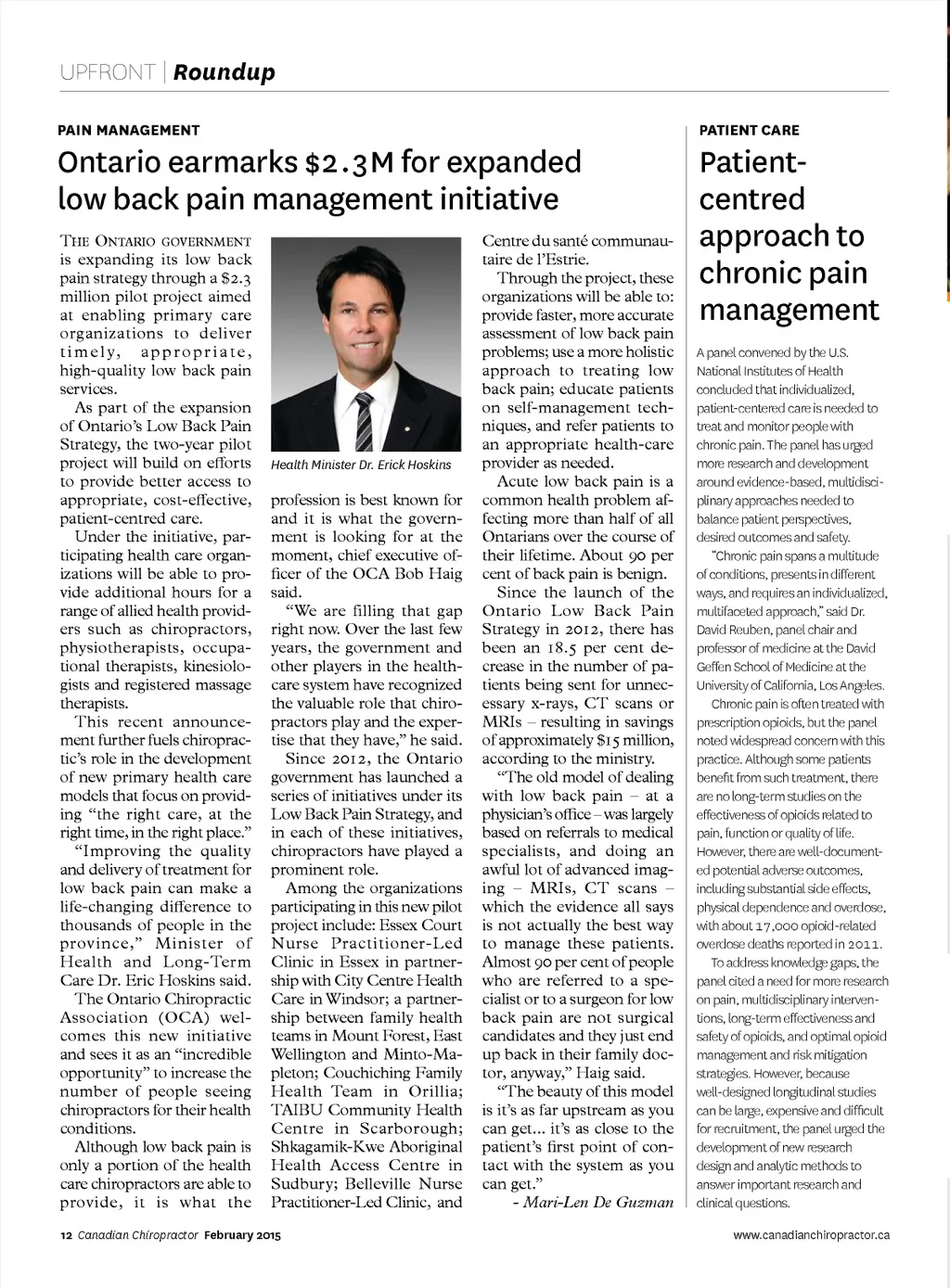
UPFRONT | Roundup PAIN MANAGEMENT Ontario earmarks $2.3M for expanded low back pain management initiative The Ontario government is expanding its low back pain strategy through a $2.3 million pilot project aimed at enabling primary care organizations to deliver timely, appropr iate, high-quality low back pain services. As part of the expansion of Ontario’s Low Back Pain Strategy, the two-year pilot project will build on efforts to provide better access to appropriate, cost-effective, patient-centred care. Under the initiative, par-ticipating health care organ-izations will be able to pro-vide additional hours for a range of allied health provid-ers such as chiropractors, physiotherapists, occupa-tional therapists, kinesiolo-gists and registered massage therapists. This recent announce-ment further fuels chiroprac-tic’s role in the development of new primary health care models that focus on provid-ing “the right care, at the right time, in the right place.” “Improving the quality and delivery of treatment for low back pain can make a life-changing difference to thousands of people in the province,” Minister of Health and Long-Term Care Dr. Eric Hoskins said. The Ontario Chiropractic Association (OCA) wel-comes this new initiative and sees it as an “incredible opportunity” to increase the number of people seeing chiropractors for their health conditions. Although low back pain is only a portion of the health care chiropractors are able to provide, it is what the Centre du santé communau-taire de l’Estrie. Through the project, these organizations will be able to: provide faster, more accurate assessment of low back pain problems; use a more holistic approach to treating low back pain; educate patients on self-management tech-niques, and refer patients to an appropriate health-care provider as needed. Acute low back pain is a common health problem af-fecting more than half of all Ontarians over the course of their lifetime. About 90 per cent of back pain is benign. Since the launch of the Ontario Low Back Pain Strategy in 2012, there has been an 18.5 per cent de-crease in the number of pa-tients being sent for unnec-essary x-rays, CT scans or MRIs – resulting in savings of approximately $15 million, according to the ministry. “The old model of dealing with low back pain – at a physician’s office – was largely based on referrals to medical specialists, and doing an awful lot of advanced imag-ing – MRIs, CT scans – which the evidence all says is not actually the best way to manage these patients. Almost 90 per cent of people who are referred to a spe-cialist or to a surgeon for low back pain are not surgical candidates and they just end up back in their family doc-tor, anyway,” Haig said. “The beauty of this model is it’s as far upstream as you can get... it’s as close to the patient’s first point of con-tact with the system as you can get.” -Mari-Len De Guzman PATIENT CARE Patient-centred approach to chronic pain management A panel convened by the U.S. National Institutes of Health concluded that individualized, patient-centered care is needed to treat and monitor people with chronic pain. The panel has urged more research and development around evidence-based, multidisci-plinary approaches needed to balance patient perspectives, desired outcomes and safety. “Chronic pain spans a multitude of conditions, presents in different ways, and requires an individualized, multifaceted approach,” said Dr. David Reuben, panel chair and professor of medicine at the David Geffen School of Medicine at the University of California, Los Angeles. Chronic pain is often treated with prescription opioids, but the panel noted widespread concern with this practice. Although some patients benefit from such treatment, there are no long-term studies on the effectiveness of opioids related to pain, function or quality of life. However, there are well-document-ed potential adverse outcomes, including substantial side effects, physical dependence and overdose, with about 17,000 opioid-related overdose deaths reported in 2011. To address knowledge gaps, the panel cited a need for more research on pain, multidisciplinary interven-tions, long-term effectiveness and safety of opioids, and optimal opioid management and risk mitigation strategies. However, because well-designed longitudinal studies can be large, expensive and difficult for recruitment, the panel urged the development of new research design and analytic methods to answer important research and clinical questions. www.canadianchiropractor.ca Health Minister Dr. Erick Hoskins profession is best known for and it is what the govern-ment is looking for at the moment, chief executive of-ficer of the OCA Bob Haig said. “We are filling that gap right now. Over the last few years, the government and other players in the health-care system have recognized the valuable role that chiro-practors play and the exper-tise that they have,” he said. Since 2012, the Ontario government has launched a series of initiatives under its Low Back Pain Strategy, and in each of these initiatives, chiropractors have played a prominent role. Among the organizations participating in this new pilot project include: Essex Court Nurse Practitioner-Led Clinic in Essex in partner-ship with City Centre Health Care in Windsor; a partner-ship between family health teams in Mount Forest, East Wellington and Minto-Ma-pleton; Couchiching Family Health Team in Orillia; TAIBU Community Health Centre in Scarborough; Shkagamik-Kwe Aboriginal Health Access Centre in Sudbury; Belleville Nurse Practitioner-Led Clinic, and 12 Canadian Chiropractor February 2015
Chiropractic + Naturopathic Doctor February 2015: Page 12