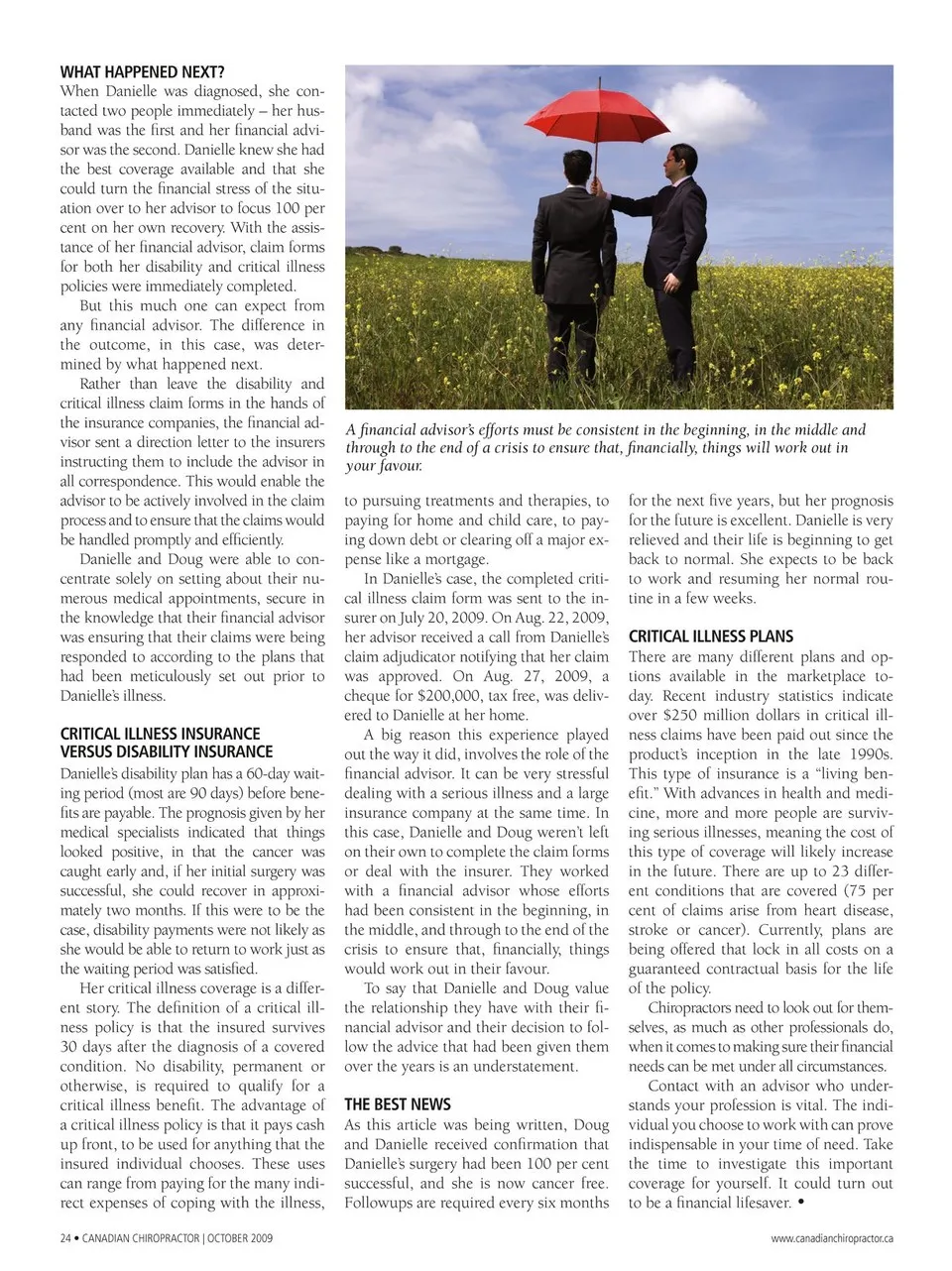
WHAT HAPPENED NEXT? When Danielle was diagnosed, she con- tacted two people immediately – her hus- band was the fi rst and her financial advi- sor was the second. Danielle knew she had the best coverage available and that she could turn the fi nancial stress of the situ- ation over to her advisor to focus 100 per cent on her own recovery. With the assis- tance of her fi nancial advisor, claim forms for both her disability and critical illness policies were immediately completed. But this much one can expect from any fi nancial advisor. The difference in the outcome, in this case, was deter- mined by what happened next. Rather than leave the disability and critical illness claim forms in the hands of the insurance companies, the financial ad- visor sent a direction letter to the insurers instructing them to include the advisor in all correspondence. This would enable the advisor to be actively involved in the claim process and to ensure that the claims would be handled promptly and efficiently. Danielle and Doug were able to con- centrate solely on setting about their nu- merous medical appointments, secure in the knowledge that their financial advisor was ensuring that their claims were being responded to according to the plans that had been meticulously set out prior to Danielle’s illness. CRITICAL ILLNESS INSURANCE VERSUS DISABILITY INSURANCE Danielle’s disability plan has a 60-day wait- ing period (most are 90 days) before bene- fi ts are payable. The prognosis given by her medical specialists indicated that things looked positive, in that the cancer was caught early and, if her initial surgery was successful, she could recover in approxi- mately two months. If this were to be the case, disability payments were not likely as she would be able to return to work just as the waiting period was satisfied. Her critical illness coverage is a differ- ent story. The defi nition of a critical ill- ness policy is that the insured survives 30 days after the diagnosis of a covered condition. No disability, permanent or otherwise, is required to qualify for a critical illness benefi t. The advantage of a critical illness policy is that it pays cash up front, to be used for anything that the insured individual chooses. These uses can range from paying for the many indi- rect expenses of coping with the illness, 24 • CANADIAN CHIROPRACTOR | OCTOBER 2009 A fi nancial advisor’s efforts must be consistent in the beginning, in the middle and through to the end of a crisis to ensure that, fi nancially, things will work out in your favour. to pursuing treatments and therapies, to paying for home and child care, to pay- ing down debt or clearing off a major ex- pense like a mortgage. In Danielle’s case, the completed criti- cal illness claim form was sent to the in- surer on July 20, 2009. On Aug. 22, 2009, her advisor received a call from Danielle’s claim adjudicator notifying that her claim was approved. On Aug. 27, 2009, a cheque for $200,000, tax free, was deliv- ered to Danielle at her home. A big reason this experience played out the way it did, involves the role of the fi nancial advisor. It can be very stressful dealing with a serious illness and a large insurance company at the same time. In this case, Danielle and Doug weren’t left on their own to complete the claim forms or deal with the insurer. They worked with a fi nancial advisor whose efforts had been consistent in the beginning, in the middle, and through to the end of the crisis to ensure that, financially, things would work out in their favour. To say that Danielle and Doug value the relationship they have with their fi- nancial advisor and their decision to fol- low the advice that had been given them over the years is an understatement. THE BEST NEWS As this article was being written, Doug and Danielle received confirmation that Danielle’s surgery had been 100 per cent successful, and she is now cancer free. Followups are required every six months for the next five years, but her prognosis for the future is excellent. Danielle is very relieved and their life is beginning to get back to normal. She expects to be back to work and resuming her normal rou- tine in a few weeks. CRITICAL ILLNESS PLANS There are many different plans and op- tions available in the marketplace to- day. Recent industry statistics indicate over $250 million dollars in critical ill- ness claims have been paid out since the product’s inception in the late 1990s. This type of insurance is a “living ben- efi t.” With advances in health and medi- cine, more and more people are surviv- ing serious illnesses, meaning the cost of this type of coverage will likely increase in the future. There are up to 23 differ- ent conditions that are covered (75 per cent of claims arise from heart disease, stroke or cancer). Currently, plans are being offered that lock in all costs on a guaranteed contractual basis for the life of the policy. Chiropractors need to look out for them- selves, as much as other professionals do, when it comes to making sure their financial needs can be met under all circumstances. Contact with an advisor who under- stands your profession is vital. The indi- vidual you choose to work with can prove indispensable in your time of need. Take the time to investigate this important coverage for yourself. It could turn out to be a financial lifesaver. • www.canadianchiropractor.ca
Chiropractic + Naturopathic Doctor October 2009: Page 24