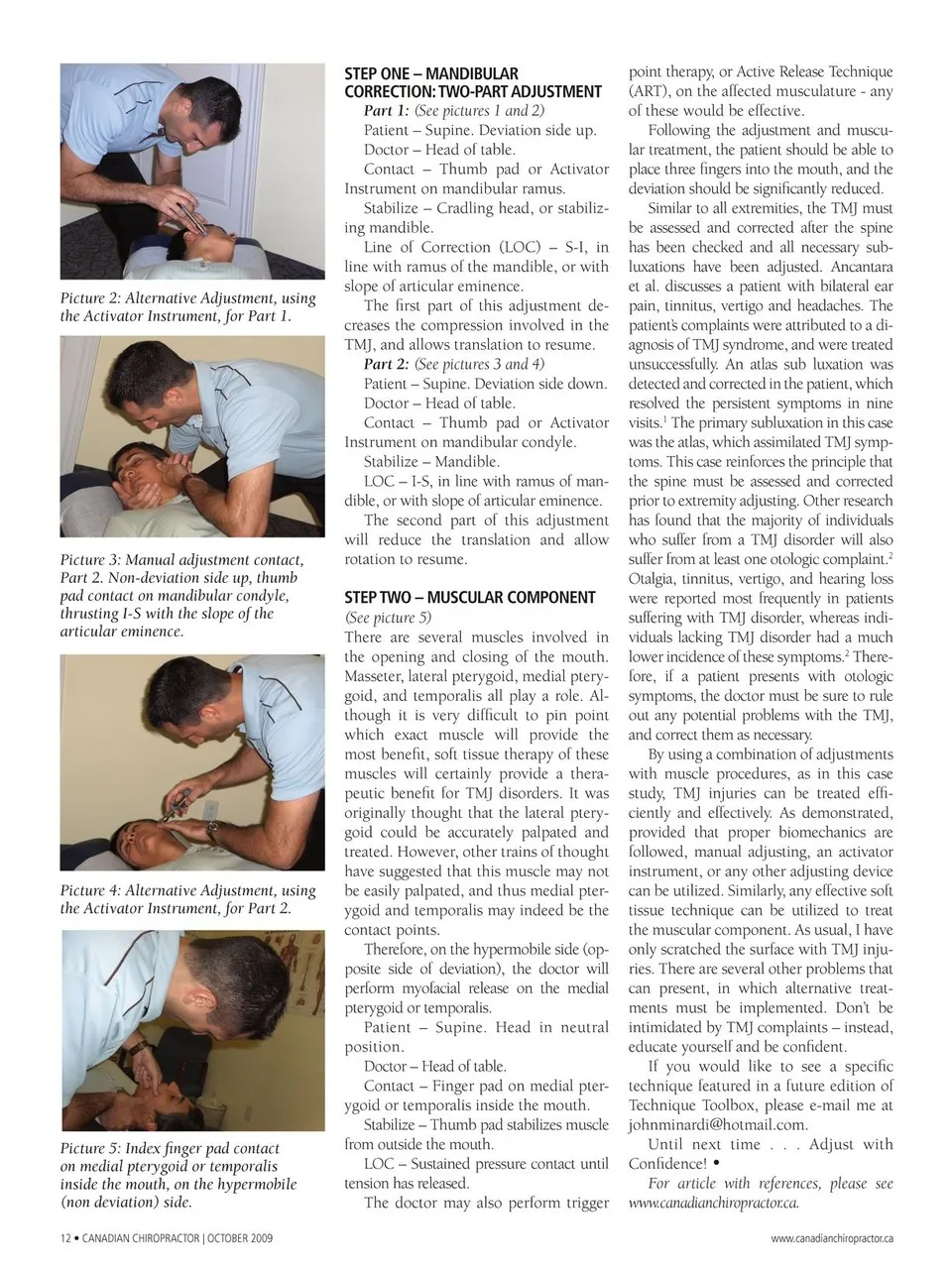
STEP ONE – MANDIBULAR CORRECTION:TWO-PART ADJUSTMENT Part 1: (See pictures 1 and 2) Patient – Supine. Deviation side up. Doctor – Head of table. Picture 2: Alternative Adjustment, using the Activator Instrument, for Part 1. Contact – Thumb pad or Activator Instrument on mandibular ramus. Stabilize – Cradling head, or stabiliz- ing mandible. Line of Correction (LOC) – S-I, in line with ramus of the mandible, or with slope of articular eminence. The fi rst part of this adjustment de- creases the compression involved in the TMJ, and allows translation to resume. Part 2: (See pictures 3 and 4) Patient – Supine. Deviation side down. Doctor – Head of table. Contact – Thumb pad or Activator Instrument on mandibular condyle. Stabilize – Mandible. LOC – I-S, in line with ramus of man- dible, or with slope of articular eminence. The second part of this adjustment Picture 3: Manual adjustment contact, Part 2. Non-deviation side up, thumb pad contact on mandibular condyle, thrusting I-S with the slope of the articular eminence. will reduce the translation and allow rotation to resume. Picture 4: Alternative Adjustment, using the Activator Instrument, for Part 2. STEP TWO – MUSCULAR COMPONENT (See picture 5) There are several muscles involved in the opening and closing of the mouth. Masseter, lateral pterygoid, medial ptery- goid, and temporalis all play a role. Al- though it is very diffi cult to pin point which exact muscle will provide the most benefi t, soft tissue therapy of these muscles will certainly provide a thera- peutic benefi t for TMJ disorders. It was originally thought that the lateral ptery- goid could be accurately palpated and treated. However, other trains of thought have suggested that this muscle may not be easily palpated, and thus medial pter- ygoid and temporalis may indeed be the contact points. Therefore, on the hypermobile side (op- posite side of deviation), the doctor will perform myofacial release on the medial pterygoid or temporalis. position. Patient – Supine. Head in neutral Doctor – Head of table. Contact – Finger pad on medial pter- ygoid or temporalis inside the mouth. Stabilize – Thumb pad stabilizes muscle Picture 5: Index fi nger pad contact on medial pterygoid or temporalis inside the mouth, on the hypermobile (non deviation) side. 12 • CANADIAN CHIROPRACTOR | OCTOBER 2009 from outside the mouth. LOC – Sustained pressure contact until tension has released. The doctor may also perform trigger point therapy, or Active Release Technique (ART), on the affected musculature - any of these would be effective. Following the adjustment and muscu- lar treatment, the patient should be able to place three fi ngers into the mouth, and the deviation should be significantly reduced. Similar to all extremities, the TMJ must be assessed and corrected after the spine has been checked and all necessary sub- luxations have been adjusted. Ancantara et al. discusses a patient with bilateral ear pain, tinnitus, vertigo and headaches. The patient’s complaints were attributed to a di- agnosis of TMJ syndrome, and were treated unsuccessfully. An atlas sub luxation was detected and corrected in the patient, which resolved the persistent symptoms in nine visits.1 The primary subluxation in this case was the atlas, which assimilated TMJ symp- toms. This case reinforces the principle that the spine must be assessed and corrected prior to extremity adjusting. Other research has found that the majority of individuals who suffer from a TMJ disorder will also suffer from at least one otologic complaint.2 Otalgia, tinnitus, vertigo, and hearing loss were reported most frequently in patients suffering with TMJ disorder, whereas indi- viduals lacking TMJ disorder had a much lower incidence of these symptoms.2 There- fore, if a patient presents with otologic symptoms, the doctor must be sure to rule out any potential problems with the TMJ, and correct them as necessary. By using a combination of adjustments with muscle procedures, as in this case study, TMJ injuries can be treated effi- ciently and effectively. As demonstrated, provided that proper biomechanics are followed, manual adjusting, an activator instrument, or any other adjusting device can be utilized. Similarly, any effective soft tissue technique can be utilized to treat the muscular component. As usual, I have only scratched the surface with TMJ inju- ries. There are several other problems that can present, in which alternative treat- ments must be implemented. Don’t be intimidated by TMJ complaints – instead, educate yourself and be confident. If you would like to see a specific technique featured in a future edition of Technique Toolbox, please e-mail me at [email protected]. Confidence! • Until next time . . . Adjust with For article with references, please see www.canadianchiropractor.ca. www.canadianchiropractor.ca
Chiropractic + Naturopathic Doctor October 2009: Page 12