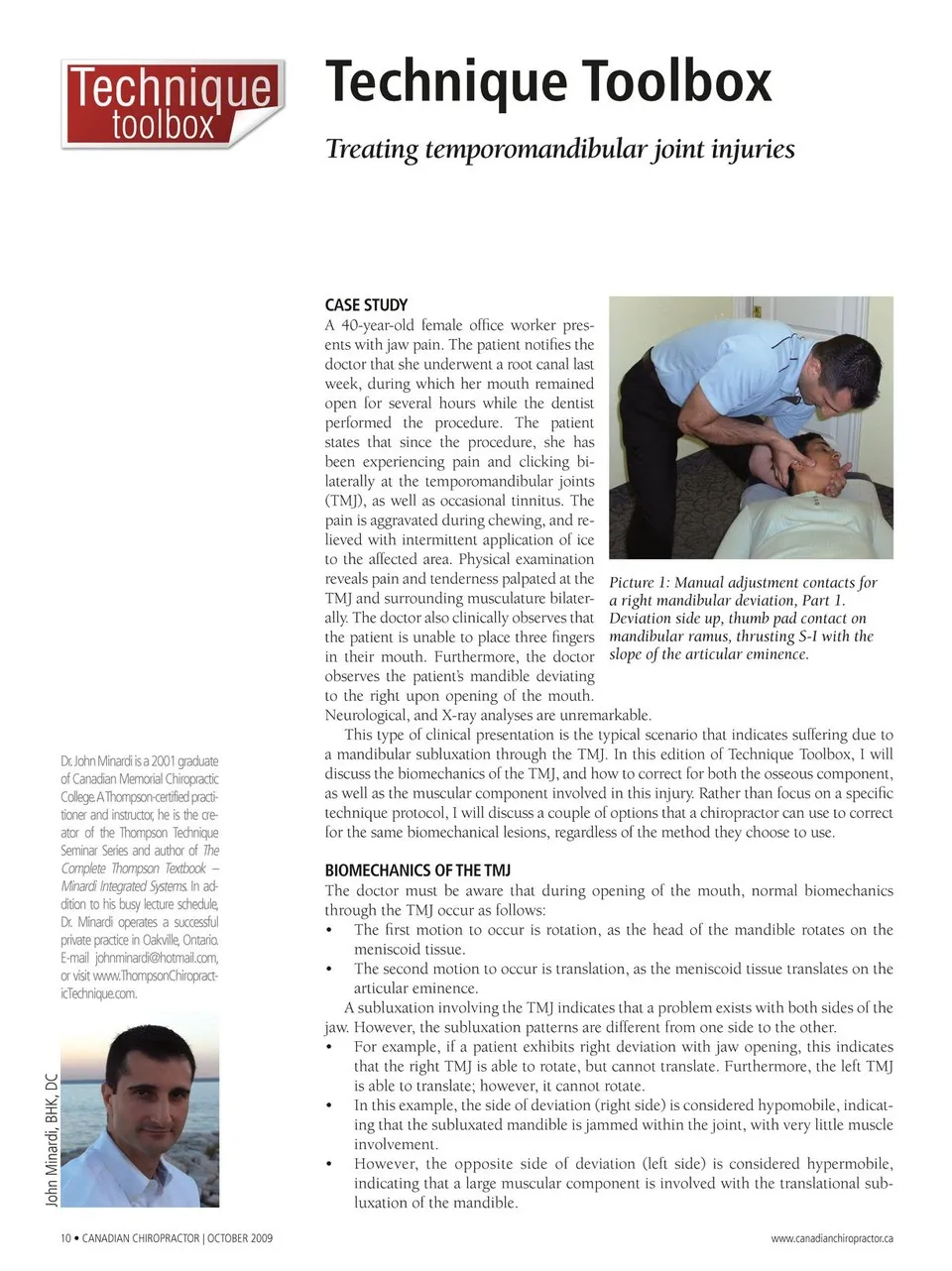
Technique Toolbox Treating temporomandibular joint injuries Dr.John Minardi is a 2001 graduate of Canadian Memorial Chiropractic College.A Thompson-certified practi- tioner and instructor, he is the cre- ator of the Thompson Technique Seminar Series and author of The Complete Thompson Textbook – Minardi Integrated Systems. In ad- dition to his busy lecture schedule, Dr. Minardi operates a successful private practice in Oakville, Ontario. E-mail [email protected], or visit www.ThompsonChiropract- icTechnique.com. CASE STUDY A 40-year-old female offi ce worker pres- ents with jaw pain. The patient notifies the doctor that she underwent a root canal last week, during which her mouth remained open for several hours while the dentist performed the procedure. The patient states that since the procedure, she has been experiencing pain and clicking bi- laterally at the temporomandibular joints (TMJ), as well as occasional tinnitus. The pain is aggravated during chewing, and re- lieved with intermittent application of ice to the affected area. Physical examination reveals pain and tenderness palpated at the TMJ and surrounding musculature bilater- ally. The doctor also clinically observes that the patient is unable to place three fingers in their mouth. Furthermore, the doctor observes the patient’s mandible deviating to the right upon opening of the mouth. Neurological, and X-ray analyses are unremarkable. This type of clinical presentation is the typical scenario that indicates suffering due to a mandibular subluxation through the TMJ. In this edition of Technique Toolbox, I will discuss the biomechanics of the TMJ, and how to correct for both the osseous component, as well as the muscular component involved in this injury. Rather than focus on a specific technique protocol, I will discuss a couple of options that a chiropractor can use to correct for the same biomechanical lesions, regardless of the method they choose to use. Picture 1: Manual adjustment contacts for a right mandibular deviation, Part 1. Deviation side up, thumb pad contact on mandibular ramus, thrusting S-I with the slope of the articular eminence. BIOMECHANICS OF THE TMJ The doctor must be aware that during opening of the mouth, normal biomechanics through the TMJ occur as follows: The fi rst motion to occur is rotation, as the head of the mandible rotates on the meniscoid tissue. • • • • • 10 • CANADIAN CHIROPRACTOR | OCTOBER 2009 The second motion to occur is translation, as the meniscoid tissue translates on the articular eminence. A subluxation involving the TMJ indicates that a problem exists with both sides of the jaw. However, the subluxation patterns are different from one side to the other. For example, if a patient exhibits right deviation with jaw opening, this indicates that the right TMJ is able to rotate, but cannot translate. Furthermore, the left TMJ is able to translate; however, it cannot rotate. In this example, the side of deviation (right side) is considered hypomobile, indicat- ing that the subluxated mandible is jammed within the joint, with very little muscle involvement. However, the opposite side of deviation (left side) is considered hypermobile, indicating that a large muscular component is involved with the translational sub- luxation of the mandible. www.canadianchiropractor.ca John Minardi, BHK, DC
Chiropractic + Naturopathic Doctor October 2009: Page 10