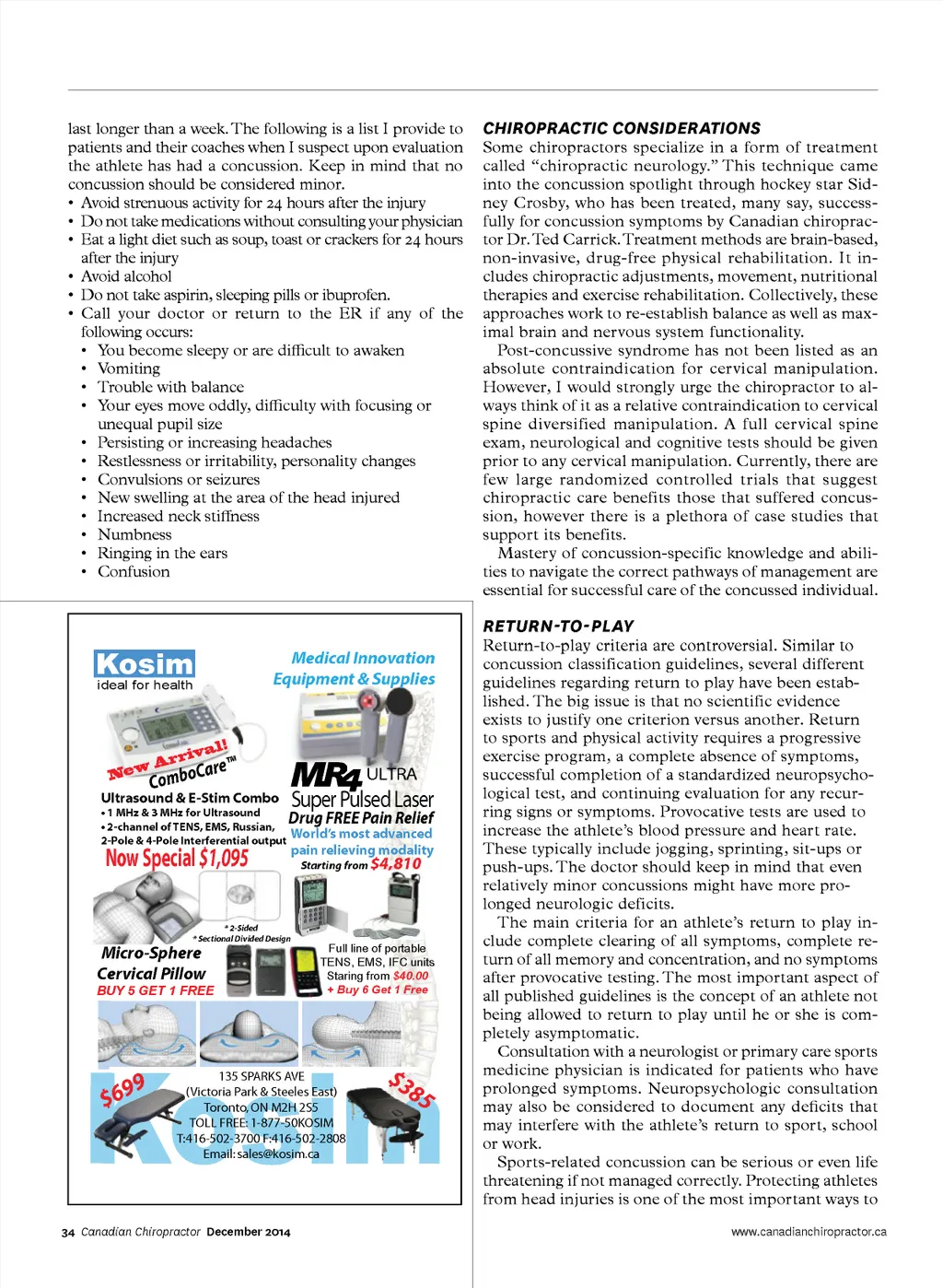
Immediately after completion of exertional exercises, a detailed head, neck and neurological exam is performed, looking for pupillary constriction, thereby assessing cranial nerve III and the autonomic nervous system. prevent a concussion. Instruction should include signs and symptoms of concussions, how such injuries occur, and possible long-term effects resulting from such in-jury. It is imperative that athletes also know the symp-toms of a concussion so they can inform the appropri-ate health providers and coaches. Providing supporting written material, as seen in the list above, is advisable. This article serves as only an overview of common management procedures, and it’s the author’s personal suggestion that it would be beneficial to take an up-dated refresher course on the latest research regarding concussion. In addition, it is prudent to note that every state and province has differing rules surrounding the scope of chiropractic practice with regards to concussion man-agement. The National Federation of State High School Associations and Centers for Disease Control and Prevention have teamed up to provide information and resources to help educate people on the impor-tance of proper concussion recognition and manage-ment. This is a free online course in which you and/or your patients will learn to recognize a suspected con-cussion, the proper protocols to manage a suspected concussion, and steps to help the athlete return to play. www.canadianchiropractor.ca Canadian Memorial Chiropractic College December 2014 Canadian Chiropractor 35
Chiropractic + Naturopathic Doctor December 2014: Page 35