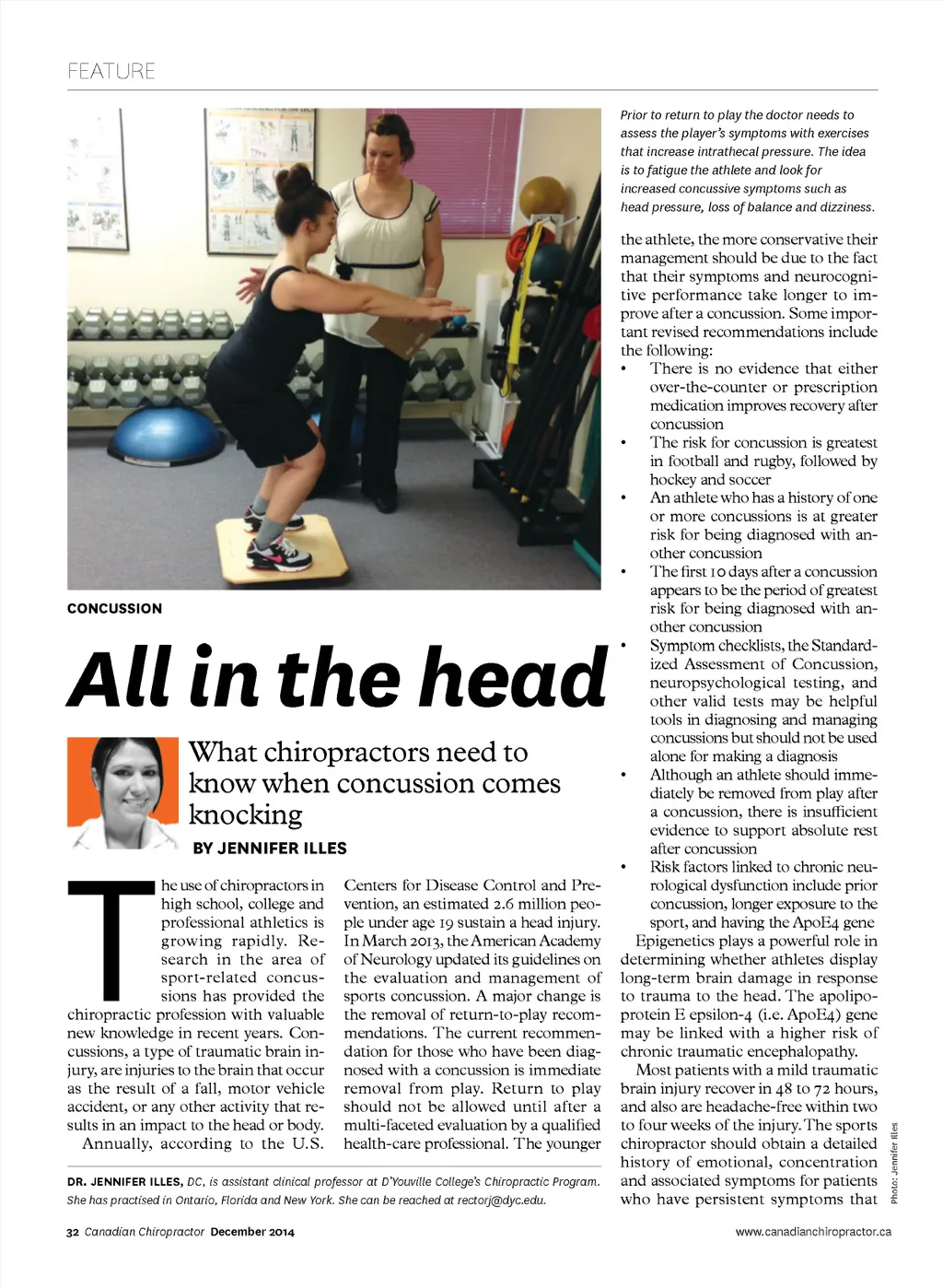
FEATURE Prior to return to play the doctor needs to assess the player’s symptoms with exercises that increase intrathecal pressure. The idea is to fatigue the athlete and look for increased concussive symptoms such as head pressure, loss of balance and dizziness. CONCUSSION All in the head T What chiropractors need to know when concussion comes knocking by JeNNIfeR IlleS Centers for Disease Control and Pre-vention, an estimated 2.6 million peo-ple under age 19 sustain a head injury. In March 2013, the American Academy of Neurology updated its guidelines on the evaluation and management of sports concussion. A major change is the removal of return-to-play recom-mendations. The current recommen-dation for those who have been diag-nosed with a concussion is immediate removal from play. Return to play should not be allowed until after a multi-faceted evaluation by a qualified health-care professional. The younger DR. JeNNIfeR IlleS, DC, is assistant clinical professor at D’Youville College’s Chiropractic Program. She has practised in Ontario, Florida and New York. She can be reached at [email protected]. 32 Canadian Chiropractor December 2014 www.canadianchiropractor.ca Photo: Jennifer Illes he use of chiropractors in high school, college and professional athletics is growing rapidly. Re-search in the area of sport-related concus-sions has provided the chiropractic profession with valuable new knowledge in recent years. Con-cussions, a type of traumatic brain in-jury, are injuries to the brain that occur as the result of a fall, motor vehicle accident, or any other activity that re-sults in an impact to the head or body. Annually, according to the U.S. the athlete, the more conservative their management should be due to the fact that their symptoms and neurocogni-tive performance take longer to im-prove after a concussion. Some impor-tant revised recommendations include the following: • There is no evidence that either over-the-counter or prescription medication improves recovery after concussion • The risk for concussion is greatest in football and rugby, followed by hockey and soccer • An athlete who has a history of one or more concussions is at greater risk for being diagnosed with an-other concussion • The first 10 days after a concussion appears to be the period of greatest risk for being diagnosed with an-other concussion • Symptom checklists, the Standard-ized Assessment of Concussion, neuropsychological testing, and other valid tests may be helpful tools in diagnosing and managing concussions but should not be used alone for making a diagnosis • Although an athlete should imme-diately be removed from play after a concussion, there is insufficient evidence to support absolute rest after concussion • Risk factors linked to chronic neu-rological dysfunction include prior concussion, longer exposure to the sport, and having the ApoE4 gene Epigenetics plays a powerful role in determining whether athletes display long-term brain damage in response to trauma to the head. The apolipo-protein E epsilon-4 (i.e. ApoE4) gene may be linked with a higher risk of chronic traumatic encephalopathy. Most patients with a mild traumatic brain injury recover in 48 to 72 hours, and also are headache-free within two to four weeks of the injury. The sports chiropractor should obtain a detailed history of emotional, concentration and associated symptoms for patients who have persistent symptoms that
Chiropractic + Naturopathic Doctor December 2014: Page 32