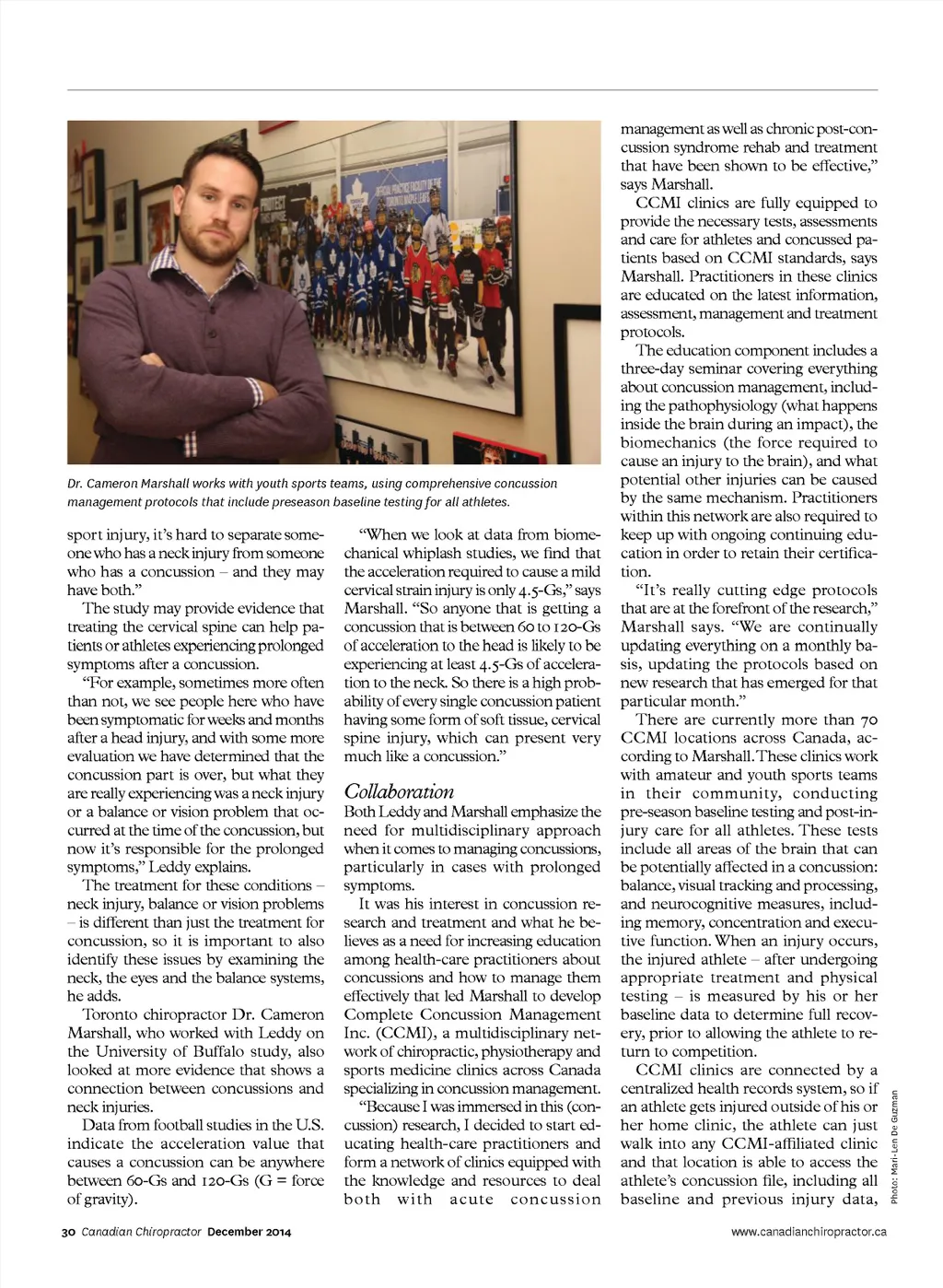
Dr. Cameron Marshall works with youth sports teams, using comprehensive concussion management protocols that include preseason baseline testing for all athletes. sport injury, it’s hard to separate some-one who has a neck injury from someone who has a concussion – and they may have both.” The study may provide evidence that treating the cervical spine can help pa-tients or athletes experiencing prolonged symptoms after a concussion. “For example, sometimes more often than not, we see people here who have been symptomatic for weeks and months after a head injury, and with some more evaluation we have determined that the concussion part is over, but what they are really experiencing was a neck injury or a balance or vision problem that oc-curred at the time of the concussion, but now it’s responsible for the prolonged symptoms,” Leddy explains. The treatment for these conditions – neck injury, balance or vision problems – is different than just the treatment for concussion, so it is important to also identify these issues by examining the neck, the eyes and the balance systems, he adds. Toronto chiropractor Dr. Cameron Marshall, who worked with Leddy on the University of Buffalo study, also looked at more evidence that shows a connection between concussions and neck injuries. Data from football studies in the U.S. indicate the acceleration value that causes a concussion can be anywhere between 60-Gs and 120-Gs (G = force of gravity). 30 Canadian Chiropractor December 2014 “When we look at data from biome-chanical whiplash studies, we find that the acceleration required to cause a mild cervical strain injury is only 4.5-Gs,” says Marshall. “So anyone that is getting a concussion that is between 60 to 120-Gs of acceleration to the head is likely to be experiencing at least 4.5-Gs of accelera-tion to the neck. So there is a high prob-ability of every single concussion patient having some form of soft tissue, cervical spine injury, which can present very much like a concussion.” Collaboration Both Leddy and Marshall emphasize the need for multidisciplinary approach when it comes to managing concussions, particularly in cases with prolonged symptoms. It was his interest in concussion re-search and treatment and what he be-lieves as a need for increasing education among health-care practitioners about concussions and how to manage them effectively that led Marshall to develop Complete Concussion Management Inc. (CCMI), a multidisciplinary net-work of chiropractic, physiotherapy and sports medicine clinics across Canada specializing in concussion management. “Because I was immersed in this (con-cussion) research, I decided to start ed-ucating health-care practitioners and form a network of clinics equipped with the knowledge and resources to deal both with acute concussion management as well as chronic post-con-cussion syndrome rehab and treatment that have been shown to be effective,” says Marshall. CCMI clinics are fully equipped to provide the necessary tests, assessments and care for athletes and concussed pa-tients based on CCMI standards, says Marshall. Practitioners in these clinics are educated on the latest information, assessment, management and treatment protocols. The education component includes a three-day seminar covering everything about concussion management, includ-ing the pathophysiology (what happens inside the brain during an impact), the biomechanics (the force required to cause an injury to the brain), and what potential other injuries can be caused by the same mechanism. Practitioners within this network are also required to keep up with ongoing continuing edu-cation in order to retain their certifica-tion. “It’s really cutting edge protocols that are at the forefront of the research,” Marshall says. “We are continually updating everything on a monthly ba-sis, updating the protocols based on new research that has emerged for that particular month.” There are currently more than 70 CCMI locations across Canada, ac-cording to Marshall. These clinics work with amateur and youth sports teams in their community, conducting pre-season baseline testing and post-in-jury care for all athletes. These tests include all areas of the brain that can be potentially affected in a concussion: balance, visual tracking and processing, and neurocognitive measures, includ-ing memory, concentration and execu-tive function. When an injury occurs, the injured athlete – after undergoing appropriate treatment and physical testing – is measured by his or her baseline data to determine full recov-ery, prior to allowing the athlete to re-turn to competition. CCMI clinics are connected by a centralized health records system, so if an athlete gets injured outside of his or her home clinic, the athlete can just walk into any CCMI-affiliated clinic and that location is able to access the athlete’s concussion file, including all baseline and previous injury data, www.canadianchiropractor.ca Photo: Mari-Len De Guzman
Chiropractic + Naturopathic Doctor December 2014: Page 30