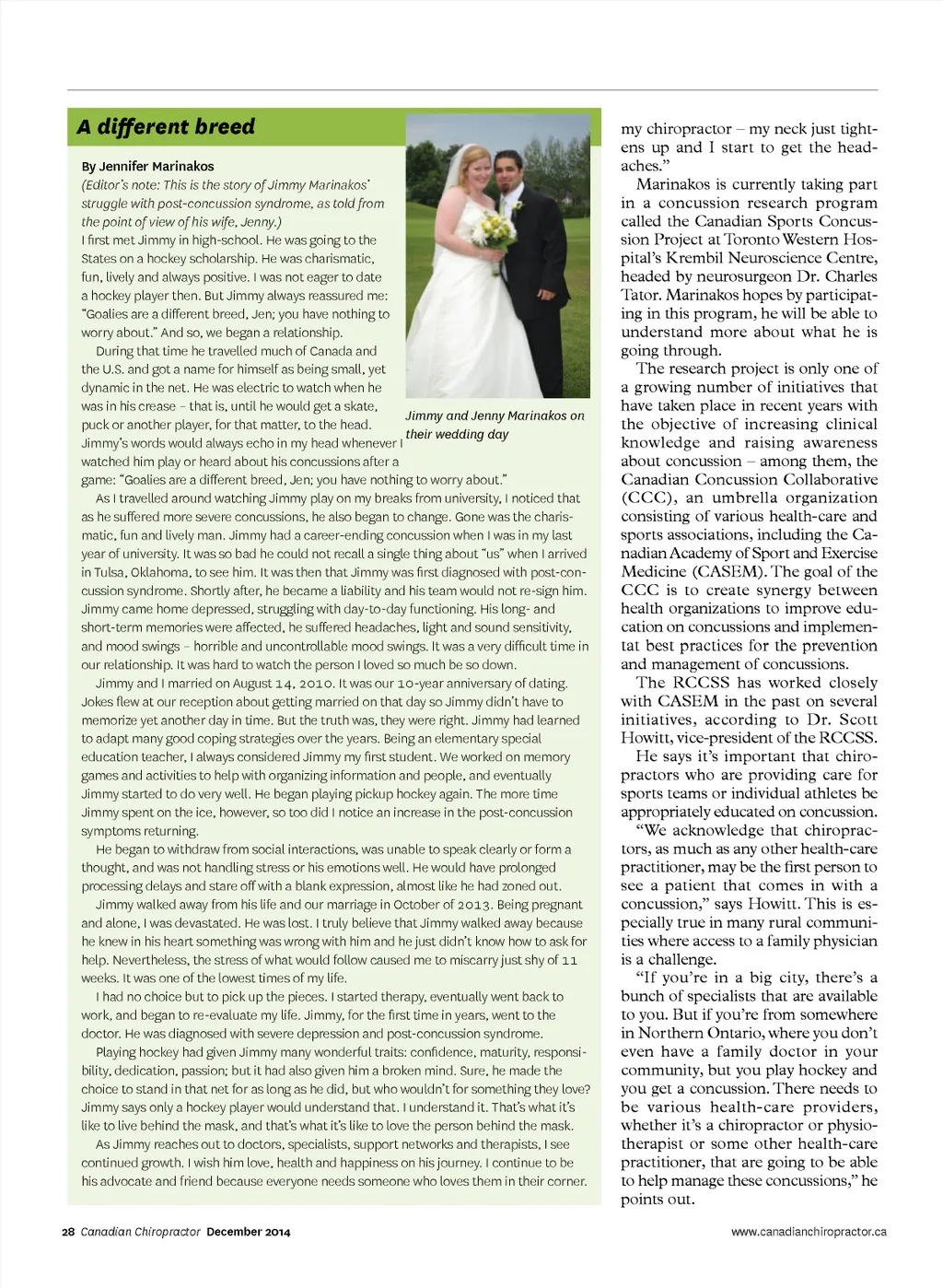
A different breed by jennifer Marinakos (Editor’s note: This is the story of Jimmy Marinakos’ struggle with post-concussion syndrome, as told from the point of view of his wife, Jenny.) I first met Jimmy in high-school. He was going to the States on a hockey scholarship. He was charismatic, fun, lively and always positive. I was not eager to date a hockey player then. But Jimmy always reassured me: “Goalies are a different breed, Jen; you have nothing to worry about.” And so, we began a relationship. During that time he travelled much of Canada and the U.S. and got a name for himself as being small, yet dynamic in the net. He was electric to watch when he was in his crease – that is, until he would get a skate, Jimmy and Jenny Marinakos on puck or another player, for that matter, to the head. their wedding day Jimmy’s words would always echo in my head whenever I watched him play or heard about his concussions after a game: “Goalies are a different breed, Jen; you have nothing to worry about.” As I travelled around watching Jimmy play on my breaks from university, I noticed that as he suffered more severe concussions, he also began to change. Gone was the charis-matic, fun and lively man. Jimmy had a career-ending concussion when I was in my last year of university. It was so bad he could not recall a single thing about “us” when I arrived in Tulsa, Oklahoma, to see him. It was then that Jimmy was first diagnosed with post-con-cussion syndrome. Shortly after, he became a liability and his team would not re-sign him. Jimmy came home depressed, struggling with day-to-day functioning. His long-and short-term memories were affected, he suffered headaches, light and sound sensitivity, and mood swings – horrible and uncontrollable mood swings. It was a very difficult time in our relationship. It was hard to watch the person I loved so much be so down. Jimmy and I married on August 14, 2010. It was our 10-year anniversary of dating. Jokes flew at our reception about getting married on that day so Jimmy didn’t have to memorize yet another day in time. But the truth was, they were right. Jimmy had learned to adapt many good coping strategies over the years. Being an elementary special education teacher, I always considered Jimmy my first student. We worked on memory games and activities to help with organizing information and people, and eventually Jimmy started to do very well. He began playing pickup hockey again. The more time Jimmy spent on the ice, however, so too did I notice an increase in the post-concussion symptoms returning. He began to withdraw from social interactions, was unable to speak clearly or form a thought, and was not handling stress or his emotions well. He would have prolonged processing delays and stare off with a blank expression, almost like he had zoned out. Jimmy walked away from his life and our marriage in October of 2013. Being pregnant and alone, I was devastated. He was lost. I truly believe that Jimmy walked away because he knew in his heart something was wrong with him and he just didn’t know how to ask for help. Nevertheless, the stress of what would follow caused me to miscarry just shy of 11 weeks. It was one of the lowest times of my life. I had no choice but to pick up the pieces. I started therapy, eventually went back to work, and began to re-evaluate my life. Jimmy, for the first time in years, went to the doctor. He was diagnosed with severe depression and post-concussion syndrome. Playing hockey had given Jimmy many wonderful traits: confidence, maturity, responsi-bility, dedication, passion; but it had also given him a broken mind. Sure, he made the choice to stand in that net for as long as he did, but who wouldn’t for something they love? Jimmy says only a hockey player would understand that. I understand it. That’s what it’s like to live behind the mask, and that’s what it’s like to love the person behind the mask. As Jimmy reaches out to doctors, specialists, support networks and therapists, I see continued growth. I wish him love, health and happiness on his journey. I continue to be his advocate and friend because everyone needs someone who loves them in their corner. 28 Canadian Chiropractor December 2014 my chiropractor – my neck just tight-ens up and I start to get the head-aches.” Marinakos is currently taking part in a concussion research program called the Canadian Sports Concus-sion Project at Toronto Western Hos-pital’s Krembil Neuroscience Centre, headed by neurosurgeon Dr. Charles Tator. Marinakos hopes by participat-ing in this program, he will be able to understand more about what he is going through. The research project is only one of a growing number of initiatives that have taken place in recent years with the objective of increasing clinical knowledge and raising awareness about concussion – among them, the Canadian Concussion Collaborative (CCC), an umbrella organization consisting of various health-care and sports associations, including the Ca-nadian Academy of Sport and Exercise Medicine (CASEM). The goal of the CCC is to create synergy between health organizations to improve edu-cation on concussions and implemen-tat best practices for the prevention and management of concussions. The RCCSS has worked closely with CASEM in the past on several initiatives, according to Dr. Scott Howitt, vice-president of the RCCSS. He says it’s important that chiro-practors who are providing care for sports teams or individual athletes be appropriately educated on concussion. “We acknowledge that chiroprac-tors, as much as any other health-care practitioner, may be the first person to see a patient that comes in with a concussion,” says Howitt. This is es-pecially true in many rural communi-ties where access to a family physician is a challenge. “If you’re in a big city, there’s a bunch of specialists that are available to you. But if you’re from somewhere in Northern Ontario, where you don’t even have a family doctor in your community, but you play hockey and you get a concussion. There needs to be various health-care providers, whether it’s a chiropractor or physio-therapist or some other health-care practitioner, that are going to be able to help manage these concussions,” he points out. www.canadianchiropractor.ca
Chiropractic + Naturopathic Doctor December 2014: Page 28