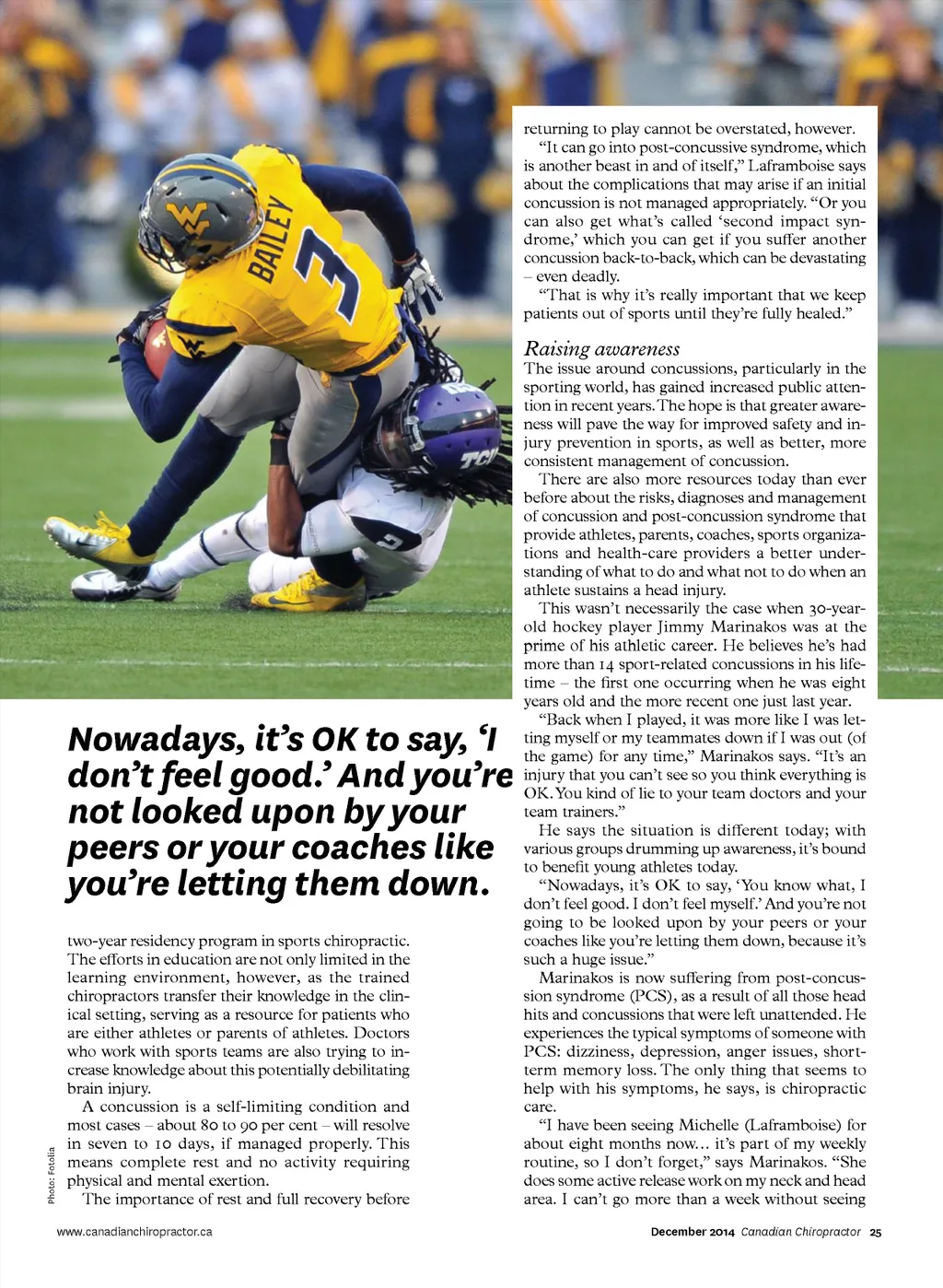
returning to play cannot be overstated, however. “It can go into post-concussive syndrome, which is another beast in and of itself,” Laframboise says about the complications that may arise if an initial concussion is not managed appropriately. “Or you can also get what’s called ‘second impact syn-drome,’ which you can get if you suffer another concussion back-to-back, which can be devastating – even deadly. “That is why it’s really important that we keep patients out of sports until they’re fully healed.” The issue around concussions, particularly in the sporting world, has gained increased public atten-tion in recent years. The hope is that greater aware-ness will pave the way for improved safety and in-jury prevention in sports, as well as better, more consistent management of concussion. There are also more resources today than ever before about the risks, diagnoses and management of concussion and post-concussion syndrome that provide athletes, parents, coaches, sports organiza-tions and health-care providers a better under-standing of what to do and what not to do when an athlete sustains a head injury. This wasn’t necessarily the case when 30-year-old hockey player Jimmy Marinakos was at the prime of his athletic career. He believes he’s had more than 14 sport-related concussions in his life-time – the first one occurring when he was eight years old and the more recent one just last year. “Back when I played, it was more like I was let-ting myself or my teammates down if I was out (of the game) for any time,” Marinakos says. “It’s an injury that you can’t see so you think everything is OK. You kind of lie to your team doctors and your team trainers.” He says the situation is different today; with various groups drumming up awareness, it’s bound to benefit young athletes today. “Nowadays, it’s OK to say, ‘You know what, I don’t feel good. I don’t feel myself.’ And you’re not going to be looked upon by your peers or your coaches like you’re letting them down, because it’s such a huge issue.” Marinakos is now suffering from post-concus-sion syndrome (PCS), as a result of all those head hits and concussions that were left unattended. He experiences the typical symptoms of someone with PCS: dizziness, depression, anger issues, short-term memory loss. The only thing that seems to help with his symptoms, he says, is chiropractic care. “I have been seeing Michelle (Laframboise) for about eight months now… it’s part of my weekly routine, so I don’t forget,” says Marinakos. “She does some active release work on my neck and head area. I can’t go more than a week without seeing December 2014 Canadian Chiropractor 25 Raising awareness nowadays, it’s oK to say, ‘i don’t feel good.’ And you’re not looked upon by your peers or your coaches like you’re letting them down. two-year residency program in sports chiropractic. The efforts in education are not only limited in the learning environment, however, as the trained chiropractors transfer their knowledge in the clin-ical setting, serving as a resource for patients who are either athletes or parents of athletes. Doctors who work with sports teams are also trying to in-crease knowledge about this potentially debilitating brain injury. A concussion is a self-limiting condition and most cases – about 80 to 90 per cent – will resolve in seven to 10 days, if managed properly. This means complete rest and no activity requiring physical and mental exertion. The importance of rest and full recovery before www.canadianchiropractor.ca Photo: Fotolia
Chiropractic + Naturopathic Doctor December 2014: Page 25