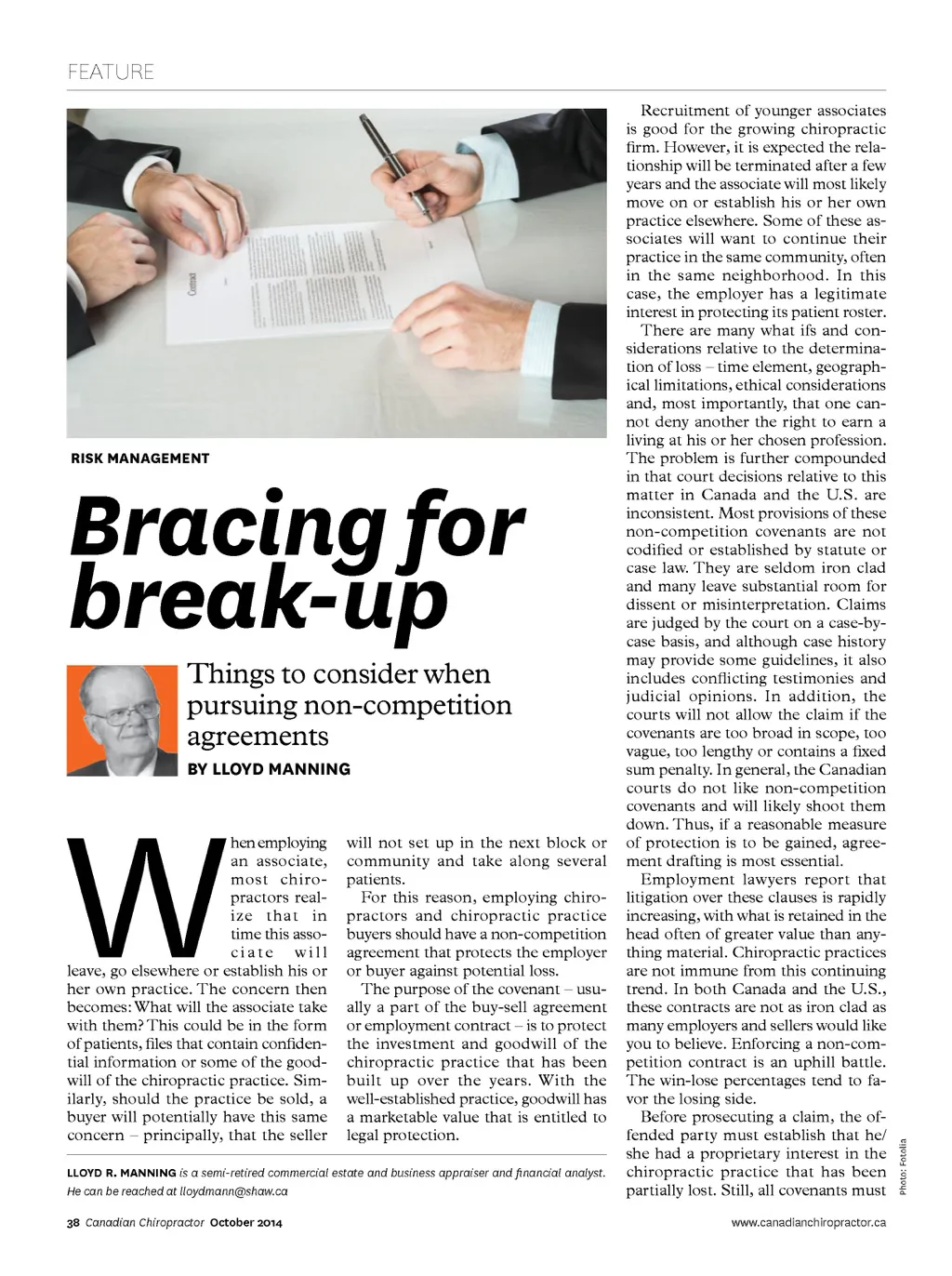
FEATURE Recruitment of younger associates is good for the growing chiropractic firm. However, it is expected the rela-tionship will be terminated after a few years and the associate will most likely move on or establish his or her own practice elsewhere. Some of these as-sociates will want to continue their practice in the same community, often in the same neighborhood. In this case, the employer has a legitimate interest in protecting its patient roster. There are many what ifs and con-siderations relative to the determina-tion of loss – time element, geograph-ical limitations, ethical considerations and, most importantly, that one can-not deny another the right to earn a living at his or her chosen profession. The problem is further compounded in that court decisions relative to this matter in Canada and the U.S. are inconsistent. Most provisions of these non-competition covenants are not codified or established by statute or case law. They are seldom iron clad and many leave substantial room for dissent or misinterpretation. Claims are judged by the court on a case-by-case basis, and although case history may provide some guidelines, it also includes conflicting testimonies and judicial opinions. In addition, the courts will not allow the claim if the covenants are too broad in scope, too vague, too lengthy or contains a fixed sum penalty. In general, the Canadian courts do not like non-competition covenants and will likely shoot them down. Thus, if a reasonable measure of protection is to be gained, agree-ment drafting is most essential. Employment lawyers report that litigation over these clauses is rapidly increasing, with what is retained in the head often of greater value than any-thing material. Chiropractic practices are not immune from this continuing trend. In both Canada and the U.S., these contracts are not as iron clad as many employers and sellers would like you to believe. Enforcing a non-com-petition contract is an uphill battle. The win-lose percentages tend to fa-vor the losing side. Before prosecuting a claim, the of-fended party must establish that he/ she had a proprietary interest in the chiropractic practice that has been partially lost. Still, all covenants must www.canadianchiropractor.ca Bracing for break-up Things to consider when pursuing non-competition agreements RISK MANAGEMENT W BY LLOYD MANNING LLOYD R. MANNING is a semi-retired commercial estate and business appraiser and financial analyst. He can be reached at [email protected] 38 Canadian Chiropractor October 2014 Photo: Fotolia hen employing an associate, most chiro-practors real-ize that in time this asso-ciate will leave, go elsewhere or establish his or her own practice. The concern then becomes: What will the associate take with them? This could be in the form of patients, files that contain confiden-tial information or some of the good-will of the chiropractic practice. Sim-ilarly, should the practice be sold, a buyer will potentially have this same concern – principally, that the seller will not set up in the next block or community and take along several patients. For this reason, employing chiro-practors and chiropractic practice buyers should have a non-competition agreement that protects the employer or buyer against potential loss. The purpose of the covenant – usu-ally a part of the buy-sell agreement or employment contract – is to protect the investment and goodwill of the chiropractic practice that has been built up over the years. With the well-established practice, goodwill has a marketable value that is entitled to legal protection.
Chiropractic + Naturopathic Doctor October 2014: Page 38