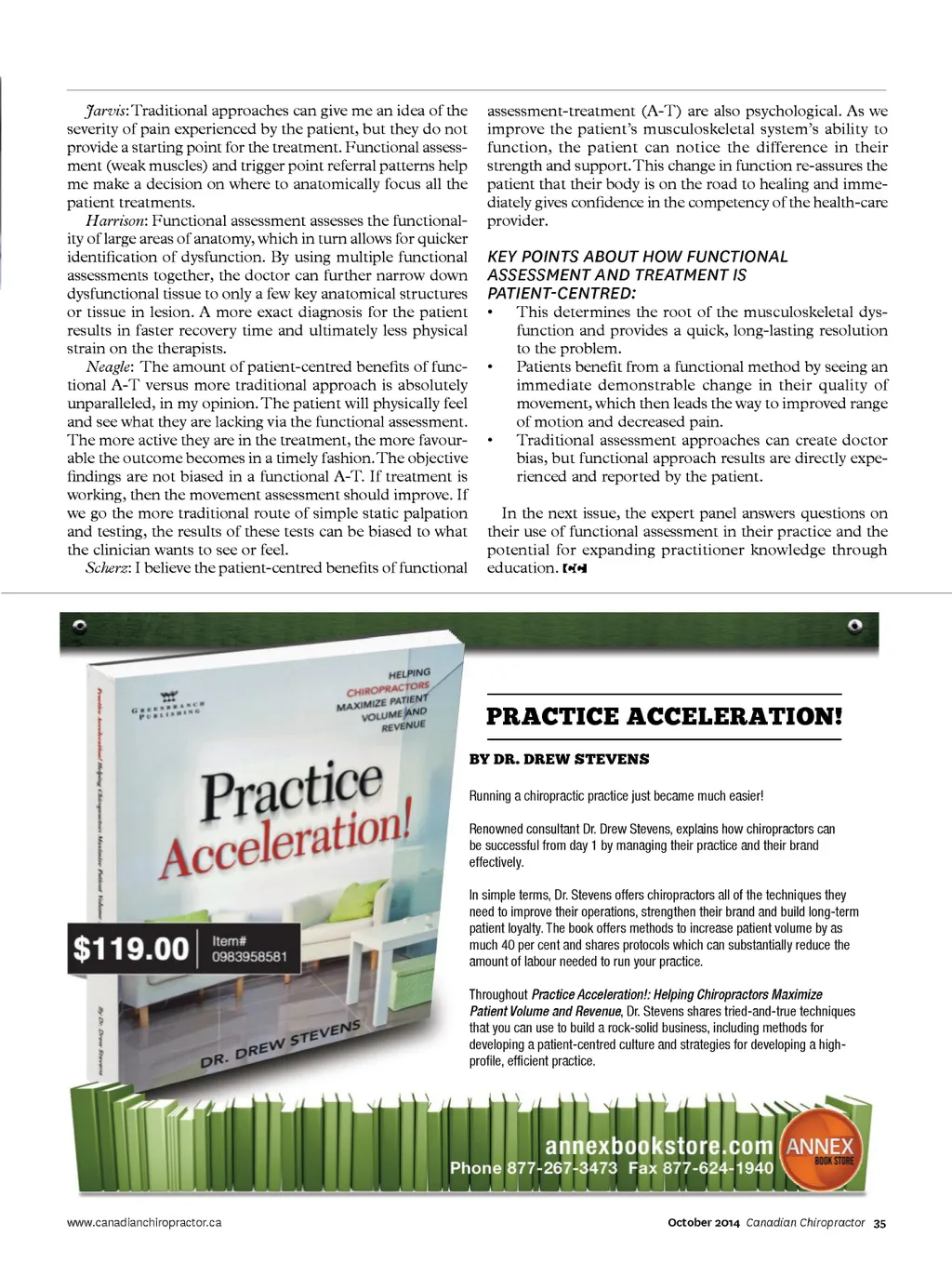
Jarvis : Traditional approaches can give me an idea of the severity of pain experienced by the patient, but they do not provide a starting point for the treatment. Functional assess-ment (weak muscles) and trigger point referral patterns help me make a decision on where to anatomically focus all the patient treatments. Harrison : Functional assessment assesses the functional-ity of large areas of anatomy, which in turn allows for quicker identification of dysfunction. By using multiple functional assessments together, the doctor can further narrow down dysfunctional tissue to only a few key anatomical structures or tissue in lesion. A more exact diagnosis for the patient results in faster recovery time and ultimately less physical strain on the therapists. Neagle : The amount of patient-centred benefits of func-tional A-T versus more traditional approach is absolutely unparalleled, in my opinion. The patient will physically feel and see what they are lacking via the functional assessment. The more active they are in the treatment, the more favour-able the outcome becomes in a timely fashion. The objective findings are not biased in a functional A-T. If treatment is working, then the movement assessment should improve. If we go the more traditional route of simple static palpation and testing, the results of these tests can be biased to what the clinician wants to see or feel. Scherz : I believe the patient-centred benefits of functional assessment-treatment (A-T) are also psychological. As we improve the patient’s musculoskeletal system’s ability to function, the patient can notice the difference in their strength and support. This change in function re-assures the patient that their body is on the road to healing and imme-diately gives confidence in the competency of the health-care provider. KEY POINTS ABOUT HOW FUNCTIONAL ASSESSMENT AND TREATMENT IS PATIENT-CENTRED: • • • This determines the root of the musculoskeletal dys-function and provides a quick, long-lasting resolution to the problem. Patients benefit from a functional method by seeing an immediate demonstrable change in their quality of movement, which then leads the way to improved range of motion and decreased pain. Traditional assessment approaches can create doctor bias, but functional approach results are directly expe-rienced and reported by the patient. In the next issue, the expert panel answers questions on their use of functional assessment in their practice and the potential for expanding practitioner knowledge through education. Practice acceleration! by Dr. Drew StevenS Running a chiropractic practice just became much easier! Renowned consultant Dr. Drew Stevens, explains how chiropractors can be successful from day 1 by managing their practice and their brand effectively. In simple terms, Dr. Stevens offers chiropractors all of the techniques they need to improve their operations, strengthen their brand and build long-term patient loyalty. The book offers methods to increase patient volume by as much 40 per cent and shares protocols which can substantially reduce the amount of labour needed to run your practice. Throughout Practice Acceleration!: Helping Chiropractors Maximize Patient Volume and Revenue , Dr. Stevens shares tried-and-true techniques that you can use to build a rock-solid business, including methods for developing a patient-centred culture and strategies for developing a high-profile, efficient practice. www.canadianchiropractor.ca Chiro book ad july13.indd 1 October 2014 Canadian Chiropractor 35 2013-06-18 7:16 AM
Chiropractic + Naturopathic Doctor October 2014: Page 35