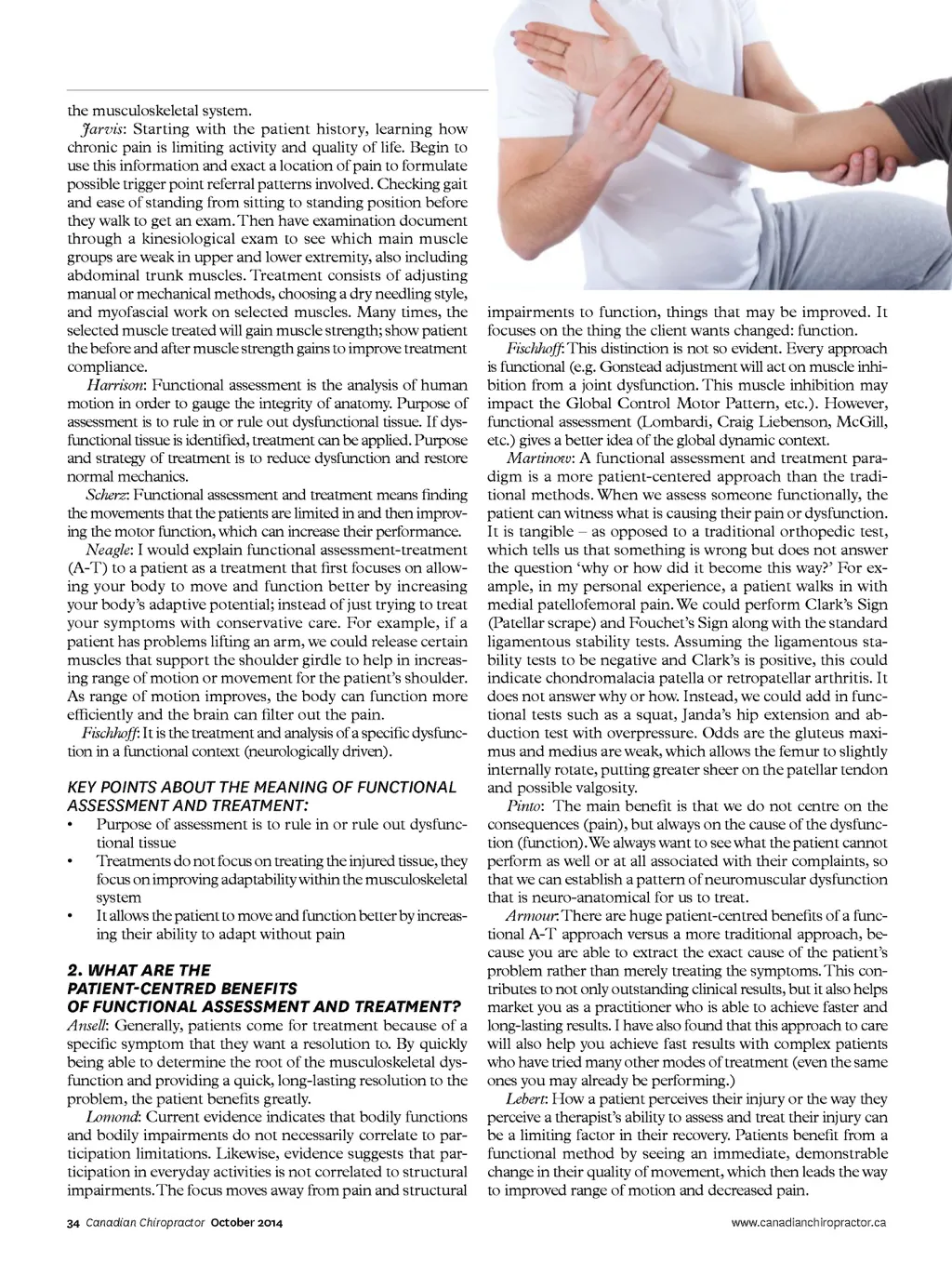
the musculoskeletal system. Jarvis : Starting with the patient history, learning how chronic pain is limiting activity and quality of life. Begin to use this information and exact a location of pain to formulate possible trigger point referral patterns involved. Checking gait and ease of standing from sitting to standing position before they walk to get an exam. Then have examination document through a kinesiological exam to see which main muscle groups are weak in upper and lower extremity, also including abdominal trunk muscles. Treatment consists of adjusting manual or mechanical methods, choosing a dry needling style, and myofascial work on selected muscles. Many times, the selected muscle treated will gain muscle strength; show patient the before and after muscle strength gains to improve treatment compliance. Harrison : Functional assessment is the analysis of human motion in order to gauge the integrity of anatomy. Purpose of assessment is to rule in or rule out dysfunctional tissue. If dys-functional tissue is identified, treatment can be applied. Purpose and strategy of treatment is to reduce dysfunction and restore normal mechanics. Scherz : Functional assessment and treatment means finding the movements that the patients are limited in and then improv-ing the motor function, which can increase their performance. Neagle : I would explain functional assessment-treatment (A-T) to a patient as a treatment that first focuses on allow-ing your body to move and function better by increasing your body’s adaptive potential; instead of just trying to treat your symptoms with conservative care. For example, if a patient has problems lifting an arm, we could release certain muscles that support the shoulder girdle to help in increas-ing range of motion or movement for the patient’s shoulder. As range of motion improves, the body can function more efficiently and the brain can filter out the pain. Fischhoff : It is the treatment and analysis of a specific dysfunc-tion in a functional context (neurologically driven). KEY POINTS ABOUT THE MEANING OF FUNCTIONAL ASSESSMENT AND TREATMENT: • • • Purpose of assessment is to rule in or rule out dysfunc-tional tissue Treatments do not focus on treating the injured tissue, they focus on improving adaptability within the musculoskeletal system It allows the patient to move and function better by increas-ing their ability to adapt without pain 2. WHAT ARE THE PATIENT-CENTRED BENEFITS OF FUNCTIONAL ASSESSMENT AND TREATMENT? Ansell : Generally, patients come for treatment because of a specific symptom that they want a resolution to. By quickly being able to determine the root of the musculoskeletal dys-function and providing a quick, long-lasting resolution to the problem, the patient benefits greatly. Lomond : Current evidence indicates that bodily functions and bodily impairments do not necessarily correlate to par-ticipation limitations. Likewise, evidence suggests that par-ticipation in everyday activities is not correlated to structural impairments. The focus moves away from pain and structural 34 Canadian Chiropractor October 2014 impairments to function, things that may be improved. It focuses on the thing the client wants changed: function. Fischhoff : This distinction is not so evident. Every approach is functional (e.g. Gonstead adjustment will act on muscle inhi-bition from a joint dysfunction. This muscle inhibition may impact the Global Control Motor Pattern, etc.). However, functional assessment (Lombardi, Craig Liebenson, McGill, etc.) gives a better idea of the global dynamic context. Martinow : A functional assessment and treatment para-digm is a more patient-centered approach than the tradi-tional methods. When we assess someone functionally, the patient can witness what is causing their pain or dysfunction. It is tangible – as opposed to a traditional orthopedic test, which tells us that something is wrong but does not answer the question ‘why or how did it become this way?’ For ex-ample, in my personal experience, a patient walks in with medial patellofemoral pain. We could perform Clark’s Sign (Patellar scrape) and Fouchet’s Sign along with the standard ligamentous stability tests. Assuming the ligamentous sta-bility tests to be negative and Clark’s is positive, this could indicate chondromalacia patella or retropatellar arthritis. It does not answer why or how. Instead, we could add in func-tional tests such as a squat, Janda’s hip extension and ab-duction test with overpressure. Odds are the gluteus maxi-mus and medius are weak, which allows the femur to slightly internally rotate, putting greater sheer on the patellar tendon and possible valgosity. Pinto : The main benefit is that we do not centre on the consequences (pain), but always on the cause of the dysfunc-tion (function). We always want to see what the patient cannot perform as well or at all associated with their complaints, so that we can establish a pattern of neuromuscular dysfunction that is neuro-anatomical for us to treat. Armour : There are huge patient-centred benefits of a func-tional A-T approach versus a more traditional approach, be-cause you are able to extract the exact cause of the patient’s problem rather than merely treating the symptoms. This con-tributes to not only outstanding clinical results, but it also helps market you as a practitioner who is able to achieve faster and long-lasting results. I have also found that this approach to care will also help you achieve fast results with complex patients who have tried many other modes of treatment (even the same ones you may already be performing.) Lebert : How a patient perceives their injury or the way they perceive a therapist’s ability to assess and treat their injury can be a limiting factor in their recovery. Patients benefit from a functional method by seeing an immediate, demonstrable change in their quality of movement, which then leads the way to improved range of motion and decreased pain. www.canadianchiropractor.ca
Chiropractic + Naturopathic Doctor October 2014: Page 34