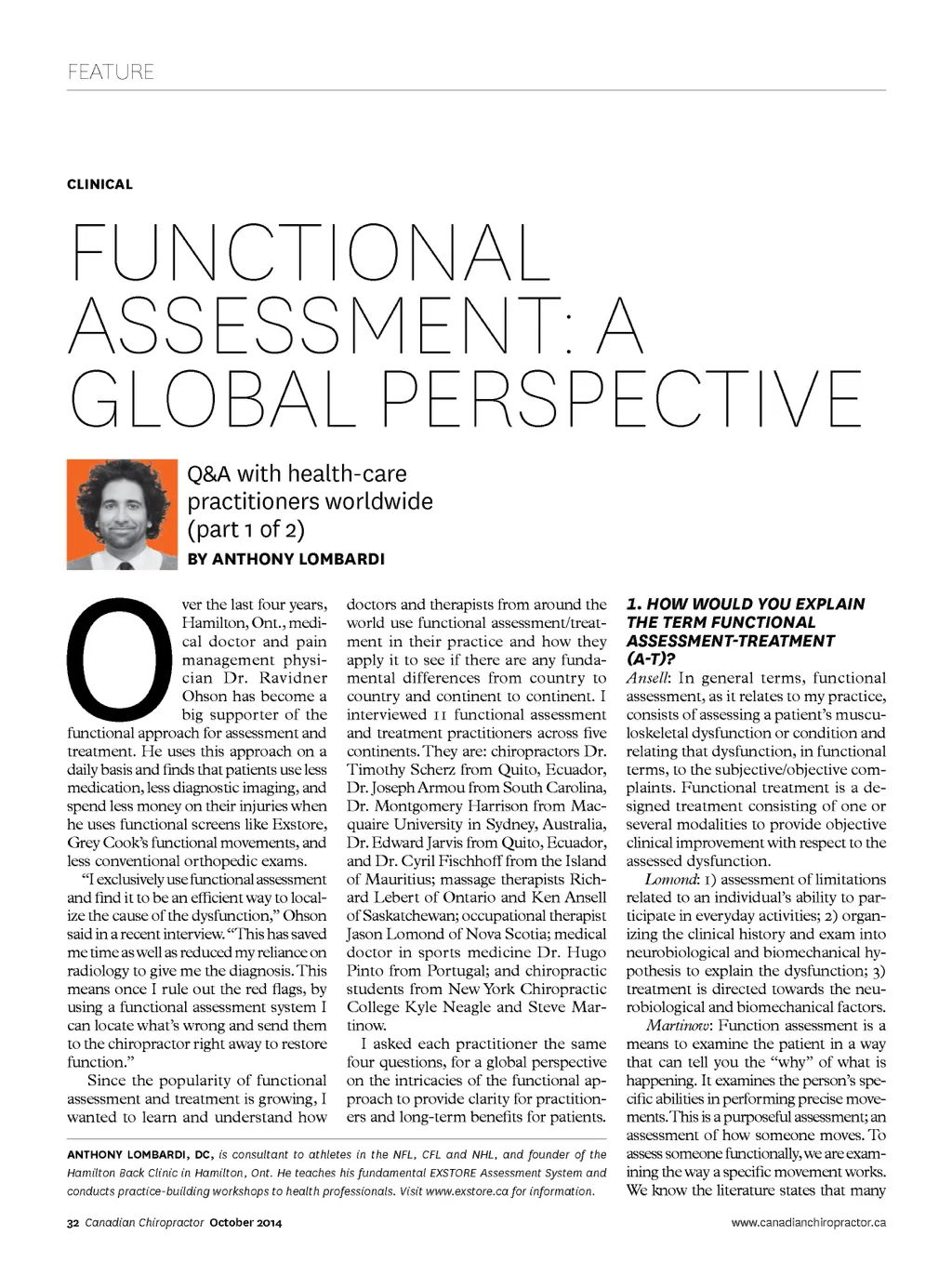
FEATURE CLINICAL FUNCTIONAL ASSESSMENT: A GLOBAL PERSPECTIVE O Q&A with health-care practitioners worldwide (part 1 of 2) BY ANTHONY LOMBARDI doctors and therapists from around the world use functional assessment/treat-ment in their practice and how they apply it to see if there are any funda-mental differences from country to country and continent to continent. I interviewed 11 functional assessment and treatment practitioners across five continents. They are: chiropractors Dr. Timothy Scherz from Quito, Ecuador, Dr. Joseph Armou from South Carolina, Dr. Montgomery Harrison from Mac-quaire University in Sydney, Australia, Dr. Edward Jarvis from Quito, Ecuador, and Dr. Cyril Fischhoff from the Island of Mauritius; massage therapists Rich-ard Lebert of Ontario and Ken Ansell of Saskatchewan; occupational therapist Jason Lomond of Nova Scotia; medical doctor in sports medicine Dr. Hugo Pinto from Portugal; and chiropractic students from New York Chiropractic College Kyle Neagle and Steve Mar-tinow. I asked each practitioner the same four questions, for a global perspective on the intricacies of the functional ap-proach to provide clarity for practition-ers and long-term benefits for patients. ver the last four years, Hamilton, Ont., medi-cal doctor and pain management physi-cian Dr. Ravidner Ohson has become a big supporter of the functional approach for assessment and treatment. He uses this approach on a daily basis and finds that patients use less medication, less diagnostic imaging, and spend less money on their injuries when he uses functional screens like Exstore, Grey Cook’s functional movements, and less conventional orthopedic exams. “I exclusively use functional assessment and find it to be an efficient way to local-ize the cause of the dysfunction,” Ohson said in a recent interview. “This has saved me time as well as reduced my reliance on radiology to give me the diagnosis. This means once I rule out the red flags, by using a functional assessment system I can locate what’s wrong and send them to the chiropractor right away to restore function.” Since the popularity of functional assessment and treatment is growing, I wanted to learn and understand how 1. HOW WOULD YOU EXPLAIN THE TERM FUNCTIONAL ASSESSMENT-TREATMENT (A-T)? ANTHONY LOMBARDI, DC, is consultant to athletes in the NFL, CFL and NHL, and founder of the Hamilton Back Clinic in Hamilton, Ont. He teaches his fundamental EXSTORE Assessment System and conducts practice-building workshops to health professionals. Visit www.exstore.ca for information. 32 Canadian Chiropractor October 2014 Ansell : In general terms, functional assessment, as it relates to my practice, consists of assessing a patient’s muscu-loskeletal dysfunction or condition and relating that dysfunction, in functional terms, to the subjective/objective com-plaints. Functional treatment is a de-signed treatment consisting of one or several modalities to provide objective clinical improvement with respect to the assessed dysfunction. Lomond : 1) assessment of limitations related to an individual’s ability to par-ticipate in everyday activities; 2) organ-izing the clinical history and exam into neurobiological and biomechanical hy-pothesis to explain the dysfunction; 3) treatment is directed towards the neu-robiological and biomechanical factors. Martinow : Function assessment is a means to examine the patient in a way that can tell you the “why” of what is happening. It examines the person’s spe-cific abilities in performing precise move-ments. This is a purposeful assessment; an assessment of how someone moves. To assess someone functionally, we are exam-ining the way a specific movement works. We know the literature states that many www.canadianchiropractor.ca
Chiropractic + Naturopathic Doctor October 2014: Page 32