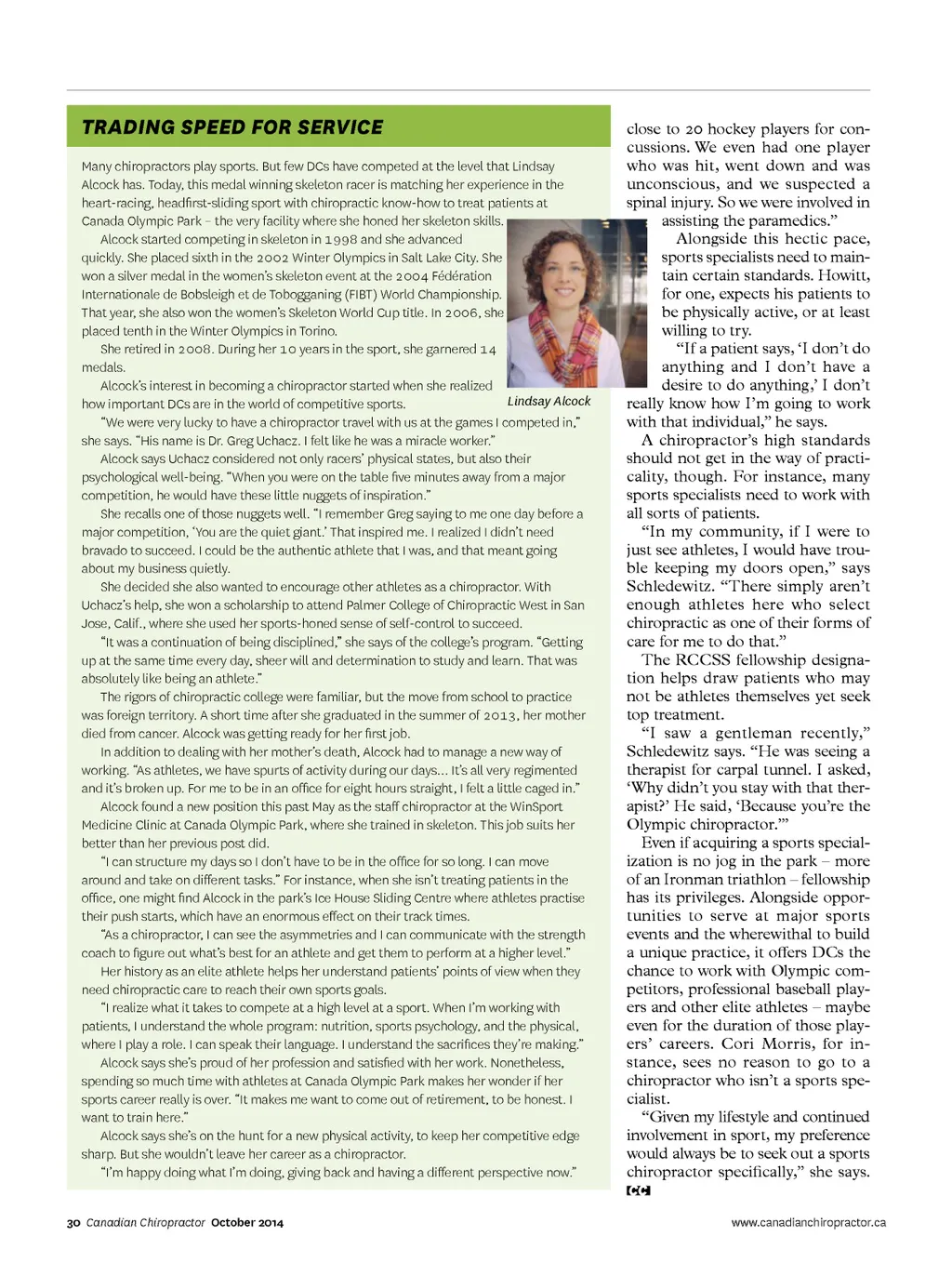
TRADING SPEED FOR SERVICE Many chiropractors play sports. But few DCs have competed at the level that Lindsay Alcock has. Today, this medal winning skeleton racer is matching her experience in the heart-racing, headfirst-sliding sport with chiropractic know-how to treat patients at Canada Olympic Park – the very facility where she honed her skeleton skills. Alcock started competing in skeleton in 1998 and she advanced quickly. She placed sixth in the 2002 Winter Olympics in Salt Lake City. She won a silver medal in the women’s skeleton event at the 2004 Fédération Internationale de Bobsleigh et de Tobogganing (FIBT) World Championship. That year, she also won the women’s Skeleton World Cup title. In 2006, she placed tenth in the Winter Olympics in Torino. She retired in 2008. During her 10 years in the sport, she garnered 14 medals. Alcock’s interest in becoming a chiropractor started when she realized Lindsay Alcock how important DCs are in the world of competitive sports. “We were very lucky to have a chiropractor travel with us at the games I competed in,” she says. “His name is Dr. Greg Uchacz. I felt like he was a miracle worker.” Alcock says Uchacz considered not only racers’ physical states, but also their psychological well-being. “When you were on the table five minutes away from a major competition, he would have these little nuggets of inspiration.” She recalls one of those nuggets well. “I remember Greg saying to me one day before a major competition, ‘You are the quiet giant.’ That inspired me. I realized I didn’t need bravado to succeed. I could be the authentic athlete that I was, and that meant going about my business quietly. She decided she also wanted to encourage other athletes as a chiropractor. With Uchacz’s help, she won a scholarship to attend Palmer College of Chiropractic West in San Jose, Calif., where she used her sports-honed sense of self-control to succeed. “It was a continuation of being disciplined,” she says of the college’s program. “Getting up at the same time every day, sheer will and determination to study and learn. That was absolutely like being an athlete.” The rigors of chiropractic college were familiar, but the move from school to practice was foreign territory. A short time after she graduated in the summer of 2013, her mother died from cancer. Alcock was getting ready for her first job. In addition to dealing with her mother’s death, Alcock had to manage a new way of working. “As athletes, we have spurts of activity during our days… It’s all very regimented and it’s broken up. For me to be in an office for eight hours straight, I felt a little caged in.” Alcock found a new position this past May as the staff chiropractor at the WinSport Medicine Clinic at Canada Olympic Park, where she trained in skeleton. This job suits her better than her previous post did. “I can structure my days so I don’t have to be in the office for so long. I can move around and take on different tasks.” For instance, when she isn’t treating patients in the office, one might find Alcock in the park’s Ice House Sliding Centre where athletes practise their push starts, which have an enormous effect on their track times. “As a chiropractor, I can see the asymmetries and I can communicate with the strength coach to figure out what’s best for an athlete and get them to perform at a higher level.” Her history as an elite athlete helps her understand patients’ points of view when they need chiropractic care to reach their own sports goals. “I realize what it takes to compete at a high level at a sport. When I’m working with patients, I understand the whole program: nutrition, sports psychology, and the physical, where I play a role. I can speak their language. I understand the sacrifices they’re making.” Alcock says she’s proud of her profession and satisfied with her work. Nonetheless, spending so much time with athletes at Canada Olympic Park makes her wonder if her sports career really is over. “It makes me want to come out of retirement, to be honest. I want to train here.” Alcock says she’s on the hunt for a new physical activity, to keep her competitive edge sharp. But she wouldn’t leave her career as a chiropractor. “I’m happy doing what I’m doing, giving back and having a different perspective now.” 30 Canadian Chiropractor October 2014 close to 20 hockey players for con-cussions. We even had one player who was hit, went down and was unconscious, and we suspected a spinal injury. So we were involved in assisting the paramedics.” Alongside this hectic pace, sports specialists need to main-tain certain standards. Howitt, for one, expects his patients to be physically active, or at least willing to try. “If a patient says, ‘I don’t do anything and I don’t have a desire to do anything,’ I don’t really know how I’m going to work with that individual,” he says. A chiropractor’s high standards should not get in the way of practi-cality, though. For instance, many sports specialists need to work with all sorts of patients. “In my community, if I were to just see athletes, I would have trou-ble keeping my doors open,” says Schledewitz. “There simply aren’t enough athletes here who select chiropractic as one of their forms of care for me to do that.” The RCCSS fellowship designa-tion helps draw patients who may not be athletes themselves yet seek top treatment. “I saw a gentleman recently,” Schledewitz says. “He was seeing a therapist for carpal tunnel. I asked, ‘Why didn’t you stay with that ther-apist?’ He said, ‘Because you’re the Olympic chiropractor.’” Even if acquiring a sports special-ization is no jog in the park – more of an Ironman triathlon – fellowship has its privileges. Alongside oppor-tunities to serve at major sports events and the wherewithal to build a unique practice, it offers DCs the chance to work with Olympic com-petitors, professional baseball play-ers and other elite athletes – maybe even for the duration of those play-ers’ careers. Cori Morris, for in-stance, sees no reason to go to a chiropractor who isn’t a sports spe-cialist. “Given my lifestyle and continued involvement in sport, my preference would always be to seek out a sports chiropractor specifically,” she says. www.canadianchiropractor.ca
Chiropractic + Naturopathic Doctor October 2014: Page 30