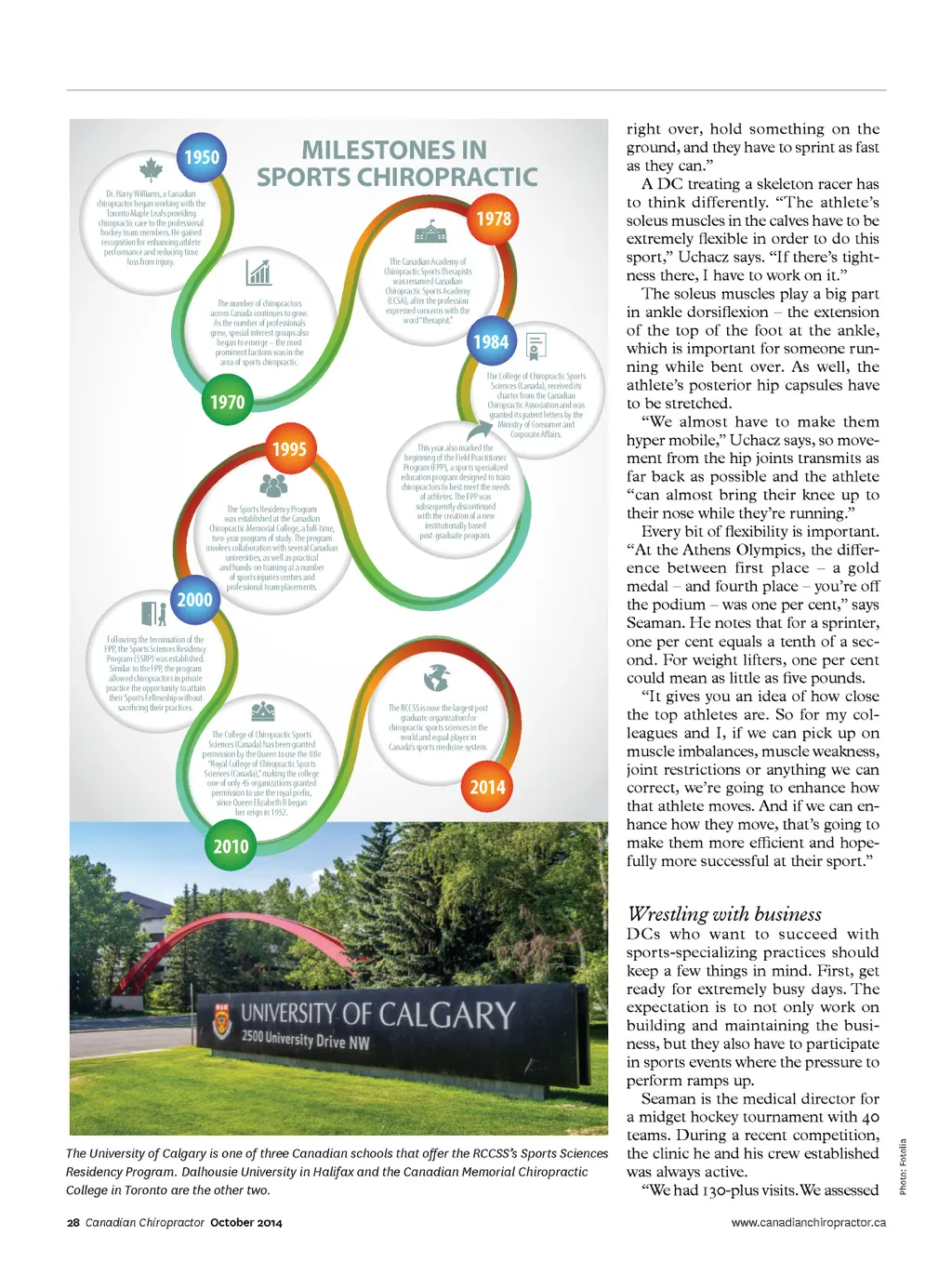
1950 Dr. Harry Williams, a Canadian chiropractor began working with the Toronto Maple Leafs providing chiropractic care to the professional hockey team members. He gained recognition for enhancing athlete performance and reducing time loss from injury. MILESTONES IN SPORTS CHIROPRACTIC 1978 The Canadian Academy of Chiropractic Sports Therapists was renamed Canadian Chiropractic Sports Academy (CCSA), after the profession expressed concerns with the word “therapist.” The number of chiropractors across Canada continues to grow. As the number of professionals grew, special interest groups also began to emerge – the most prominent factions was in the area of sports chiropractic. 1984 The College of Chiropractic Sports Sciences (Canada), received its charter from the Canadian Chiropractic Association and was granted its patent letters by the Ministry of Consumer and Corporate Aairs. This year also marked the beginning of the Field Practitioner Program (FPP), a sports specialized education program designed to train chiropractors to best meet the needs of athletes. The FPP was subsequently discontinued with the creation of a new institutionally based post-graduate program. 1970 1995 The Sports Residency Program was established at the Canadian Chiropractic Memorial College, a full-time, two-year program of study. The program involves collaboration with several Canadian universities, as well as practical and hands-on training at a number of sports injuries centres and professional team placements. 2000 Following the termination of the FPP, the Sports Sciences Residency Program (SSRP) was established. Similar to the FPP, the program allowed chiropractors in private practice the opportunity to attain their Sports Fellowship without sacricing their practices. The College of Chiropractic Sports Sciences (Canada) has been granted permission by the Queen to use the title “Royal College of Chiropractic Sports Sciences (Canada),” making the college one of only 45 organizations granted permission to use the royal prex, since Queen Elizabeth II began her reign in 1952. The RCCSS is now the largest post graduate organization for chiropractic sports sciences in the world and equal player in Canada’s sports medicine system. 2014 2010 right over, hold something on the ground, and they have to sprint as fast as they can.” A DC treating a skeleton racer has to think differently. “The athlete’s soleus muscles in the calves have to be extremely flexible in order to do this sport,” Uchacz says. “If there’s tight-ness there, I have to work on it.” The soleus muscles play a big part in ankle dorsiflexion – the extension of the top of the foot at the ankle, which is important for someone run-ning while bent over. As well, the athlete’s posterior hip capsules have to be stretched. “We almost have to make them hyper mobile,” Uchacz says, so move-ment from the hip joints transmits as far back as possible and the athlete “can almost bring their knee up to their nose while they’re running.” Every bit of flexibility is important. “At the Athens Olympics, the differ-ence between first place – a gold medal – and fourth place – you’re off the podium – was one per cent,” says Seaman. He notes that for a sprinter, one per cent equals a tenth of a sec-ond. For weight lifters, one per cent could mean as little as five pounds. “It gives you an idea of how close the top athletes are. So for my col-leagues and I, if we can pick up on muscle imbalances, muscle weakness, joint restrictions or anything we can correct, we’re going to enhance how that athlete moves. And if we can en-hance how they move, that’s going to make them more efficient and hope-fully more successful at their sport.” Wrestling with business The University of Calgary is one of three Canadian schools that offer the RCCSS’s Sports Sciences Residency Program. Dalhousie University in Halifax and the Canadian Memorial Chiropractic College in Toronto are the other two. 28 Canadian Chiropractor October 2014 DCs who want to succeed with sports-specializing practices should keep a few things in mind. First, get ready for extremely busy days. The expectation is to not only work on building and maintaining the busi-ness, but they also have to participate in sports events where the pressure to perform ramps up. Seaman is the medical director for a midget hockey tournament with 40 teams. During a recent competition, the clinic he and his crew established was always active. “We had 130-plus visits. We assessed www.canadianchiropractor.ca Photo: Fotolia
Chiropractic + Naturopathic Doctor October 2014: Page 28