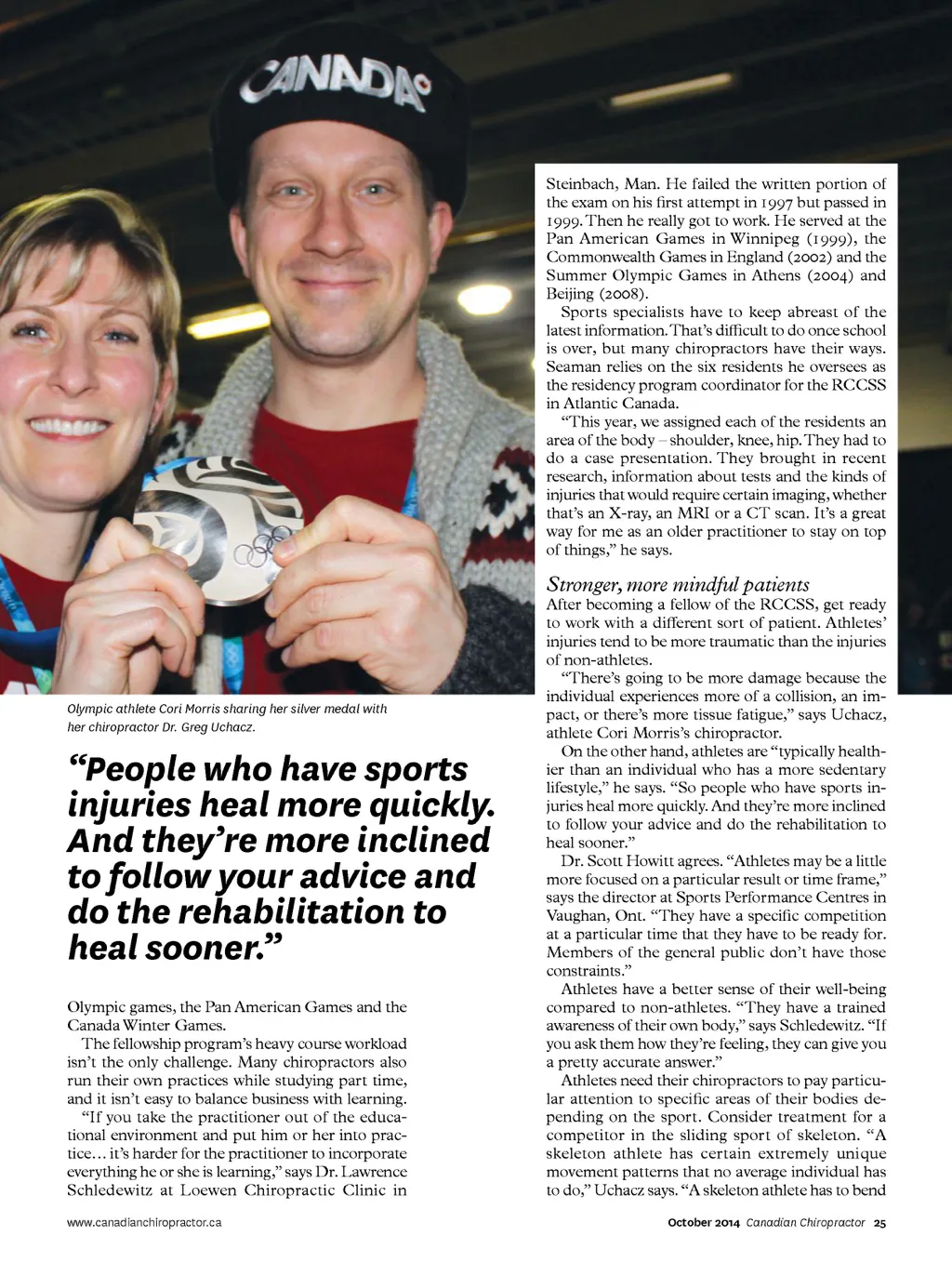
Steinbach, Man. He failed the written portion of the exam on his first attempt in 1997 but passed in 1999. Then he really got to work. He served at the Pan American Games in Winnipeg (1999), the Commonwealth Games in England (2002) and the Summer Olympic Games in Athens (2004) and Beijing (2008). Sports specialists have to keep abreast of the latest information. That’s difficult to do once school is over, but many chiropractors have their ways. Seaman relies on the six residents he oversees as the residency program coordinator for the RCCSS in Atlantic Canada. “This year, we assigned each of the residents an area of the body – shoulder, knee, hip. They had to do a case presentation. They brought in recent research, information about tests and the kinds of injuries that would require certain imaging, whether that’s an X-ray, an MRI or a CT scan. It’s a great way for me as an older practitioner to stay on top of things,” he says. After becoming a fellow of the RCCSS, get ready to work with a different sort of patient. Athletes’ injuries tend to be more traumatic than the injuries of non-athletes. “There’s going to be more damage because the individual experiences more of a collision, an im-pact, or there’s more tissue fatigue,” says Uchacz, athlete Cori Morris’s chiropractor. On the other hand, athletes are “typically health-ier than an individual who has a more sedentary lifestyle,” he says. “So people who have sports in-juries heal more quickly. And they’re more inclined to follow your advice and do the rehabilitation to heal sooner.” Dr. Scott Howitt agrees. “Athletes may be a little more focused on a particular result or time frame,” says the director at Sports Performance Centres in Vaughan, Ont. “They have a specific competition at a particular time that they have to be ready for. Members of the general public don’t have those constraints.” Athletes have a better sense of their well-being compared to non-athletes. “They have a trained awareness of their own body,” says Schledewitz. “If you ask them how they’re feeling, they can give you a pretty accurate answer.” Athletes need their chiropractors to pay particu-lar attention to specific areas of their bodies de-pending on the sport. Consider treatment for a competitor in the sliding sport of skeleton. “A skeleton athlete has certain extremely unique movement patterns that no average individual has to do,” Uchacz says. “A skeleton athlete has to bend October 2014 Canadian Chiropractor 25 Stronger, more mindful patients Olympic athlete Cori Morris sharing her silver medal with her chiropractor Dr. Greg Uchacz. “People who have sports injuries heal more quickly. And they’re more inclined to follow your advice and do the rehabilitation to heal sooner.” Olympic games, the Pan American Games and the Canada Winter Games. The fellowship program’s heavy course workload isn’t the only challenge. Many chiropractors also run their own practices while studying part time, and it isn’t easy to balance business with learning. “If you take the practitioner out of the educa-tional environment and put him or her into prac-tice… it’s harder for the practitioner to incorporate everything he or she is learning,” says Dr. Lawrence Schledewitz at Loewen Chiropractic Clinic in www.canadianchiropractor.ca
Chiropractic + Naturopathic Doctor October 2014: Page 25