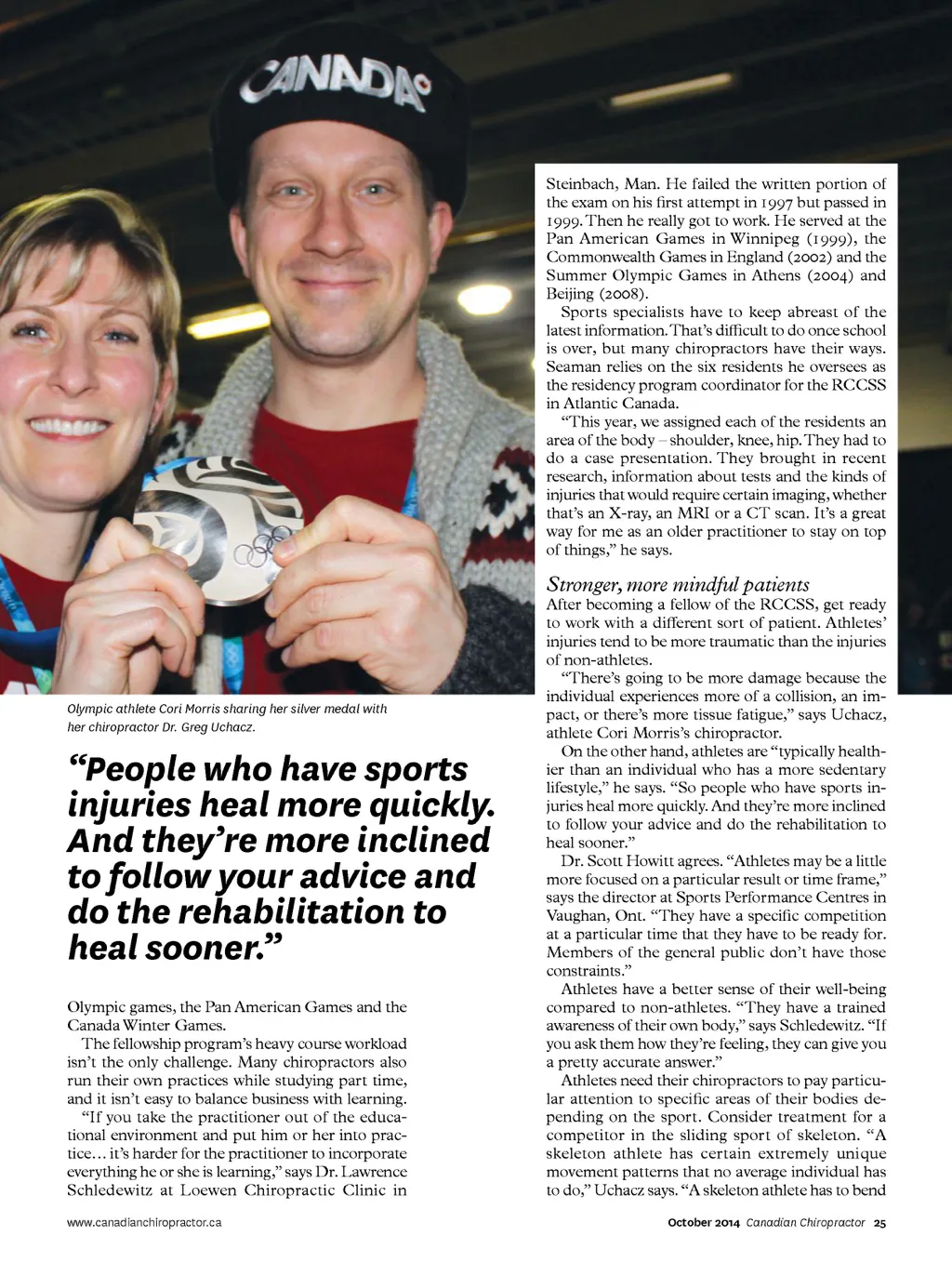
COVER Sporting chance Pursuing sports chiropractic as a career path can be as rewarding as it is challenging SPORTS CHIROPRACTIC Y B y S tefan D uBowSki STEFAN DUBOWSKI is a freelance writer based in Ottawa. You can reach him at [email protected]. 24 Canadian Chiropractor October 2014 www.canadianchiropractor.ca Photo creidt: Dr. Greg Uchacz ou might know Cori Morris as a member of the women’s curling team that won the silver medal at the Van-couver 2010 Winter Olympics. But you might not know just how impor-tant chiropractic care is for this Cal-gary athlete. When Morris was in her early 20s, she started having trouble with her sacroiliac joint – a result of imbalances caused by years of figure skating and other sports. Chiropractic treatment helped. But when she began curling on a competitive level, the care she was receiving no longer did the job. Seek-ing a different option, Morris found ProActive Health Group in Calgary, where Dr. Greg Uchacz is the clinic director. “I checked out the website and saw Greg’s in-volvement with athletes at the highest levels, and decided to give it a try,” Morris says. “Greg became an instrumental part of a journey that took me all the way to the podium.” Uchacz knows chiropractic care for athletes. He is a fellow of the Royal College of Chiropractic Sports Sciences – Canada (RCCSS), which means he has completed the college’s rigorous Sports Sciences Residency Program. He has also sup-ported athletes at more than 180 international competitions, including three Olympic Winter Games. He is the health-care director for Nordic Combined Canada. For eight years, he was RCCSS’s president. And – like other sports spe-cialists – he faced an alpine incline to accomplish Sports chiropractic in Canada has existed for more than six decades these career achievements. In fact, any DC who has braved the RCCSS fellowship program and gone on to specialize in treating athletes may be said to have tackled a task that mimics what their patients face as they sweat their way to sports excellence. It involves effort, sacrifice and dedication with no guarantee of suc-cess. Yet RCCSS fellows say their work is as reward-ing as a gold medal finish. Want to know what it takes to be a sports spe-cialist? Read on to learn about the educational gauntlet, characteristics of the elite-athlete patient, and the business aspects of operating a sports-fo-cused practice. A left hook to the books RCCSS’s Sports Sciences Residency Program is the course every chiropractor has to master to be-come a sports specialist. Offered through a number of post-secondary institutions including the Uni-versity of Calgary, Dalhousie University in Halifax and Canadian Memorial Chiropractic College in Toronto, the program involves 1,000 hours of field-work and various subjects of study, such as nutri-tion, exercise physiology and acute injury manage-ment. The program has evolved since it began in 1984, but one aspect hasn’t changed: it’s difficult. Many chiropractors fail. “The volume of information is one thing,” says Dr. Brian Seaman at Halifax Chiropractic Clinic. Only three of the doctors who wrote the exam in his year of 1988 passed (including him). Five others failed. Seaman went on to treat competitors at four
Chiropractic + Naturopathic Doctor October 2014: Page 24