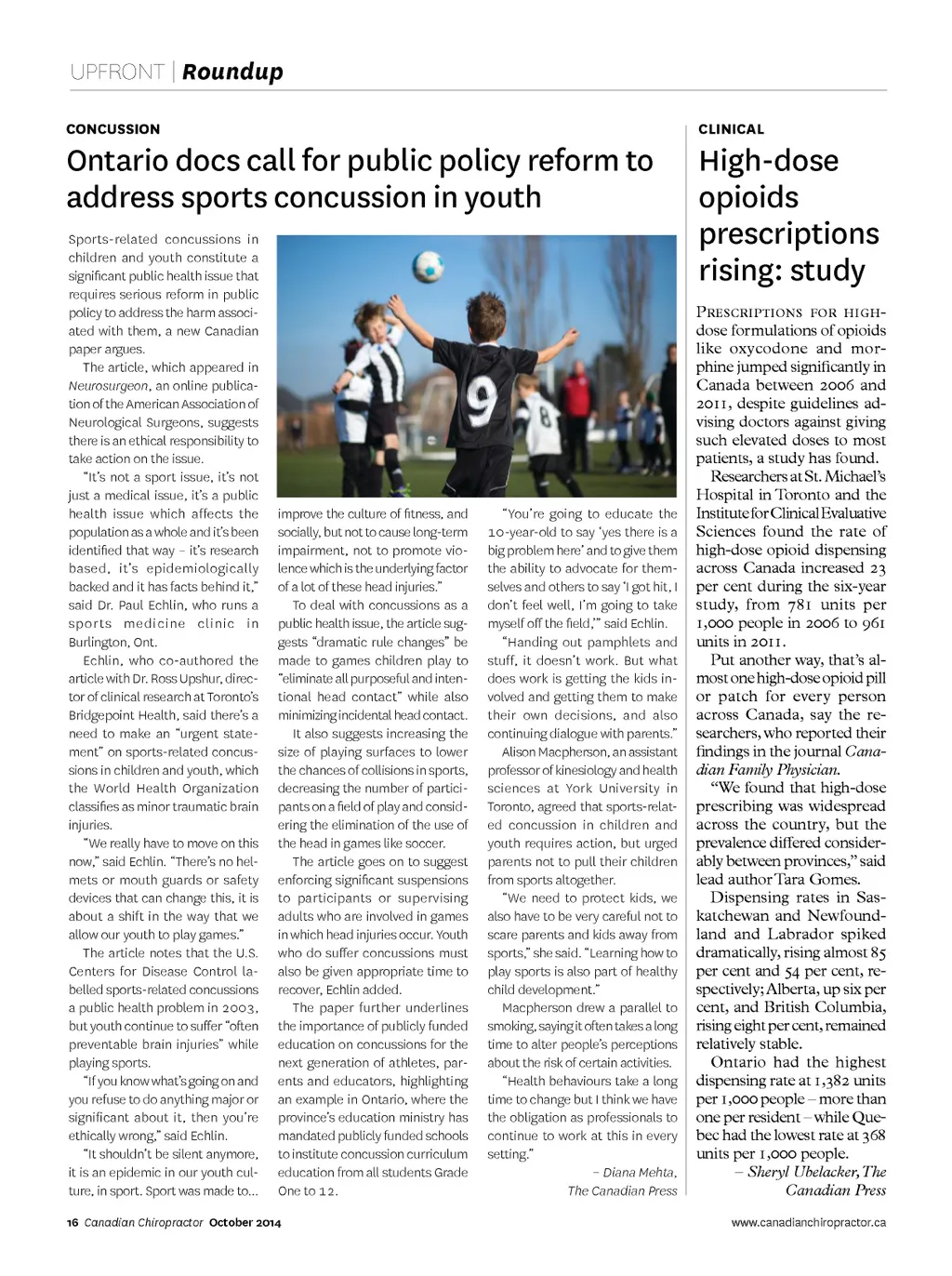
UPFRONT | Roundup CONCUSSION Ontario docs call for public policy reform to address sports concussion in youth Sports-related concussions in children and youth constitute a significant public health issue that requires serious reform in public policy to address the harm associ-ated with them, a new Canadian paper argues. The article, which appeared in Neurosurgeon , an online publica-tion of the American Association of Neurological Surgeons, suggests there is an ethical responsibility to take action on the issue. “It’s not a sport issue, it’s not just a medical issue, it’s a public health issue which affects the population as a whole and it’s been identified that way – it’s research based, it’s epidemiologically backed and it has facts behind it,” said Dr. Paul Echlin, who runs a sports medicine clinic in Burlington, Ont. Echlin, who co-authored the article with Dr. Ross Upshur, direc-tor of clinical research at Toronto’s Bridgepoint Health, said there’s a need to make an “urgent state-ment” on sports-related concus-sions in children and youth, which the World Health Organization classifies as minor traumatic brain injuries. “We really have to move on this now,” said Echlin. “There’s no hel-mets or mouth guards or safety devices that can change this, it is about a shift in the way that we allow our youth to play games.” The article notes that the U.S. Centers for Disease Control la-belled sports-related concussions a public health problem in 2003, but youth continue to suffer “often preventable brain injuries” while playing sports. “If you know what’s going on and you refuse to do anything major or significant about it, then you’re ethically wrong,” said Echlin. “It shouldn’t be silent anymore, it is an epidemic in our youth cul-ture, in sport. Sport was made to... CLINICAL High-dose opioids prescriptions rising: study Prescriptions for high-dose formulations of opioids like oxycodone and mor-phine jumped significantly in Canada between 2006 and 2011, despite guidelines ad-vising doctors against giving such elevated doses to most patients, a study has found. Researchers at St. Michael’s Hospital in Toronto and the Institute for Clinical Evaluative Sciences found the rate of high-dose opioid dispensing across Canada increased 23 per cent during the six-year study, from 781 units per 1,000 people in 2006 to 961 units in 2011. Put another way, that’s al-most one high-dose opioid pill or patch for every person across Canada, say the re-searchers, who reported their findings in the journal Cana-dian Family Physician. “We found that high-dose prescribing was widespread across the country, but the prevalence differed consider-ably between provinces,” said lead author Tara Gomes. Dispensing rates in Sas-katchewan and Newfound-land and Labrador spiked dramatically, rising almost 85 per cent and 54 per cent, re-spectively; Alberta, up six per cent, and British Columbia, rising eight per cent, remained relatively stable. Ontario had the highest dispensing rate at 1,382 units per 1,000 people – more than one per resident – while Que-bec had the lowest rate at 368 units per 1,000 people. – Sheryl Ubelacker, The Canadian Press www.canadianchiropractor.ca improve the culture of fitness, and socially, but not to cause long-term impairment, not to promote vio-lence which is the underlying factor of a lot of these head injuries.” To deal with concussions as a public health issue, the article sug-gests “dramatic rule changes” be made to games children play to “eliminate all purposeful and inten-tional head contact” while also minimizing incidental head contact. It also suggests increasing the size of playing surfaces to lower the chances of collisions in sports, decreasing the number of partici-pants on a field of play and consid-ering the elimination of the use of the head in games like soccer. The article goes on to suggest enforcing significant suspensions to participants or supervising adults who are involved in games in which head injuries occur. Youth who do suffer concussions must also be given appropriate time to recover, Echlin added. The paper further underlines the importance of publicly funded education on concussions for the next generation of athletes, par-ents and educators, highlighting an example in Ontario, where the province’s education ministry has mandated publicly funded schools to institute concussion curriculum education from all students Grade One to 12. “You’re going to educate the 10-year-old to say ‘yes there is a big problem here’ and to give them the ability to advocate for them-selves and others to say ‘I got hit, I don’t feel well, I’m going to take myself off the field,’” said Echlin. “Handing out pamphlets and stuff, it doesn’t work. But what does work is getting the kids in-volved and getting them to make their own decisions, and also continuing dialogue with parents.” Alison Macpherson, an assistant professor of kinesiology and health sciences at York University in Toronto, agreed that sports-relat-ed concussion in children and youth requires action, but urged parents not to pull their children from sports altogether. “We need to protect kids, we also have to be very careful not to scare parents and kids away from sports,” she said. “Learning how to play sports is also part of healthy child development.” Macpherson drew a parallel to smoking, saying it often takes a long time to alter people’s perceptions about the risk of certain activities. “Health behaviours take a long time to change but I think we have the obligation as professionals to continue to work at this in every setting.” – Diana Mehta, The Canadian Press 16 Canadian Chiropractor October 2014
Chiropractic + Naturopathic Doctor October 2014: Page 16