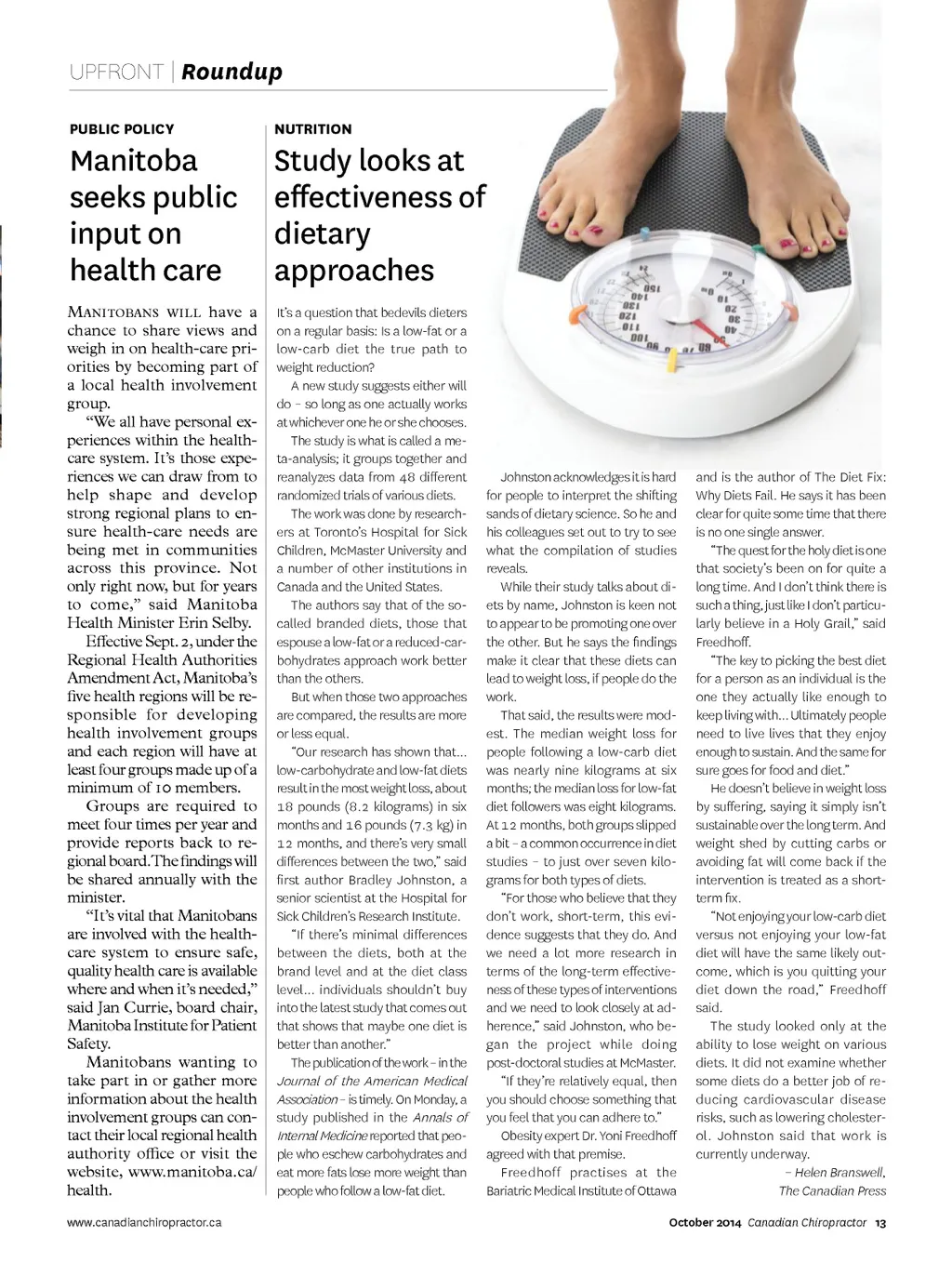
UPFRONT | Roundup PUBLIC POLICY Manitoba seeks public input on health care Manitobans will have a chance to share views and weigh in on health-care pri-orities by becoming part of a local health involvement group. “We all have personal ex-periences within the health-care system. It’s those expe-riences we can draw from to help shape and develop strong regional plans to en-sure health-care needs are being met in communities across this province. Not only right now, but for years to come,” said Manitoba Health Minister Erin Selby. Effective Sept. 2, under the Regional Health Authorities Amendment Act, Manitoba’s five health regions will be re-sponsible for developing health involvement groups and each region will have at least four groups made up of a minimum of 10 members. Groups are required to meet four times per year and provide reports back to re-gional board. The findings will be shared annually with the minister. “It’s vital that Manitobans are involved with the health-care system to ensure safe, quality health care is available where and when it’s needed,” said Jan Currie, board chair, Manitoba Institute for Patient Safety. Manitobans wanting to take part in or gather more information about the health involvement groups can con-tact their local regional health authority office or visit the website, www.manitoba.ca/ health. www.canadianchiropractor.ca NUTRITION Study looks at effectiveness of dietary approaches It’s a question that bedevils dieters on a regular basis: Is a low-fat or a low-carb diet the true path to weight reduction? A new study suggests either will do – so long as one actually works at whichever one he or she chooses. The study is what is called a me-ta-analysis; it groups together and reanalyzes data from 48 different randomized trials of various diets. The work was done by research-ers at Toronto’s Hospital for Sick Children, McMaster University and a number of other institutions in Canada and the United States. The authors say that of the so-called branded diets, those that espouse a low-fat or a reduced-car-bohydrates approach work better than the others. But when those two approaches are compared, the results are more or less equal. “Our research has shown that... low-carbohydrate and low-fat diets result in the most weight loss, about 18 pounds (8.2 kilograms) in six months and 16 pounds (7.3 kg) in 12 months, and there’s very small differences between the two,” said first author Bradley Johnston, a senior scientist at the Hospital for Sick Children’s Research Institute. “If there’s minimal differences between the diets, both at the brand level and at the diet class level... individuals shouldn’t buy into the latest study that comes out that shows that maybe one diet is better than another.” The publication of the work – in the Journal of the American Medical Association – is timely. On Monday, a study published in the Annals of Internal Medicine reported that peo-ple who eschew carbohydrates and eat more fats lose more weight than people who follow a low-fat diet. Johnston acknowledges it is hard for people to interpret the shifting sands of dietary science. So he and his colleagues set out to try to see what the compilation of studies reveals. While their study talks about di-ets by name, Johnston is keen not to appear to be promoting one over the other. But he says the findings make it clear that these diets can lead to weight loss, if people do the work. That said, the results were mod-est. The median weight loss for people following a low-carb diet was nearly nine kilograms at six months; the median loss for low-fat diet followers was eight kilograms. At 12 months, both groups slipped a bit – a common occurrence in diet studies – to just over seven kilo-grams for both types of diets. “For those who believe that they don’t work, short-term, this evi-dence suggests that they do. And we need a lot more research in terms of the long-term effective-ness of these types of interventions and we need to look closely at ad-herence,” said Johnston, who be-gan the project while doing post-doctoral studies at McMaster. “If they’re relatively equal, then you should choose something that you feel that you can adhere to.” Obesity expert Dr. Yoni Freedhoff agreed with that premise. Freedhoff practises at the Bariatric Medical Institute of Ottawa and is the author of The Diet Fix: Why Diets Fail. He says it has been clear for quite some time that there is no one single answer. “The quest for the holy diet is one that society’s been on for quite a long time. And I don’t think there is such a thing, just like I don’t particu-larly believe in a Holy Grail,” said Freedhoff. “The key to picking the best diet for a person as an individual is the one they actually like enough to keep living with... Ultimately people need to live lives that they enjoy enough to sustain. And the same for sure goes for food and diet.” He doesn’t believe in weight loss by suffering, saying it simply isn’t sustainable over the long term. And weight shed by cutting carbs or avoiding fat will come back if the intervention is treated as a short-term fix. “Not enjoying your low-carb diet versus not enjoying your low-fat diet will have the same likely out-come, which is you quitting your diet down the road,” Freedhoff said. The study looked only at the ability to lose weight on various diets. It did not examine whether some diets do a better job of re-ducing cardiovascular disease risks, such as lowering cholester-ol. Johnston said that work is currently underway. – Helen Branswell, The Canadian Press October 2014 Canadian Chiropractor 13
Chiropractic + Naturopathic Doctor October 2014: Page 13