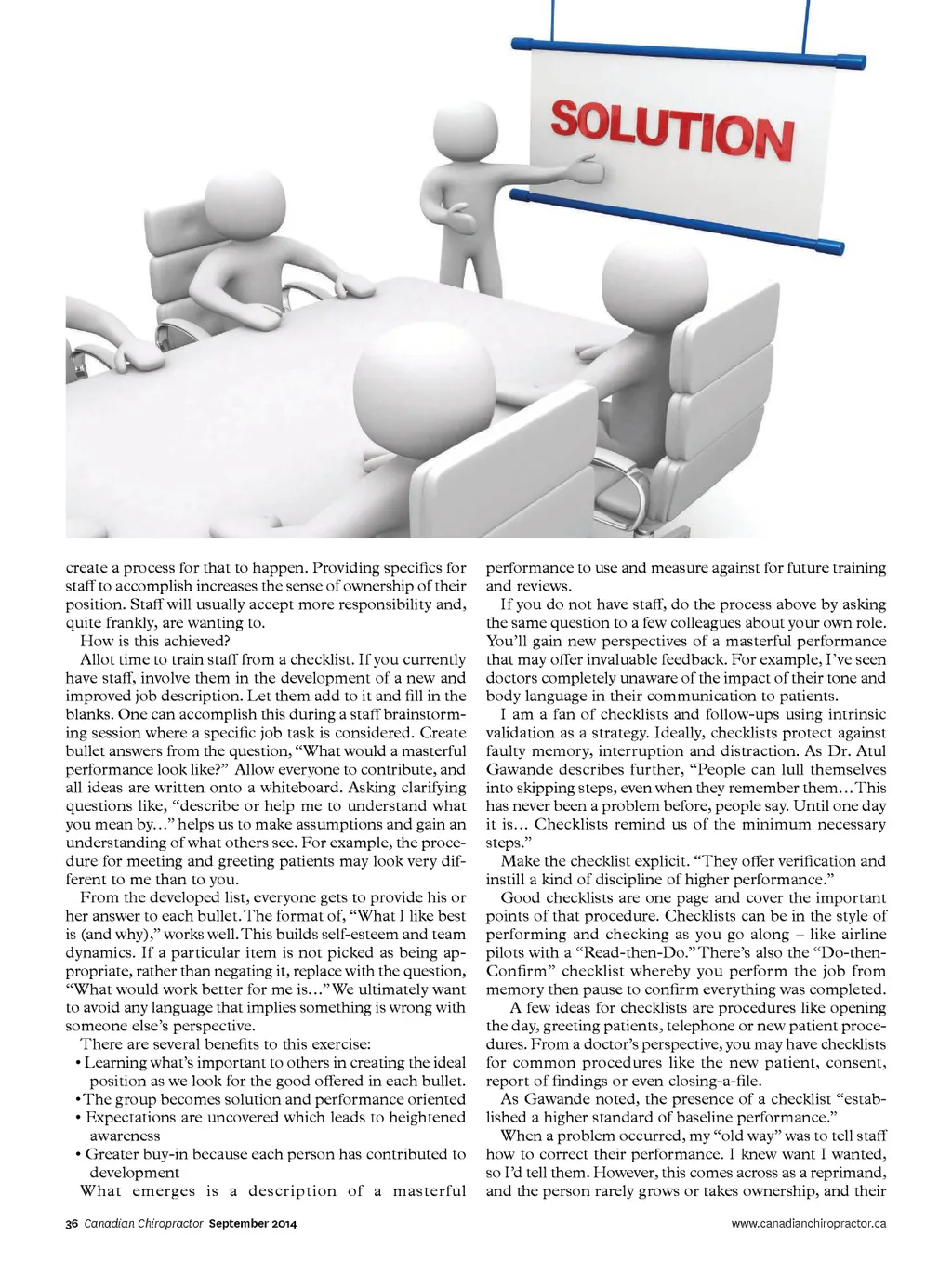
create a process for that to happen. Providing specifics for staff to accomplish increases the sense of ownership of their position. Staff will usually accept more responsibility and, quite frankly, are wanting to. How is this achieved? Allot time to train staff from a checklist. If you currently have staff, involve them in the development of a new and improved job description. Let them add to it and fill in the blanks. One can accomplish this during a staff brainstorm-ing session where a specific job task is considered. Create bullet answers from the question, “What would a masterful performance look like?” Allow everyone to contribute, and all ideas are written onto a whiteboard. Asking clarifying questions like, “describe or help me to understand what you mean by…” helps us to make assumptions and gain an understanding of what others see. For example, the proce-dure for meeting and greeting patients may look very dif-ferent to me than to you. From the developed list, everyone gets to provide his or her answer to each bullet. The format of, “What I like best is (and why),” works well. This builds self-esteem and team dynamics. If a particular item is not picked as being ap-propriate, rather than negating it, replace with the question, “What would work better for me is…” We ultimately want to avoid any language that implies something is wrong with someone else’s perspective. There are several benefits to this exercise: • Learning what’s important to others in creating the ideal position as we look for the good offered in each bullet. • The group becomes solution and performance oriented • Expectations are uncovered which leads to heightened awareness • Greater buy-in because each person has contributed to development What emerges is a description of a masterful 36 Canadian Chiropractor September 2014 performance to use and measure against for future training and reviews. If you do not have staff, do the process above by asking the same question to a few colleagues about your own role. You’ll gain new perspectives of a masterful performance that may offer invaluable feedback. For example, I’ve seen doctors completely unaware of the impact of their tone and body language in their communication to patients. I am a fan of checklists and follow-ups using intrinsic validation as a strategy. Ideally, checklists protect against faulty memory, interruption and distraction. As Dr. Atul Gawande describes further, “People can lull themselves into skipping steps, even when they remember them… This has never been a problem before, people say. Until one day it is… Checklists remind us of the minimum necessary steps.” Make the checklist explicit. “They offer verification and instill a kind of discipline of higher performance.” Good checklists are one page and cover the important points of that procedure. Checklists can be in the style of performing and checking as you go along – like airline pilots with a “Read-then-Do.” There’s also the “Do-then-Confirm” checklist whereby you perform the job from memory then pause to confirm everything was completed. A few ideas for checklists are procedures like opening the day, greeting patients, telephone or new patient proce-dures. From a doctor’s perspective, you may have checklists for common procedures like the new patient, consent, report of findings or even closing-a-file. As Gawande noted, the presence of a checklist “estab-lished a higher standard of baseline performance.” When a problem occurred, my “old way” was to tell staff how to correct their performance. I knew want I wanted, so I’d tell them. However, this comes across as a reprimand, and the person rarely grows or takes ownership, and their www.canadianchiropractor.ca
Chiropractic + Naturopathic Doctor September 2014: Page 36