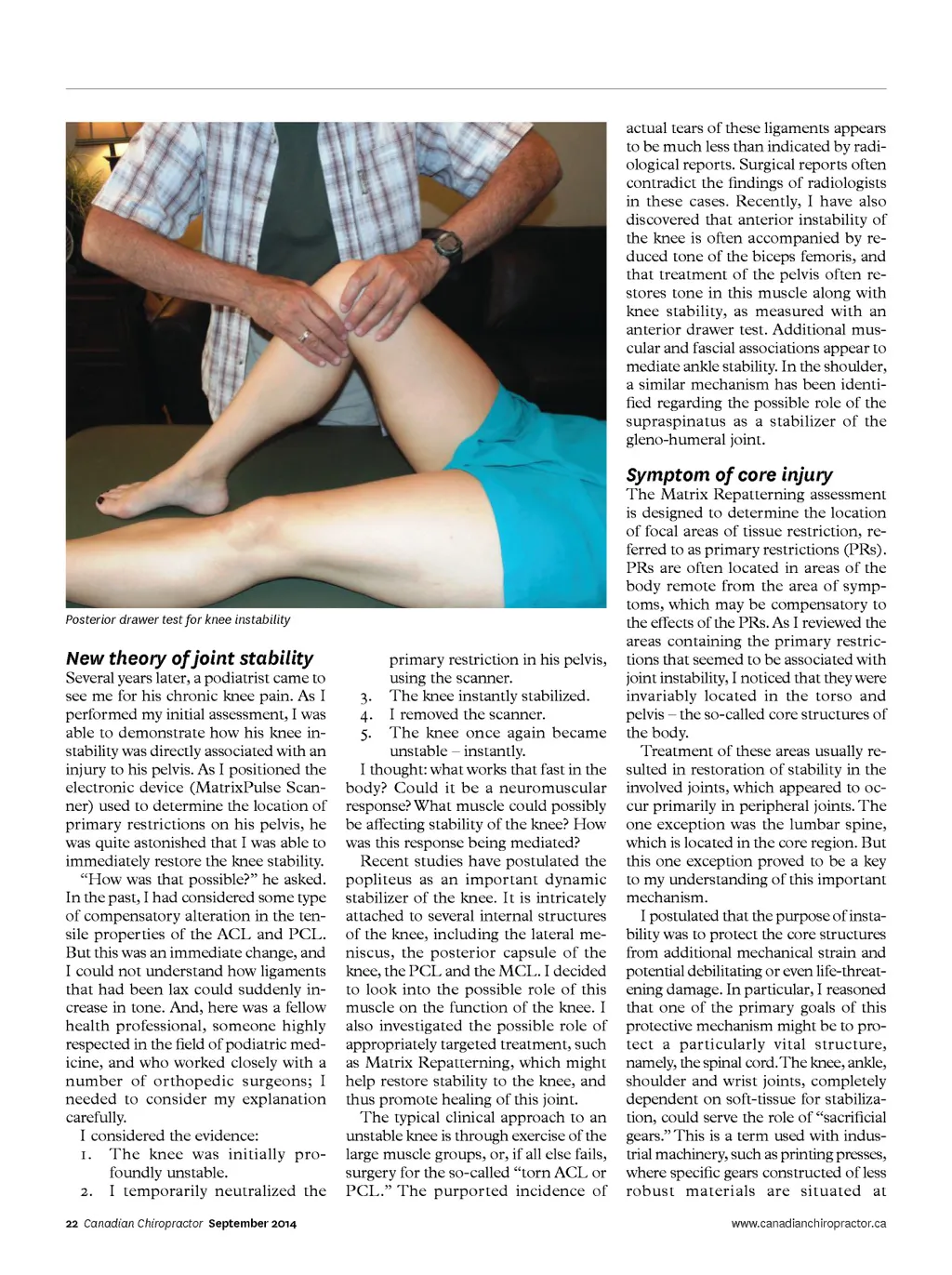
actual tears of these ligaments appears to be much less than indicated by radi-ological reports. Surgical reports often contradict the findings of radiologists in these cases. Recently, I have also discovered that anterior instability of the knee is often accompanied by re-duced tone of the biceps femoris, and that treatment of the pelvis often re-stores tone in this muscle along with knee stability, as measured with an anterior drawer test. Additional mus-cular and fascial associations appear to mediate ankle stability. In the shoulder, a similar mechanism has been identi-fied regarding the possible role of the supraspinatus as a stabilizer of the gleno-humeral joint. The Matrix Repatterning assessment is designed to determine the location of focal areas of tissue restriction, re-ferred to as primary restrictions (PRs). PRs are often located in areas of the body remote from the area of symp-toms, which may be compensatory to the effects of the PRs. As I reviewed the areas containing the primary restric-tions that seemed to be associated with joint instability, I noticed that they were invariably located in the torso and pelvis – the so-called core structures of the body. Treatment of these areas usually re-sulted in restoration of stability in the involved joints, which appeared to oc-cur primarily in peripheral joints. The one exception was the lumbar spine, which is located in the core region. But this one exception proved to be a key to my understanding of this important mechanism. I postulated that the purpose of insta-bility was to protect the core structures from additional mechanical strain and potential debilitating or even life-threat-ening damage. In particular, I reasoned that one of the primary goals of this protective mechanism might be to pro-tect a particularly vital structure, namely, the spinal cord. The knee, ankle, shoulder and wrist joints, completely dependent on soft-tissue for stabiliza-tion, could serve the role of “sacrificial gears.” This is a term used with indus-trial machinery, such as printing presses, where specific gears constructed of less robust materials are situated at www.canadianchiropractor.ca Symptom of core injury Posterior drawer test for knee instability New theory of joint stability Several years later, a podiatrist came to see me for his chronic knee pain. As I performed my initial assessment, I was able to demonstrate how his knee in-stability was directly associated with an injury to his pelvis. As I positioned the electronic device (MatrixPulse Scan-ner) used to determine the location of primary restrictions on his pelvis, he was quite astonished that I was able to immediately restore the knee stability. “How was that possible?” he asked. In the past, I had considered some type of compensatory alteration in the ten-sile properties of the ACL and PCL. But this was an immediate change, and I could not understand how ligaments that had been lax could suddenly in-crease in tone. And, here was a fellow health professional, someone highly respected in the field of podiatric med-icine, and who worked closely with a number of orthopedic surgeons; I needed to consider my explanation carefully. I considered the evidence: 1. The knee was initially pro-foundly unstable. 2. I temporarily neutralized the 22 Canadian Chiropractor September 2014 primary restriction in his pelvis, using the scanner. 3. The knee instantly stabilized. 4. I removed the scanner. 5. The knee once again became unstable – instantly. I thought: what works that fast in the body? Could it be a neuromuscular response? What muscle could possibly be affecting stability of the knee? How was this response being mediated? Recent studies have postulated the popliteus as an important dynamic stabilizer of the knee. It is intricately attached to several internal structures of the knee, including the lateral me-niscus, the posterior capsule of the knee, the PCL and the MCL. I decided to look into the possible role of this muscle on the function of the knee. I also investigated the possible role of appropriately targeted treatment, such as Matrix Repatterning, which might help restore stability to the knee, and thus promote healing of this joint. The typical clinical approach to an unstable knee is through exercise of the large muscle groups, or, if all else fails, surgery for the so-called “torn ACL or PCL.” The purported incidence of
Chiropractic + Naturopathic Doctor September 2014: Page 22