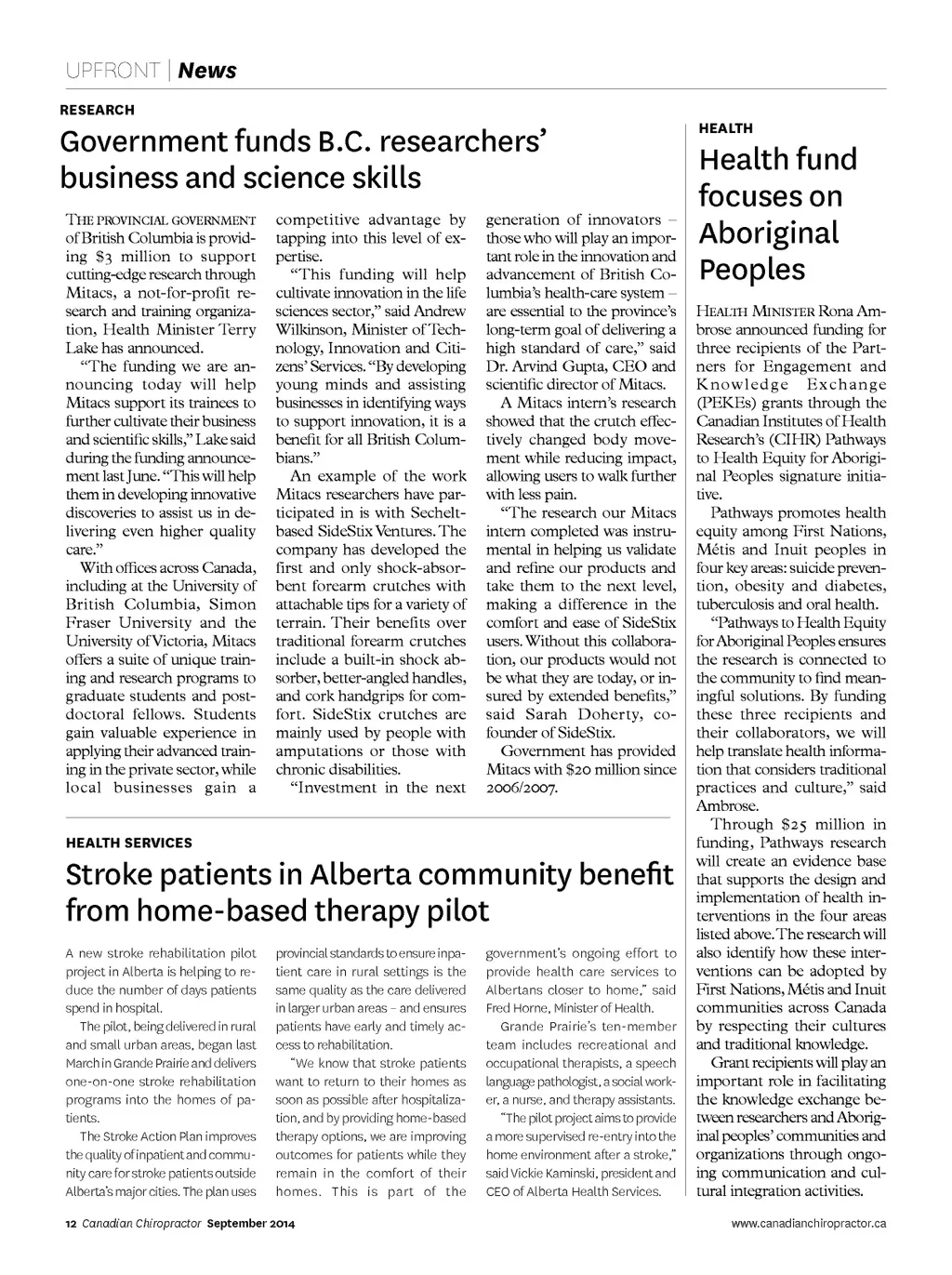
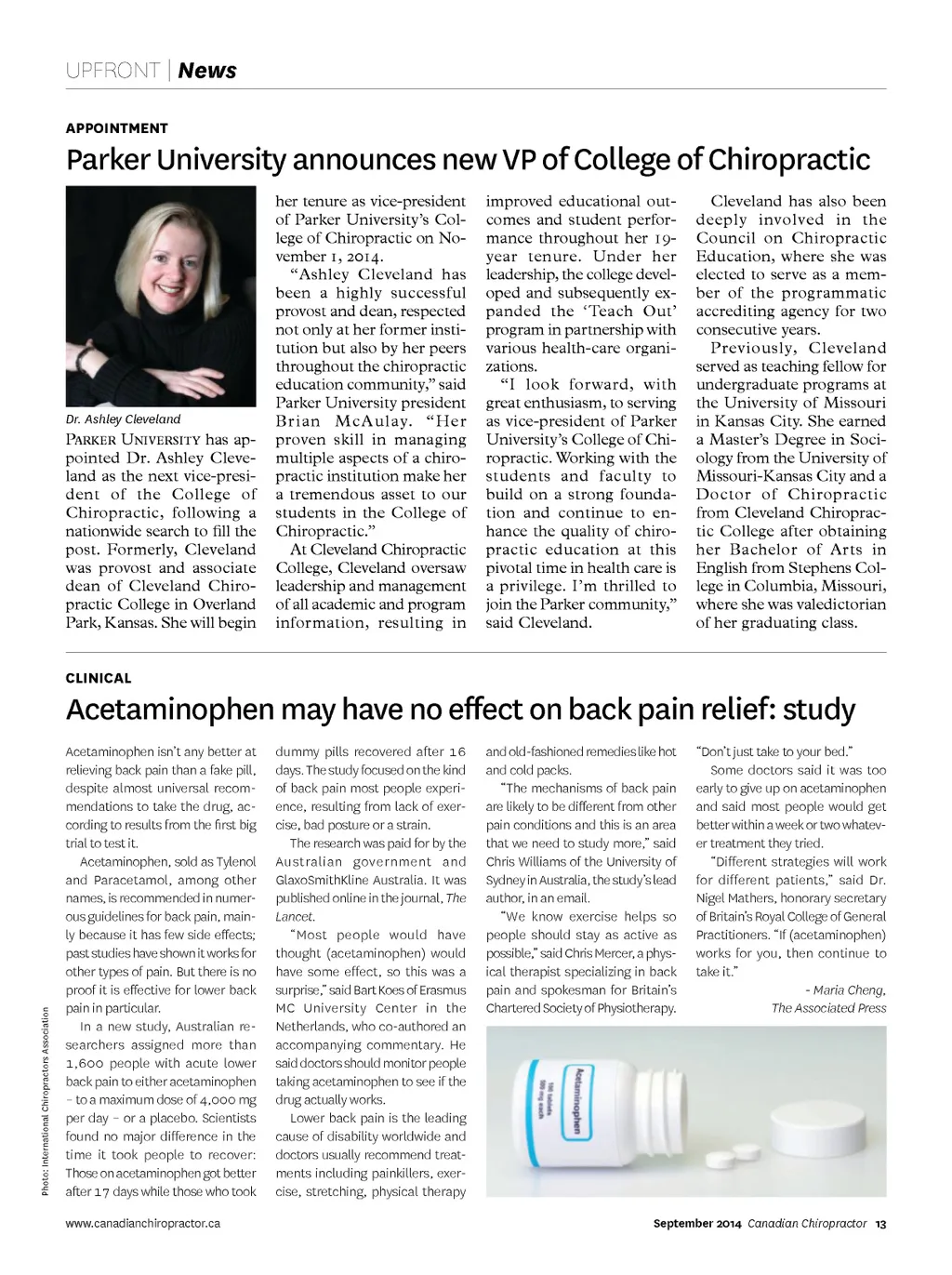
UPFRONT | News APPOINTMENT Parker University announces new VP of College of Chiropractic her tenure as vice-president of Parker University’s Col-lege of Chiropractic on No-vember 1, 2014. “Ashley Cleveland has been a highly successful provost and dean, respected not only at her former insti-tution but also by her peers throughout the chiropractic education community,” said Parker University president Br ian McAulay. “Her proven skill in managing multiple aspects of a chiro-practic institution make her a tremendous asset to our students in the College of Chiropractic.” At Cleveland Chiropractic College, Cleveland oversaw leadership and management of all academic and program information, resulting in improved educational out-comes and student perfor-mance throughout her 19-year tenure. Under her leadership, the college devel-oped and subsequently ex-panded the ‘Teach Out’ program in partnership with various health-care organi-zations. “I look forward, with great enthusiasm, to serving as vice-president of Parker University’s College of Chi-ropractic. Working with the students and faculty to build on a strong founda-tion and continue to en-hance the quality of chiro-practic education at this pivotal time in health care is a privilege. I’m thrilled to join the Parker community,” said Cleveland. Cleveland has also been deeply involved in the Council on Chiropractic Education, where she was elected to serve as a mem-ber of the programmatic accrediting agency for two consecutive years. Previously, Cleveland served as teaching fellow for undergraduate programs at the University of Missouri in Kansas City. She earned a Master’s Degree in Soci-ology from the University of Missouri-Kansas City and a Doctor of Chiropractic from Cleveland Chiroprac-tic College after obtaining her Bachelor of Arts in English from Stephens Col-lege in Columbia, Missouri, where she was valedictorian of her graduating class. Dr. Ashley Cleveland Parker University has ap-pointed Dr. Ashley Cleve-land as the next vice-presi-dent of the College of Chiropractic, following a nationwide search to fill the post. Formerly, Cleveland was provost and associate dean of Cleveland Chiro-practic College in Overland Park, Kansas. She will begin CLINICAL Acetaminophen may have no effect on back pain relief: study Acetaminophen isn’t any better at relieving back pain than a fake pill, despite almost universal recom-mendations to take the drug, ac-cording to results from the first big trial to test it. Acetaminophen, sold as Tylenol and Paracetamol, among other names, is recommended in numer-ous guidelines for back pain, main-ly because it has few side effects; past studies have shown it works for other types of pain. But there is no proof it is effective for lower back pain in particular. In a new study, Australian re-searchers assigned more than 1,600 people with acute lower back pain to either acetaminophen – to a maximum dose of 4,000 mg per day – or a placebo. Scientists found no major difference in the time it took people to recover: Those on acetaminophen got better after 17 days while those who took www.canadianchiropractor.ca dummy pills recovered after 16 days. The study focused on the kind of back pain most people experi-ence, resulting from lack of exer-cise, bad posture or a strain. The research was paid for by the Australian government and GlaxoSmithKline Australia. It was published online in the journal, The Lancet. “Most people would have thought (acetaminophen) would have some effect, so this was a surprise,” said Bart Koes of Erasmus MC University Center in the Netherlands, who co-authored an accompanying commentary. He said doctors should monitor people taking acetaminophen to see if the drug actually works. Lower back pain is the leading cause of disability worldwide and doctors usually recommend treat-ments including painkillers, exer-cise, stretching, physical therapy Photo: International Chiropractors Association and old-fashioned remedies like hot and cold packs. “The mechanisms of back pain are likely to be different from other pain conditions and this is an area that we need to study more,” said Chris Williams of the University of Sydney in Australia, the study’s lead author, in an email. “We know exercise helps so people should stay as active as possible,” said Chris Mercer, a phys-ical therapist specializing in back pain and spokesman for Britain’s Chartered Society of Physiotherapy. “Don’t just take to your bed.” Some doctors said it was too early to give up on acetaminophen and said most people would get better within a week or two whatev-er treatment they tried. “Different strategies will work for different patients,” said Dr. Nigel Mathers, honorary secretary of Britain’s Royal College of General Practitioners. “If (acetaminophen) works for you, then continue to take it.” -Maria Cheng, The Associated Press September 2014 Canadian Chiropractor 13
Chiropractic + Naturopathic Doctor September 2014: Page 13