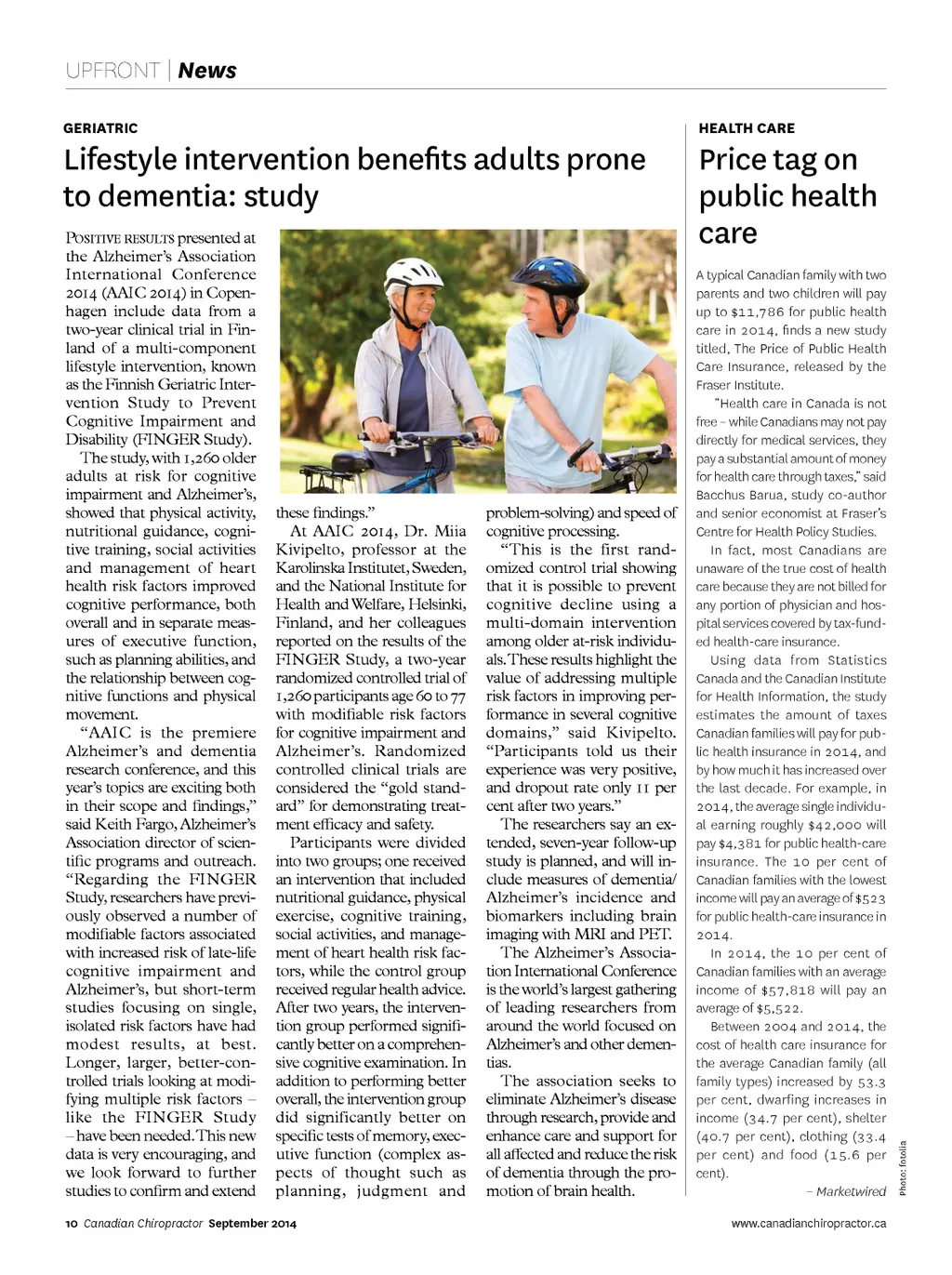
UPFRONT | News GERIATRIC Lifestyle intervention benefits adults prone to dementia: study Positive results presented at the Alzheimer’s Association International Conference 2014 (AAIC 2014) in Copen-hagen include data from a two-year clinical trial in Fin-land of a multi-component lifestyle intervention, known as the Finnish Geriatric Inter-vention Study to Prevent Cognitive Impairment and Disability (FINGER Study). The study, with 1,260 older adults at risk for cognitive impairment and Alzheimer’s, showed that physical activity, nutritional guidance, cogni-tive training, social activities and management of heart health risk factors improved cognitive performance, both overall and in separate meas-ures of executive function, such as planning abilities, and the relationship between cog-nitive functions and physical movement. “AAIC is the premiere Alzheimer’s and dementia research conference, and this year’s topics are exciting both in their scope and findings,” said Keith Fargo, Alzheimer’s Association director of scien-tific programs and outreach. “Regarding the FINGER Study, researchers have previ-ously observed a number of modifiable factors associated with increased risk of late-life cognitive impairment and Alzheimer’s, but short-term studies focusing on single, isolated risk factors have had modest results, at best. Longer, larger, better-con-trolled trials looking at modi-fying multiple risk factors – like the FINGER Study – have been needed. This new data is very encouraging, and we look forward to further studies to confirm and extend HEALTH CARE Price tag on public health care A typical Canadian family with two parents and two children will pay up to $11,786 for public health care in 2014, finds a new study titled, The Price of Public Health Care Insurance, released by the Fraser Institute. “Health care in Canada is not free – while Canadians may not pay directly for medical services, they pay a substantial amount of money for health care through taxes,” said Bacchus Barua, study co-author and senior economist at Fraser’s Centre for Health Policy Studies. In fact, most Canadians are unaware of the true cost of health care because they are not billed for any portion of physician and hos-pital services covered by tax-fund-ed health-care insurance. Using data from Statistics Canada and the Canadian Institute for Health Information, the study estimates the amount of taxes Canadian families will pay for pub-lic health insurance in 2014, and by how much it has increased over the last decade. For example, in 2014, the average single individu-al earning roughly $42,000 will pay $4,381 for public health-care insurance. The 10 per cent of Canadian families with the lowest income will pay an average of $523 for public health-care insurance in 2014. In 2014, the 10 per cent of Canadian families with an average income of $57,818 will pay an average of $5,522. Between 2004 and 2014, the cost of health care insurance for the average Canadian family (all family types) increased by 53.3 per cent, dwarfing increases in income (34.7 per cent), shelter (40.7 per cent), clothing (33.4 per cent) and food (15.6 per cent). – Marketwired www.canadianchiropractor.ca these findings.” At AAIC 2014, Dr. Miia Kivipelto, professor at the Karolinska Institutet, Sweden, and the National Institute for Health and Welfare, Helsinki, Finland, and her colleagues reported on the results of the FINGER Study, a two-year randomized controlled trial of 1,260 participants age 60 to 77 with modifiable risk factors for cognitive impairment and Alzheimer’s. Randomized controlled clinical trials are considered the “gold stand-ard” for demonstrating treat-ment efficacy and safety. Participants were divided into two groups; one received an intervention that included nutritional guidance, physical exercise, cognitive training, social activities, and manage-ment of heart health risk fac-tors, while the control group received regular health advice. After two years, the interven-tion group performed signifi-cantly better on a comprehen-sive cognitive examination. In addition to performing better overall, the intervention group did significantly better on specific tests of memory, exec-utive function (complex as-pects of thought such as planning, judgment and problem-solving) and speed of cognitive processing. “This is the first rand-omized control trial showing that it is possible to prevent cognitive decline using a multi-domain intervention among older at-risk individu-als. These results highlight the value of addressing multiple risk factors in improving per-formance in several cognitive domains,” said Kivipelto. “Participants told us their experience was very positive, and dropout rate only 11 per cent after two years.” The researchers say an ex-tended, seven-year follow-up study is planned, and will in-clude measures of dementia/ Alzheimer’s incidence and biomarkers including brain imaging with MRI and PET. The Alzheimer’s Associa-tion International Conference is the world’s largest gathering of leading researchers from around the world focused on Alzheimer’s and other demen-tias. The association seeks to eliminate Alzheimer’s disease through research, provide and enhance care and support for all affected and reduce the risk of dementia through the pro-motion of brain health. 10 Canadian Chiropractor September 2014 Photo: fotolia
Chiropractic + Naturopathic Doctor September 2014: Page 10