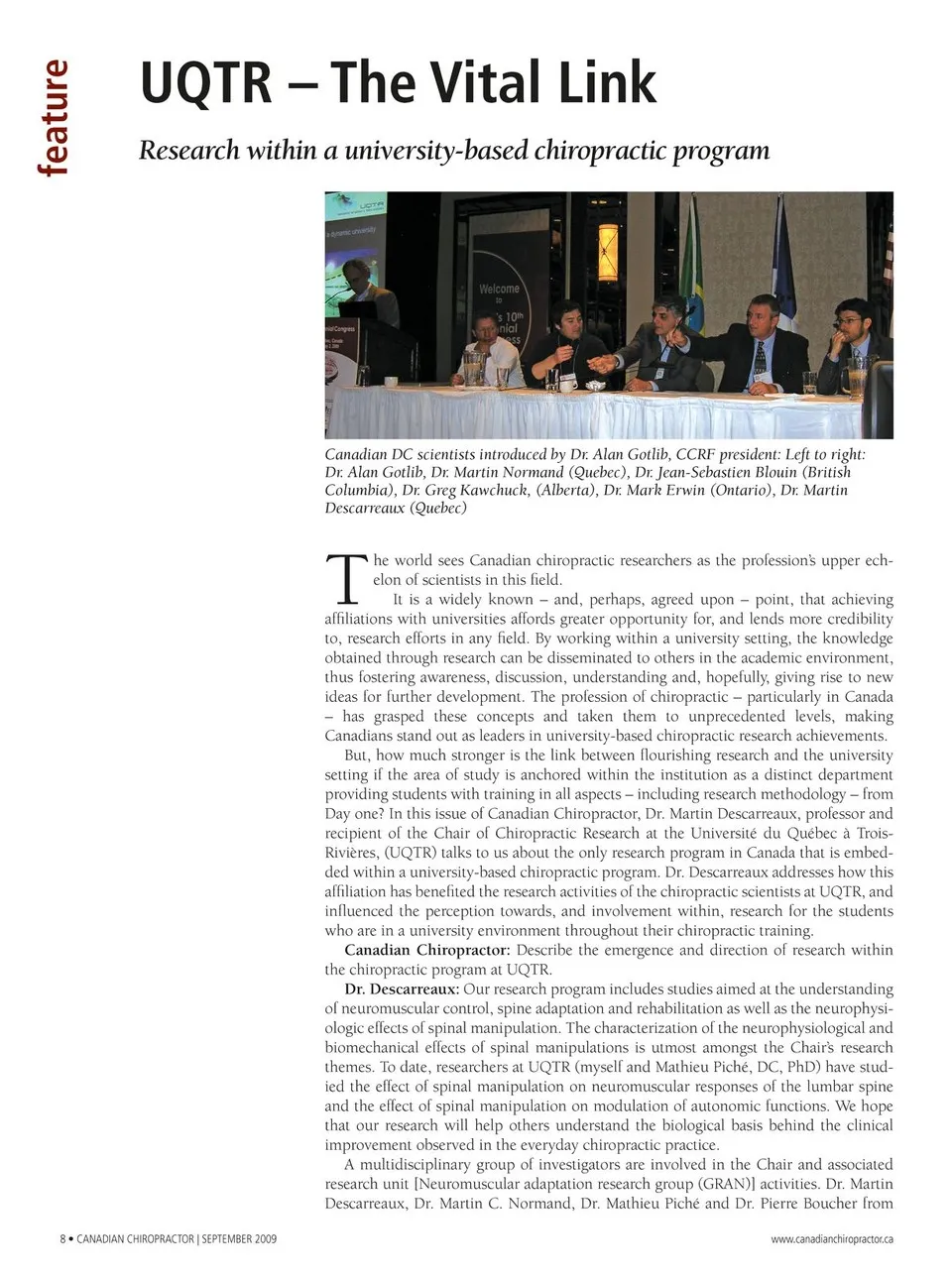
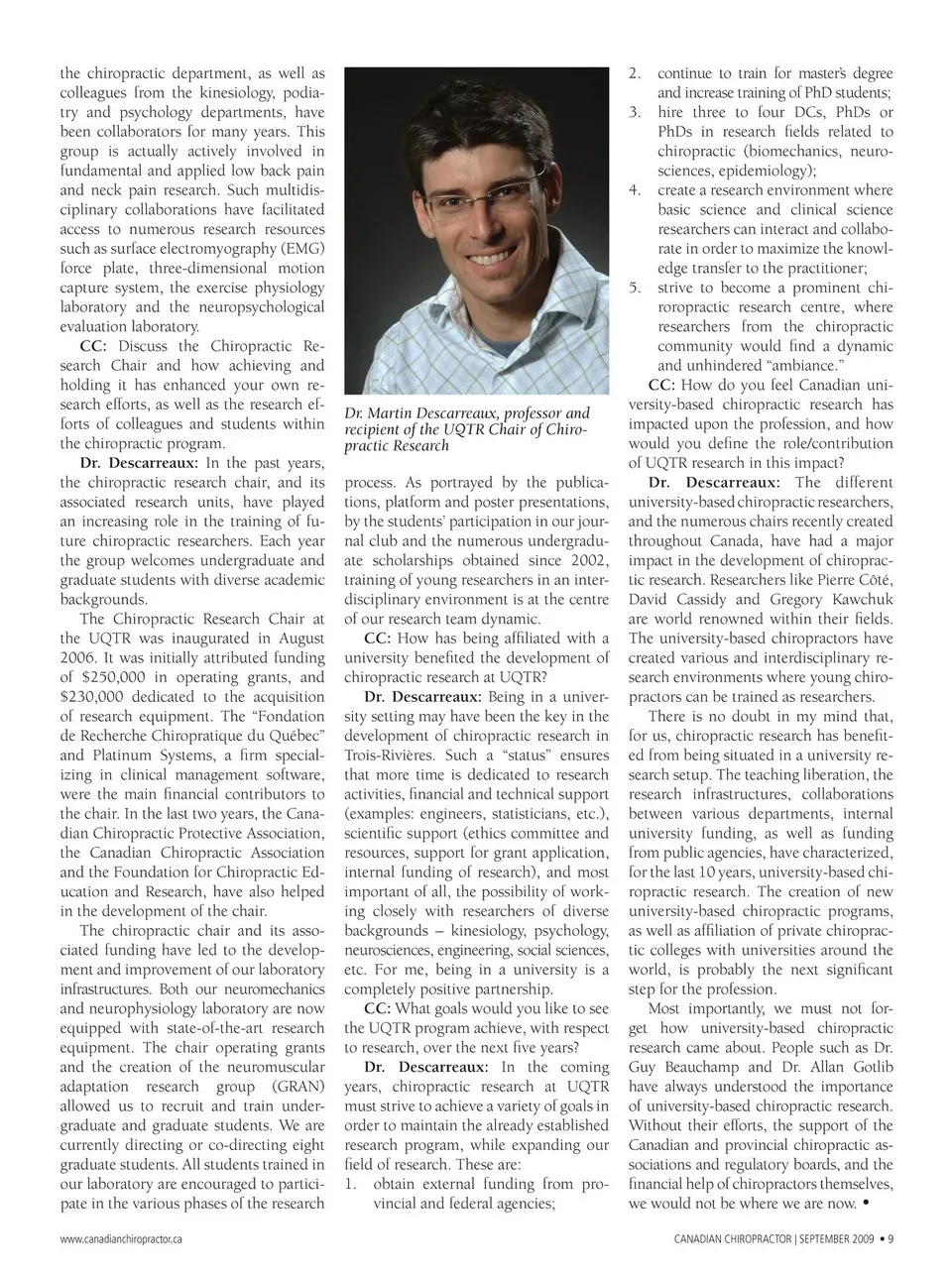
the chiropractic department, as well as colleagues from the kinesiology, podia- try and psychology departments, have been collaborators for many years. This group is actually actively involved in fundamental and applied low back pain and neck pain research. Such multidis- ciplinary collaborations have facilitated access to numerous research resources such as surface electromyography (EMG) force plate, three-dimensional motion capture system, the exercise physiology laboratory and the neuropsychological evaluation laboratory. CC: Discuss the Chiropractic Re- search Chair and how achieving and holding it has enhanced your own re- search efforts, as well as the research ef- forts of colleagues and students within the chiropractic program. Dr. Descarreaux: In the past years, the chiropractic research chair, and its associated research units, have played an increasing role in the training of fu- ture chiropractic researchers. Each year the group welcomes undergraduate and graduate students with diverse academic backgrounds. The Chiropractic Research Chair at the UQTR was inaugurated in August 2006. It was initially attributed funding of $250,000 in operating grants, and $230,000 dedicated to the acquisition of research equipment. The “Fondation de Recherche Chiropratique du Québec” and Platinum Systems, a firm special- izing in clinical management software, were the main fi nancial contributors to the chair. In the last two years, the Cana- dian Chiropractic Protective Association, the Canadian Chiropractic Association and the Foundation for Chiropractic Ed- ucation and Research, have also helped in the development of the chair. The chiropractic chair and its asso- ciated funding have led to the develop- ment and improvement of our laboratory infrastructures. Both our neuromechanics and neurophysiology laboratory are now equipped with state-of-the-art research equipment. The chair operating grants and the creation of the neuromuscular adaptation research group (GRAN) allowed us to recruit and train under- graduate and graduate students. We are currently directing or co-directing eight graduate students. All students trained in our laboratory are encouraged to partici- pate in the various phases of the research www.canadianchiropractor.ca Dr. Martin Descarreaux, professor and recipient of the UQTR Chair of Chiro- practic Research process. As portrayed by the publica- tions, platform and poster presentations, by the students’ participation in our jour- nal club and the numerous undergradu- ate scholarships obtained since 2002, training of young researchers in an inter- disciplinary environment is at the centre of our research team dynamic. CC: How has being affi liated with a university benefi ted the development of chiropractic research at UQTR? Dr. Descarreaux: Being in a univer- sity setting may have been the key in the development of chiropractic research in Trois-Rivières. Such a “status” ensures that more time is dedicated to research activities, fi nancial and technical support (examples: engineers, statisticians, etc.), scientifi c support (ethics committee and resources, support for grant application, internal funding of research), and most important of all, the possibility of work- ing closely with researchers of diverse backgrounds – kinesiology, psychology, neurosciences, engineering, social sciences, etc. For me, being in a university is a completely positive partnership. CC: What goals would you like to see the UQTR program achieve, with respect to research, over the next five years? Dr. Descarreaux: In the coming years, chiropractic research at UQTR must strive to achieve a variety of goals in order to maintain the already established research program, while expanding our fi eld of research. These are: obtain external funding from pro- vincial and federal agencies; 1. 2. 3. 4. 5. continue to train for master’s degree and increase training of PhD students; hire three to four DCs, PhDs or PhDs in research fi elds related to chiropractic (biomechanics, neuro- sciences, epidemiology); create a research environment where basic science and clinical science researchers can interact and collabo- rate in order to maximize the knowl- edge transfer to the practitioner; strive to become a prominent chi- roropractic research centre, where researchers from the chiropractic community would fi nd a dynamic and unhindered “ambiance.” CC: How do you feel Canadian uni- versity-based chiropractic research has impacted upon the profession, and how would you defi ne the role/contribution of UQTR research in this impact? Dr. Descarreaux: The different university-based chiropractic researchers, and the numerous chairs recently created throughout Canada, have had a major impact in the development of chiroprac- tic research. Researchers like Pierre Côté, David Cassidy and Gregory Kawchuk are world renowned within their fields. The university-based chiropractors have created various and interdisciplinary re- search environments where young chiro- practors can be trained as researchers. There is no doubt in my mind that, for us, chiropractic research has benefit- ed from being situated in a university re- search setup. The teaching liberation, the research infrastructures, collaborations between various departments, internal university funding, as well as funding from public agencies, have characterized, for the last 10 years, university-based chi- ropractic research. The creation of new university-based chiropractic programs, as well as affiliation of private chiroprac- tic colleges with universities around the world, is probably the next significant step for the profession. Most importantly, we must not for- get how university-based chiropractic research came about. People such as Dr. Guy Beauchamp and Dr. Allan Gotlib have always understood the importance of university-based chiropractic research. Without their efforts, the support of the Canadian and provincial chiropractic as- sociations and regulatory boards, and the fi nancial help of chiropractors themselves, we would not be where we are now. • CANADIAN CHIROPRACTOR | SEPTEMBER 2009 • 9
Chiropractic + Naturopathic Doctor September 2009: Page 9