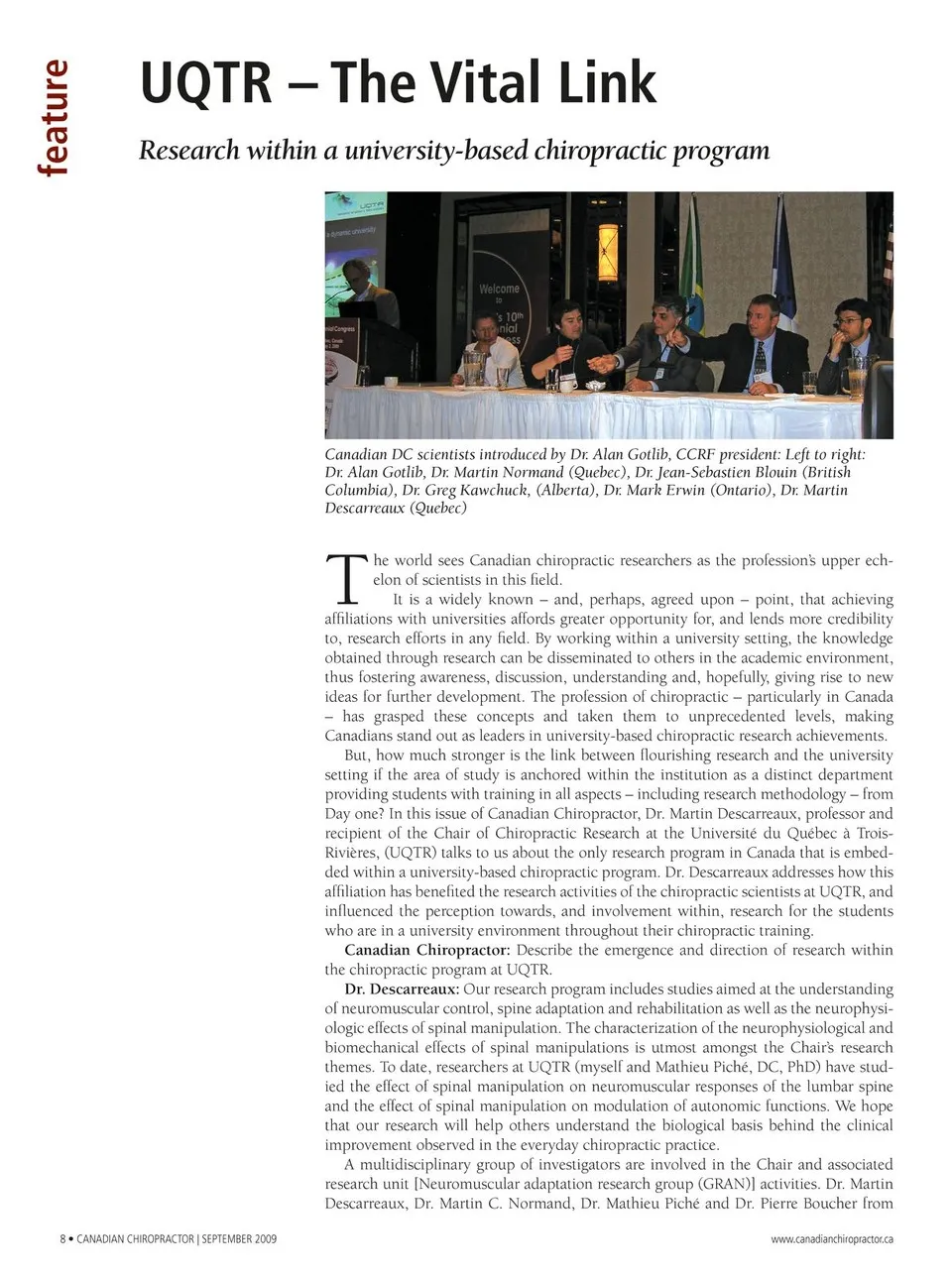
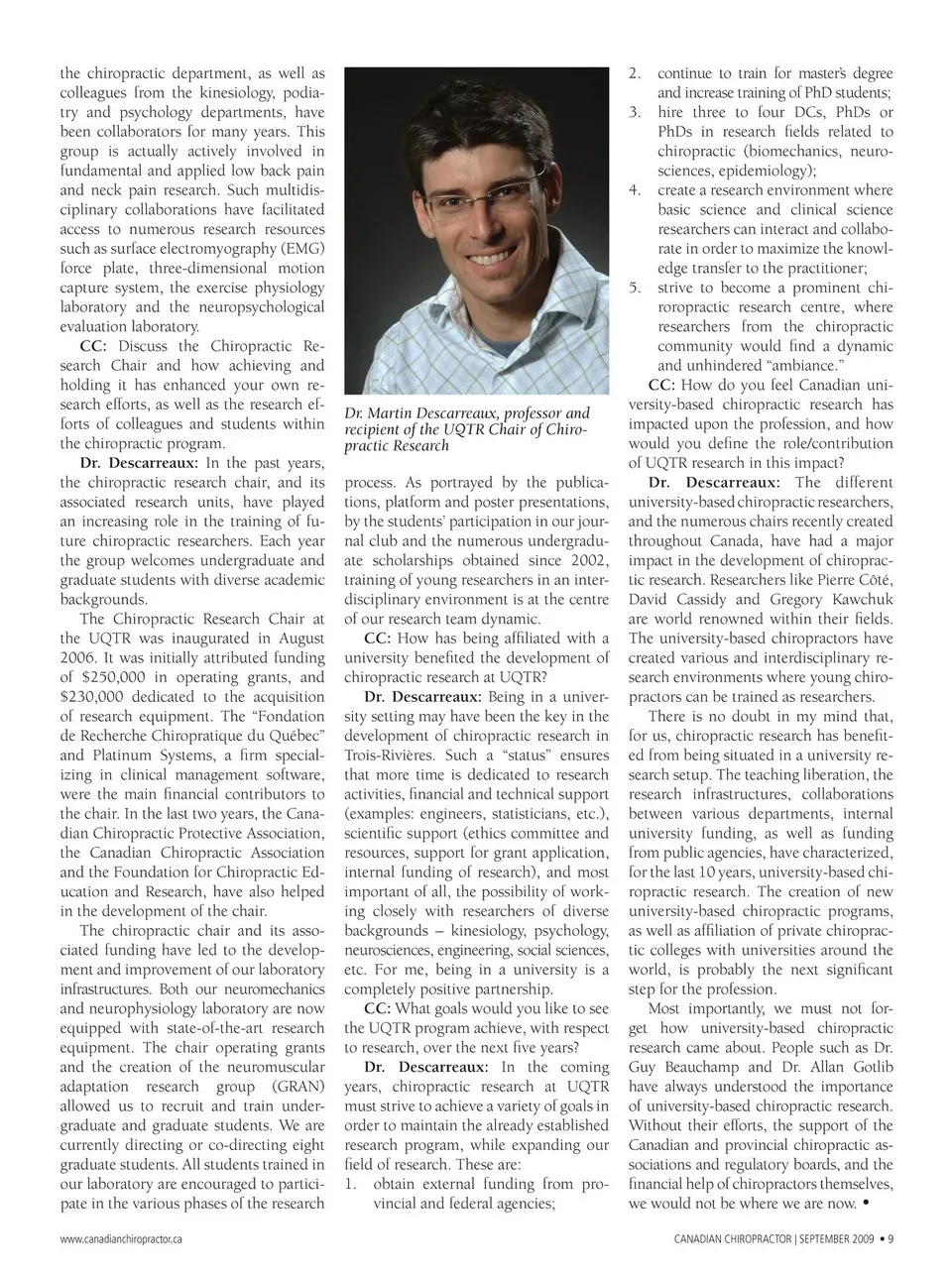
UQTR – The Vital Link Research within a university-based chiropractic program Canadian DC scientists introduced by Dr. Alan Gotlib, CCRF president: Left to right: Dr. Alan Gotlib, Dr. Martin Normand (Quebec), Dr. Jean-Sebastien Blouin (British Columbia), Dr. Greg Kawchuck, (Alberta), Dr. Mark Erwin (Ontario), Dr. Martin Descarreaux (Quebec) T he world sees Canadian chiropractic researchers as the profession’s upper ech- elon of scientists in this field. It is a widely known – and, perhaps, agreed upon – point, that achieving affi liations with universities affords greater opportunity for, and lends more credibility to, research efforts in any fi eld. By working within a university setting, the knowledge obtained through research can be disseminated to others in the academic environment, thus fostering awareness, discussion, understanding and, hopefully, giving rise to new ideas for further development. The profession of chiropractic – particularly in Canada – has grasped these concepts and taken them to unprecedented levels, making Canadians stand out as leaders in university-based chiropractic research achievements. But, how much stronger is the link between fl ourishing research and the university setting if the area of study is anchored within the institution as a distinct department providing students with training in all aspects – including research methodology – from Day one? In this issue of Canadian Chiropractor, Dr. Martin Descarreaux, professor and recipient of the Chair of Chiropractic Research at the Université du Québec à Trois- Rivières, (UQTR) talks to us about the only research program in Canada that is embed- ded within a university-based chiropractic program. Dr. Descarreaux addresses how this affi liation has benefi ted the research activities of the chiropractic scientists at UQTR, and infl uenced the perception towards, and involvement within, research for the students who are in a university environment throughout their chiropractic training. Canadian Chiropractor: Describe the emergence and direction of research within the chiropractic program at UQTR. Dr. Descarreaux: Our research program includes studies aimed at the understanding of neuromuscular control, spine adaptation and rehabilitation as well as the neurophysi- ologic effects of spinal manipulation. The characterization of the neurophysiological and biomechanical effects of spinal manipulations is utmost amongst the Chair’s research themes. To date, researchers at UQTR (myself and Mathieu Piché, DC, PhD) have stud- ied the effect of spinal manipulation on neuromuscular responses of the lumbar spine and the effect of spinal manipulation on modulation of autonomic functions. We hope that our research will help others understand the biological basis behind the clinical improvement observed in the everyday chiropractic practice. A multidisciplinary group of investigators are involved in the Chair and associated research unit [Neuromuscular adaptation research group (GRAN)] activities. Dr. Martin Descarreaux, Dr. Martin C. Normand, Dr. Mathieu Piché and Dr. Pierre Boucher from 8 • CANADIAN CHIROPRACTOR | SEPTEMBER 2009 www.canadianchiropractor.ca feature
Chiropractic + Naturopathic Doctor September 2009: Page 8