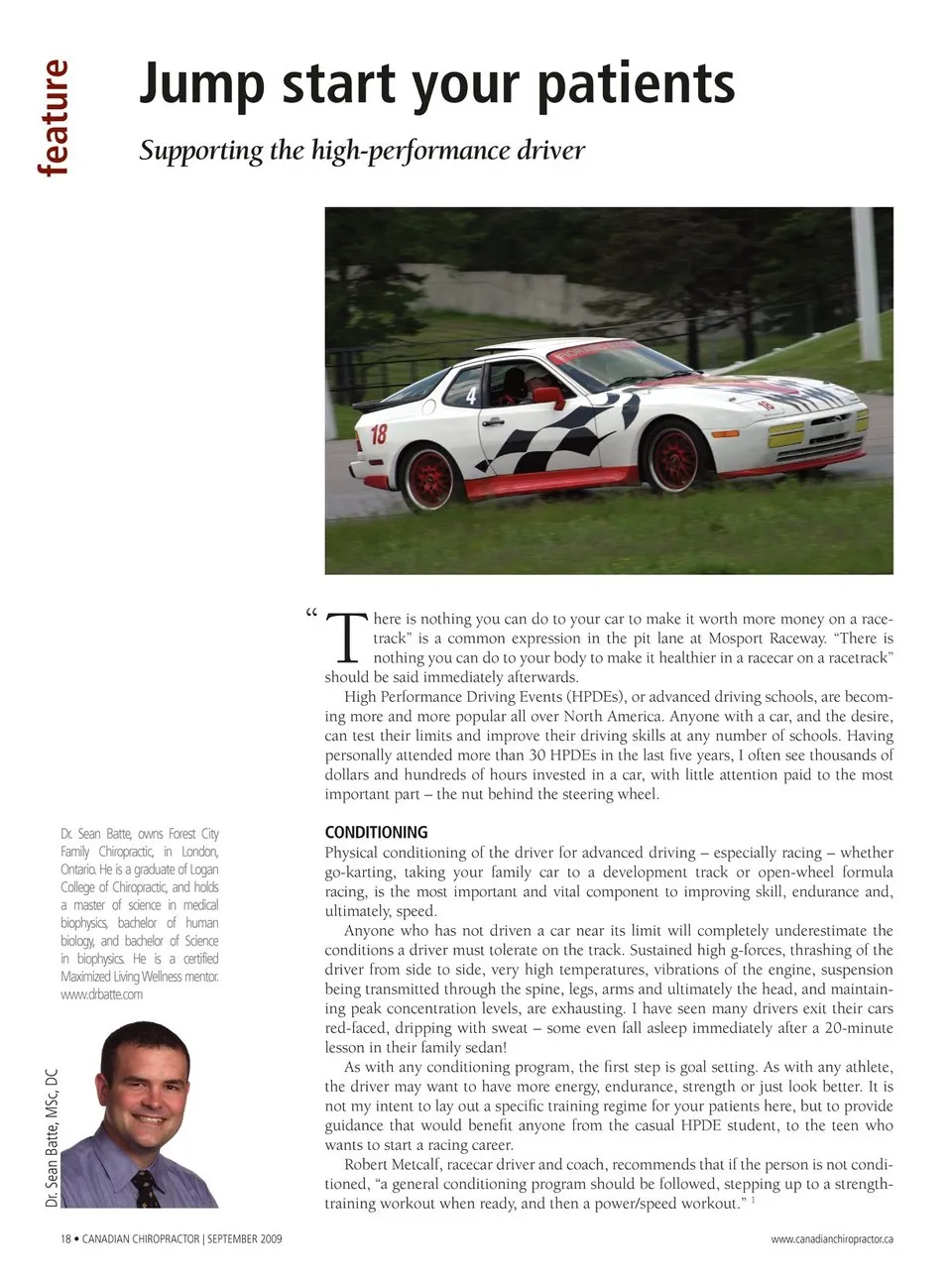
Jump start your patients Supporting the high-performance driver “T Dr. Sean Batte, owns Forest City Family Chiropractic, in London, Ontario. He is a graduate of Logan College of Chiropractic, and holds a master of science in medical biophysics, bachelor of human biology, and bachelor of Science in biophysics. He is a certified Maximized Living Wellness mentor. www.drbatte.com here is nothing you can do to your car to make it worth more money on a race- track” is a common expression in the pit lane at Mosport Raceway. “There is nothing you can do to your body to make it healthier in a racecar on a racetrack” should be said immediately afterwards. High Performance Driving Events (HPDEs), or advanced driving schools, are becom- ing more and more popular all over North America. Anyone with a car, and the desire, can test their limits and improve their driving skills at any number of schools. Having personally attended more than 30 HPDEs in the last five years, I often see thousands of dollars and hundreds of hours invested in a car, with little attention paid to the most important part – the nut behind the steering wheel. CONDITIONING Physical conditioning of the driver for advanced driving – especially racing – whether go-karting, taking your family car to a development track or open-wheel formula racing, is the most important and vital component to improving skill, endurance and, ultimately, speed. Anyone who has not driven a car near its limit will completely underestimate the conditions a driver must tolerate on the track. Sustained high g-forces, thrashing of the driver from side to side, very high temperatures, vibrations of the engine, suspension being transmitted through the spine, legs, arms and ultimately the head, and maintain- ing peak concentration levels, are exhausting. I have seen many drivers exit their cars red-faced, dripping with sweat – some even fall asleep immediately after a 20-minute lesson in their family sedan! As with any conditioning program, the fi rst step is goal setting. As with any athlete, the driver may want to have more energy, endurance, strength or just look better. It is not my intent to lay out a specifi c training regime for your patients here, but to provide guidance that would benefi t anyone from the casual HPDE student, to the teen who wants to start a racing career. Robert Metcalf, racecar driver and coach, recommends that if the person is not condi- tioned, “a general conditioning program should be followed, stepping up to a strength- training workout when ready, and then a power/speed workout.” 1 18 • CANADIAN CHIROPRACTOR | SEPTEMBER 2009 www.canadianchiropractor.ca Dr. Sean Batte, MSc, DC feature
Chiropractic + Naturopathic Doctor September 2009: Page 18