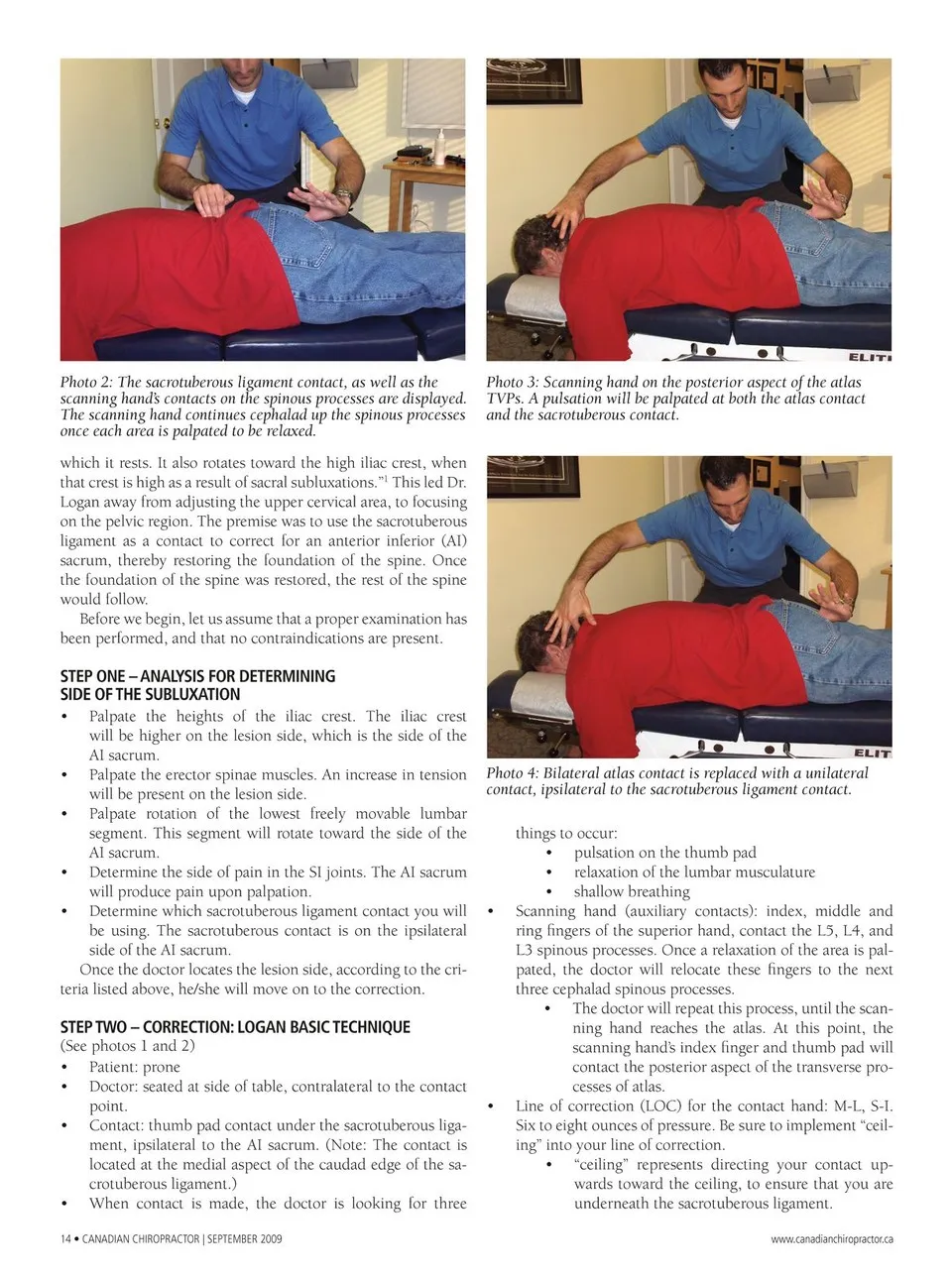
Photo 2: The sacrotuberous ligament contact, as well as the scanning hand’s contacts on the spinous processes are displayed. The scanning hand continues cephalad up the spinous processes once each area is palpated to be relaxed. which it rests. It also rotates toward the high iliac crest, when that crest is high as a result of sacral subluxations.”1 This led Dr. Logan away from adjusting the upper cervical area, to focusing on the pelvic region. The premise was to use the sacrotuberous ligament as a contact to correct for an anterior inferior (AI) sacrum, thereby restoring the foundation of the spine. Once the foundation of the spine was restored, the rest of the spine would follow. Before we begin, let us assume that a proper examination has been performed, and that no contraindications are present. STEP ONE – ANALYSIS FOR DETERMINING SIDE OF THE SUBLUXATION • • • • • Palpate the heights of the iliac crest. The iliac crest will be higher on the lesion side, which is the side of the AI sacrum. Palpate the erector spinae muscles. An increase in tension will be present on the lesion side. Palpate rotation of the lowest freely movable lumbar segment. This segment will rotate toward the side of the AI sacrum. Determine the side of pain in the SI joints. The AI sacrum will produce pain upon palpation. Determine which sacrotuberous ligament contact you will be using. The sacrotuberous contact is on the ipsilateral side of the AI sacrum. Once the doctor locates the lesion side, according to the cri- teria listed above, he/she will move on to the correction. STEP TWO – CORRECTION:LOGAN BASIC TECHNIQUE (See photos 1 and 2) • • • • Patient: prone Doctor: seated at side of table, contralateral to the contact point. Contact: thumb pad contact under the sacrotuberous liga- ment, ipsilateral to the AI sacrum. (Note: The contact is located at the medial aspect of the caudad edge of the sa- crotuberous ligament.) When contact is made, the doctor is looking for three 14 • CANADIAN CHIROPRACTOR | SEPTEMBER 2009 • Photo 4: Bilateral atlas contact is replaced with a unilateral contact, ipsilateral to the sacrotuberous ligament contact. things to occur: • • • • pulsation on the thumb pad relaxation of the lumbar musculature shallow breathing Scanning hand (auxiliary contacts): index, middle and ring fi ngers of the superior hand, contact the L5, L4, and L3 spinous processes. Once a relaxation of the area is pal- pated, the doctor will relocate these fi ngers to the next three cephalad spinous processes. The doctor will repeat this process, until the scan- ning hand reaches the atlas. At this point, the scanning hand’s index fi nger and thumb pad will contact the posterior aspect of the transverse pro- cesses of atlas. • Line of correction (LOC) for the contact hand: M-L, S-I. Six to eight ounces of pressure. Be sure to implement “ceil- ing” into your line of correction. “ceiling” represents directing your contact up- wards toward the ceiling, to ensure that you are underneath the sacrotuberous ligament. • www.canadianchiropractor.ca Photo 3: Scanning hand on the posterior aspect of the atlas TVPs. A pulsation will be palpated at both the atlas contact and the sacrotuberous contact.
Chiropractic + Naturopathic Doctor September 2009: Page 14