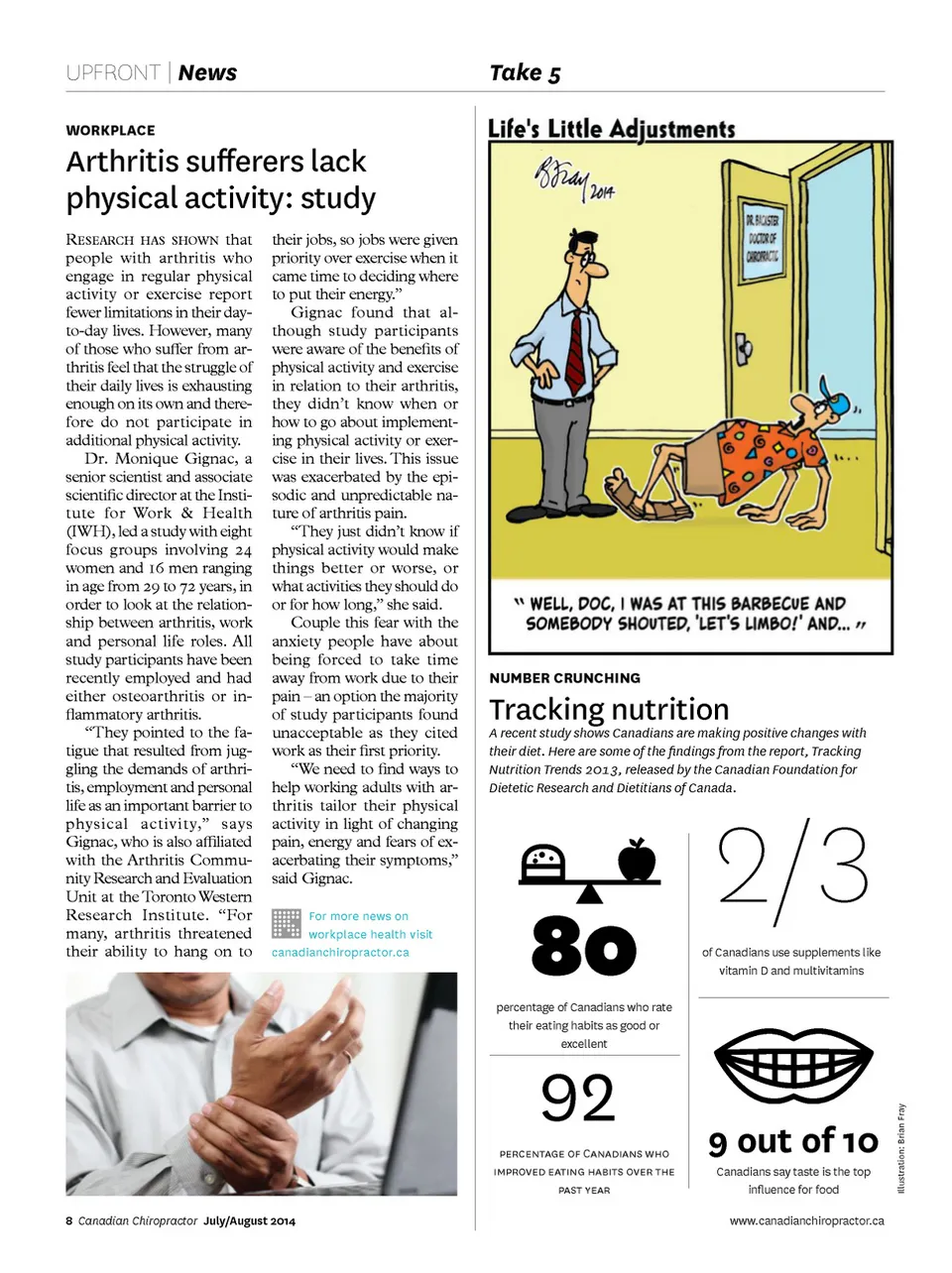
UPFRONT | News WORKPLACE Take 5 Arthritis sufferers lack physical activity: study Research has shown that people with arthritis who engage in regular physical activity or exercise report fewer limitations in their day-to-day lives. However, many of those who suffer from ar-thritis feel that the struggle of their daily lives is exhausting enough on its own and there-fore do not participate in additional physical activity. Dr. Monique Gignac, a senior scientist and associate scientific director at the Insti-tute for Work & Health (IWH), led a study with eight focus groups involving 24 women and 16 men ranging in age from 29 to 72 years, in order to look at the relation-ship between arthritis, work and personal life roles. All study participants have been recently employed and had either osteoarthritis or in-flammatory arthritis. “They pointed to the fa-tigue that resulted from jug-gling the demands of arthri-tis, employment and personal life as an important barrier to physical activity,” says Gignac, who is also affiliated with the Arthritis Commu-nity Research and Evaluation Unit at the Toronto Western Research Institute. “For many, arthritis threatened their ability to hang on to their jobs, so jobs were given priority over exercise when it came time to deciding where to put their energy.” Gignac found that al-though study participants were aware of the benefits of physical activity and exercise in relation to their arthritis, they didn’t know when or how to go about implement-ing physical activity or exer-cise in their lives. This issue was exacerbated by the epi-sodic and unpredictable na-ture of arthritis pain. “They just didn’t know if physical activity would make things better or worse, or what activities they should do or for how long,” she said. Couple this fear with the anxiety people have about being forced to take time away from work due to their pain – an option the majority of study participants found unacceptable as they cited work as their first priority. “We need to find ways to help working adults with ar-thritis tailor their physical activity in light of changing pain, energy and fears of ex-acerbating their symptoms,” said Gignac. For more news on workplace health visit canadianchiropractor.ca NUMBER CRUNCHING A recent study shows Canadians are making positive changes with their diet. Here are some of the findings from the report, Tracking Nutrition Trends 2013, released by the Canadian Foundation for Dietetic Research and Dietitians of Canada. Tracking nutrition percentage of Canadians who rate their eating habits as good or excellent 80 92 2/3 9 out of 10 Canadians say taste is the top influence for food www.canadianchiropractor.ca Illustration: Brian Fray of Canadians use supplements like vitamin D and multivitamins percentage of Canadians who improved eating habits over the past year 8 Canadian Chiropractor July/August 2014
Chiropractic + Naturopathic Doctor July August 2014: Page 8